
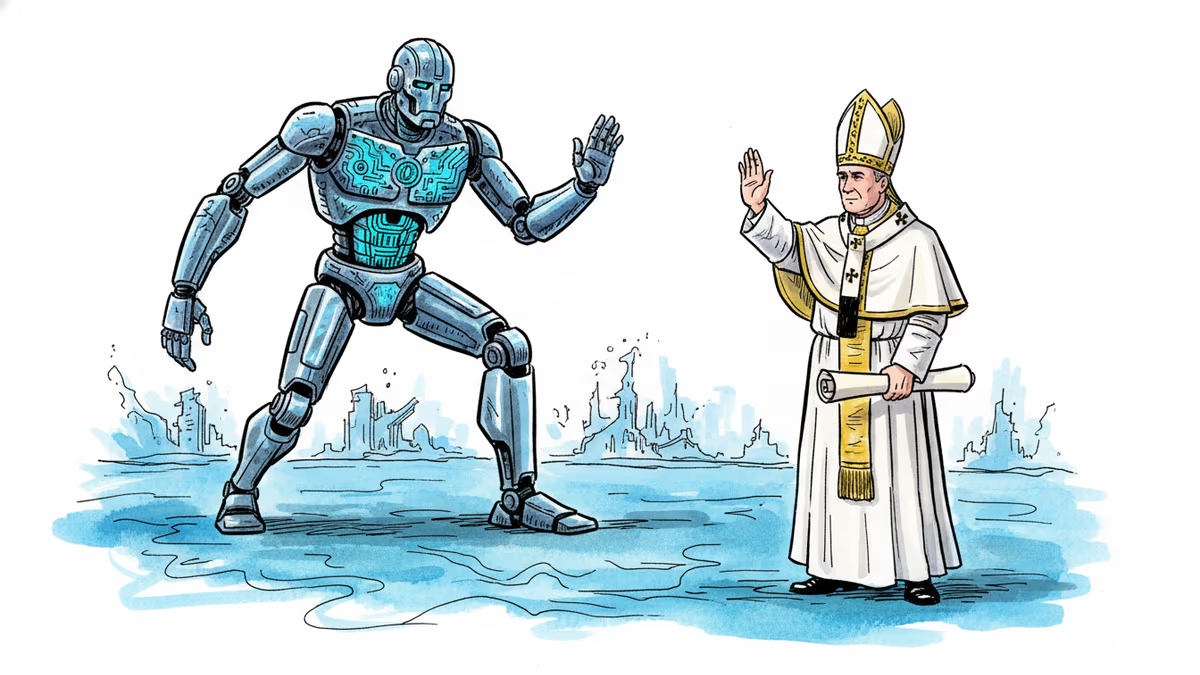
The Pope Wants to Slow Down AI
Pope Leo XIV's first encyclical, Magnifica humanitas, calls for democratic guardrails, labor protections, and moral limits on AI. What does it mean when the world's oldest institution confronts its newest disruption?
The world's oldest institution just told the world's fastest-moving industry to pump the brakes.
On May 19, 2026, Pope Leo XIV released Magnifica humanitas — Latin for "magnificent humanity" — the first encyclical of his papacy, and the Catholic Church's most authoritative statement yet on artificial intelligence. The document doesn't condemn AI. It does something more pointed: it argues that the technology's rollout needs to slow down, that democratic societies must wrest control of its direction from a narrow class of tech oligarchs, and that the very phrase "artificial intelligence" is a category error. Intelligence, the pope writes, belongs to human persons alone.
The 135-Year Echo
The date Leo XIV signed the document — May 15 — wasn't chosen at random. It marks exactly 135 years since Pope Leo XIII issued Rerum Novarum, the landmark encyclical that confronted the Industrial Revolution head-on. That 19th-century document redefined the relationship between labor and capital, warned against the dangers of communism, and — crucially — reasserted the Catholic Church as a moral authority in an era of dizzying technological and economic change.
The current pope took his name deliberately. By releasing Magnifica humanitas on this anniversary, he's drawing an explicit line between the two moments in history. "Like the earlier Leo," he said at the document's presentation, "I feel entrusted to look upon another huge transformation with eyes of faith, with lucidity of reason, with openness to mystery and with cries of the poor and the earth resounding in my heart."
The Chicago-born pontiff broke with tradition by attending the release in person — popes typically don't — and addressed the audience in English. Seated alongside him were AI researchers and industry figures, including Anthropic co-founder Chris Olah, who consulted on the document. The symbolism was hard to miss: the Church isn't just issuing a condemnation from on high. It's pulling up a chair at the table.
What the Document Actually Says
Magnifica humanitas is more policy memo than theological treatise, and that's intentional. Its practical recommendations span three broad areas.
On governance, the encyclical calls for a "more active" democratic process capable of "slowing things down when everything is accelerating" and ensuring communities can still participate in decisions about AI's development. Personal data, it argues, "should not be treated as something to be sold off or entrusted to a select few" — a direct challenge to the data-extraction business models that underpin much of the AI industry. The document also demands better education on AI's risks, specifically naming sexual exploitation, blackmail, grooming, and disinformation as areas requiring urgent attention.
On labor, Leo is unambiguous: governments have a duty to protect the dignity of work, fund job retraining for displaced workers, and redistribute the wealth that AI generates to those it displaces. Labor unions are asked to adapt, but the burden falls primarily on states and corporations. The encyclical invokes the biblical Tower of Babel as a warning: "We must avoid the 'Babel syndrome,' namely the idolatry of profit that sacrifices the weak."

On war, the document breaks new ground. As autonomous weapons systems proliferate, Leo argues that traditional "just war" theory is becoming obsolete. "When a decision to strike becomes automated or opaque, the risk of abdicating responsibility increases." The encyclical calls for an international compact on AI in warfare and insists that "those who design, train, authorize and employ technology must be held accountable for their decisions" — a standard that would fundamentally challenge current military AI development in the US, China, and elsewhere.
Why the Church Feels the Urgency
Pope Francis addressed climate change with Laudato Si in 2015 — after decades of scientific consensus had already been ignored. Benedict XVI wrote about the global economic order in 2009 — after the financial system had already collapsed. Both encyclicals arrived, as Catholic writer Christopher Hale has observed, "in the long shadow of the crises they addressed."
Leo XIV is trying to be early this time. Dan Rober, an associate professor of Catholic Studies at Sacred Heart University, frames it this way: "Leo is concerned that we don't just submit to inevitability on questions of AI, but ask critical questions and push back in ways that are necessary before it's too late to push back, before damage is done that can't easily be undone."
But there's a deeper anxiety running beneath the policy arguments. The Catholic Church has spent two millennia as an intermediary — between humans and God, between moral questions and lived answers. AI is now positioning itself in exactly that space. It counsels the grieving. It answers ethical dilemmas. It interprets, guides, and increasingly, decides. For an institution whose entire authority rests on being the proper interpreter of truth and conscience, that's not an abstract philosophical concern.
"You could see a way in which AI becomes its own kind of religion," Rober told Vox. "Certainly the way a lot of Silicon Valley founders talk about it, it does have religious overtones. You listen to the Google founders talk about the singularity, and that sounds a lot like religion."
Multiple Lenses, One Document
Not everyone will read Magnifica humanitas the same way.
For AI safety researchers and ethicists, the encyclical is a potential ally. A moral authority with 1.3 billion followers calling for democratic oversight and accountability chains is exactly the kind of external pressure that technical communities often lack the political standing to demand themselves. The involvement of Anthropic's Chris Olah signals that at least some in the industry see value in this kind of engagement.
From a secular liberal perspective, questions arise. The Catholic Church is not a democratically elected body. Its authority to shape technology policy — even through persuasion — sits in tension with the pluralistic values it claims to defend. The encyclical's formal apology for the Church's historical defense of slavery, included in the same document, is a reminder that moral institutions are not immune to moral failure.
In non-Western contexts, the document may read differently still. Much of the Global South, where AI's labor displacement effects will be felt most acutely, is heavily Catholic — but also deeply skeptical of institutions that have historically spoken for them rather than with them. Whether Magnifica humanitas reaches those communities as an ally or as another form of top-down authority is an open question.
For the tech industry itself, the encyclical presents a choice: engage with this moral framework seriously, or dismiss it and risk ceding the ethical narrative to an institution with centuries of practice in shaping public conscience.
This content is AI-generated based on source articles. While we strive for accuracy, errors may occur. We recommend verifying with the original source.
Related Articles

The average U.S. retirement age has climbed from 57 to well past 65. As people live longer and social bonds outside work erode, the old script for stepping away no longer holds. Here's why.
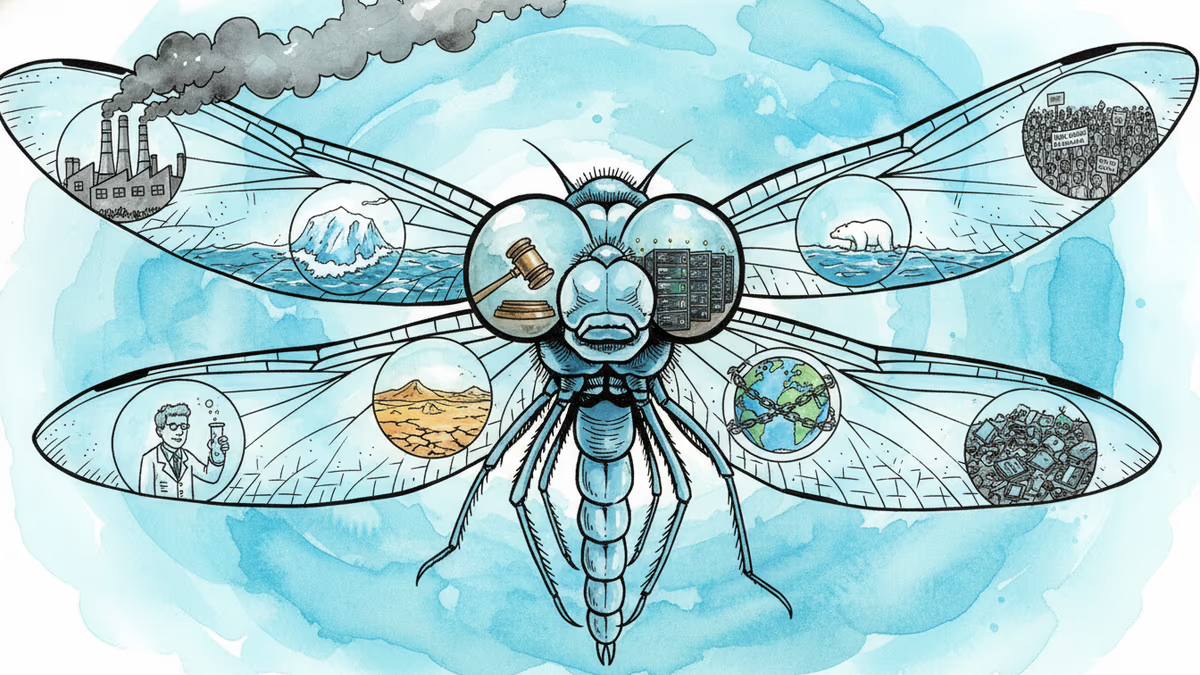
AI looks like liberation, threat, or environmental disaster depending on where you stand. A framework of nine competing narratives reveals why single-lens thinking is the real danger.
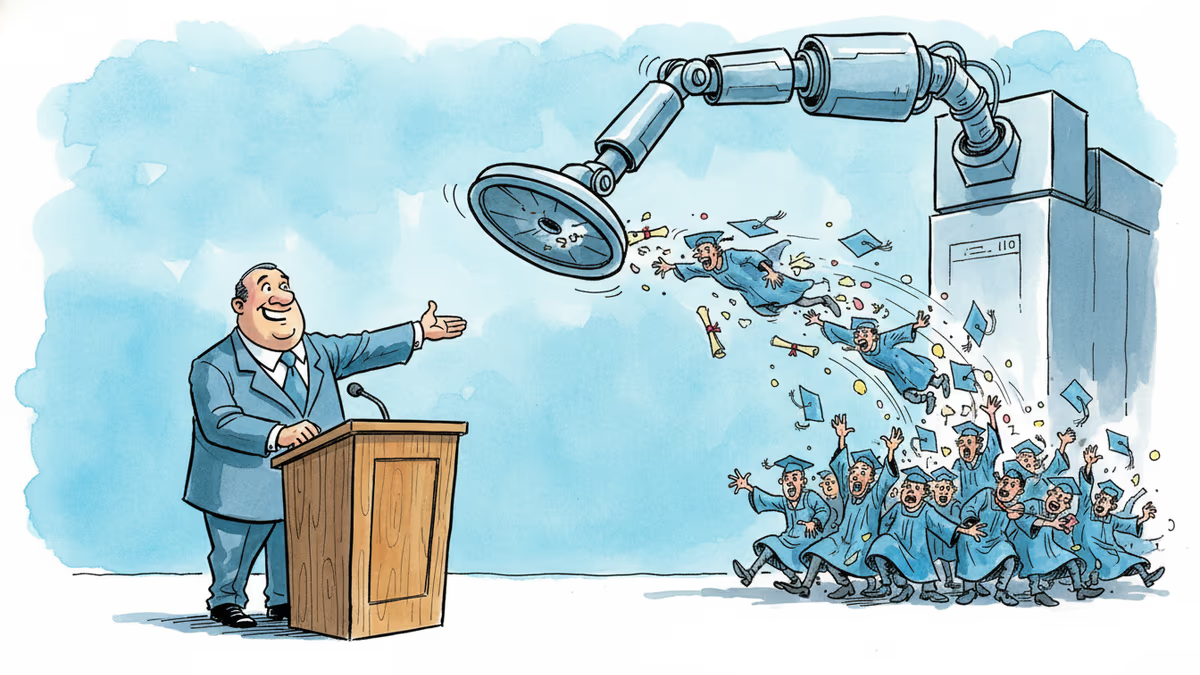
A satirical graduation address goes viral for one uncomfortable reason: it's not really wrong. What the joke reveals about AI, entry-level jobs, and the deal we made with work.
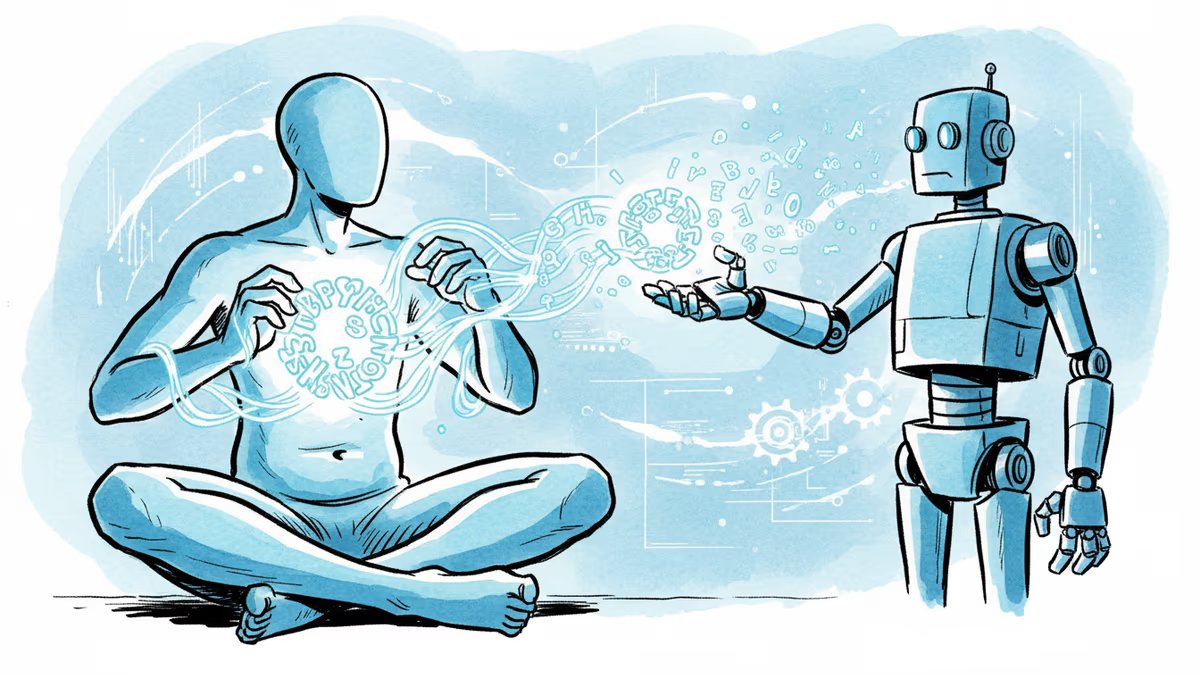
Philosopher Nicholas Humphrey argues that human souls weren't bestowed by God or genes — we invented them through language. In the age of AI, that claim carries unsettling new weight.
The average U.S. retirement age has climbed from 57 to well past 65. As people live longer and social bonds outside work erode, the old script for stepping away no longer holds. Here's why.
AI looks like liberation, threat, or environmental disaster depending on where you stand. A framework of nine competing narratives reveals why single-lens thinking is the real danger.
A satirical graduation address goes viral for one uncomfortable reason: it's not really wrong. What the joke reveals about AI, entry-level jobs, and the deal we made with work.
Philosopher Nicholas Humphrey argues that human souls weren't bestowed by God or genes — we invented them through language. In the age of AI, that claim carries unsettling new weight.
Thoughts
Share your thoughts on this article
Sign in to join the conversation