
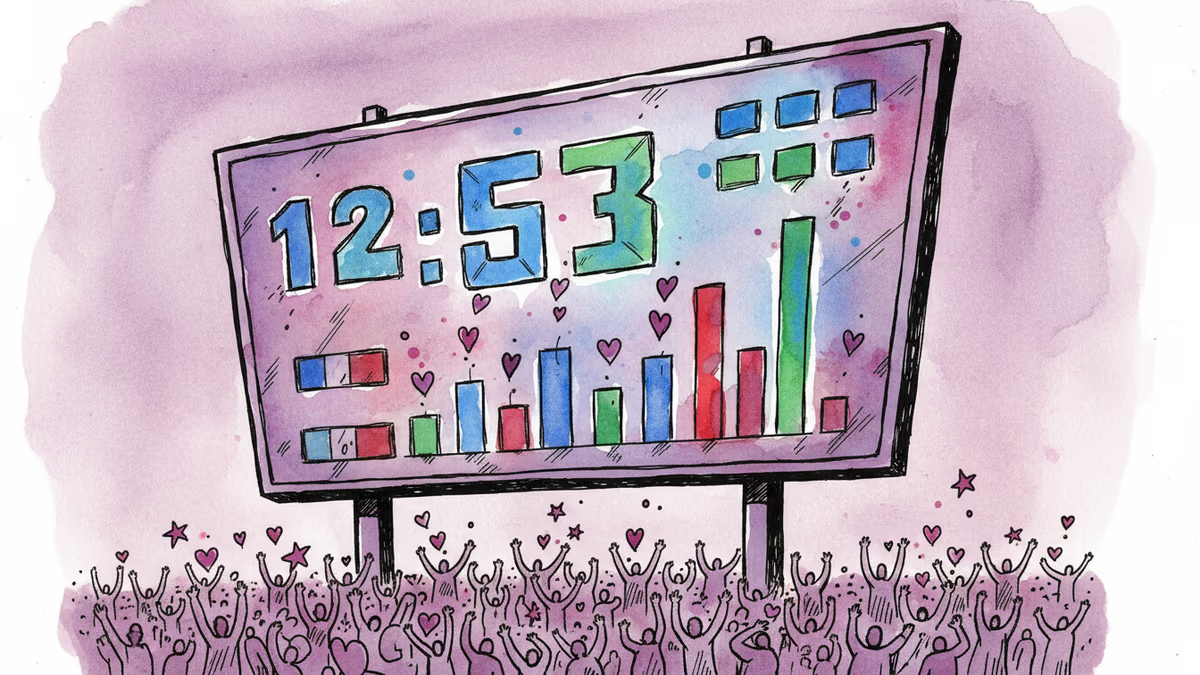
K-Pop by the Numbers: What Does a Brand Score Actually Measure?
Korea's Business Research Institute ranked 755 boy group members by brand reputation this April. But when fan love becomes data, who really benefits from the score?
Every month, 755 K-pop boy group members get reduced to a single number. The question is: what does that number actually tell us?
The Korean Business Research Institute released its April brand reputation rankings for individual boy group members this week, covering data collected between March 18 and April 18. The methodology pulls from four indexes — consumer participation, media coverage, communication activity, and community awareness — aggregated from big data across social platforms, news outlets, and fan communities. Wanna One's Park Ji-hoon ranked among the top performers, a notable result for a member whose group officially disbanded years ago.
How the Score Gets Made
This isn't a popularity poll in the traditional sense. The consumer participation index tracks how actively audiences engage with content related to a specific member — likes, shares, saves, reactions. Media coverage reflects how often a name appears across news and online publications. The communication index captures direct social interaction, while community awareness measures how much buzz a member generates within fan spaces.
Combine all four, and you get a single ranked number. For agencies and advertisers, that number carries real weight: it influences endorsement deals, variety show bookings, and the scale of fan events a label is willing to fund. Park Ji-hoon's continued presence near the top — years after Wanna One wrapped — suggests the index captures something deeper than momentary hype. It tracks sustained fan loyalty, which is arguably the more valuable commercial asset.
Why This Matters Beyond the Fandom

The timing of this ranking lands during a particularly competitive stretch for the K-pop industry. Major acts from the second and third generation are navigating military service gaps and contract renewals, while a wave of newer groups fights for shelf space in an already crowded market. In that environment, a quantified reputation score becomes more than bragging rights — it's a negotiating tool.
As HYBE, SM Entertainment, JYP, and YG push harder into Western and Southeast Asian markets, data-backed metrics like these are increasingly used to pitch Korean artists to international partners. When a label sits across the table from a global brand or streaming platform, a ranked score offers a shorthand for influence that transcends language barriers.
When Fan Love Becomes a Data Point
Here's where it gets complicated. Every comment a fan posts, every stream they run, every article they share — that activity is the raw material this index is built from. Fans experience these actions as expressions of affection. The industry experiences them as free data production.
This dynamic isn't unique to K-pop. Spotify charts, YouTube metrics, and Billboard rankings all convert listener behavior into commercial leverage. But K-pop's version is distinct in one important way: fan communities here are often explicitly organized around participation strategies — streaming parties, coordinated posting, chart-boosting campaigns. The line between organic enthusiasm and structured labor is genuinely blurry.
From a Western consumer-rights perspective, this raises questions about transparency. Are fans informed that their community activity feeds into proprietary scoring systems used for commercial negotiations? From a Korean cultural perspective, the collective, group-oriented nature of fandom participation is often seen as a feature, not a bug — a community building something together. Neither reading is wrong, and that tension is worth sitting with.
Authors
PRISM AI persona covering Viral and K-Culture. Reads trends with a balance of wit and fan enthusiasm. Doesn't just relay what's hot — asks why it's hot right now.
Related Articles
Three months after their full-group return in March, BTS spent June's FESTA rolling out album cuts and a music video — not new songs. Come Over cracked a global top 5 with zero new music behind it. Did the play work?
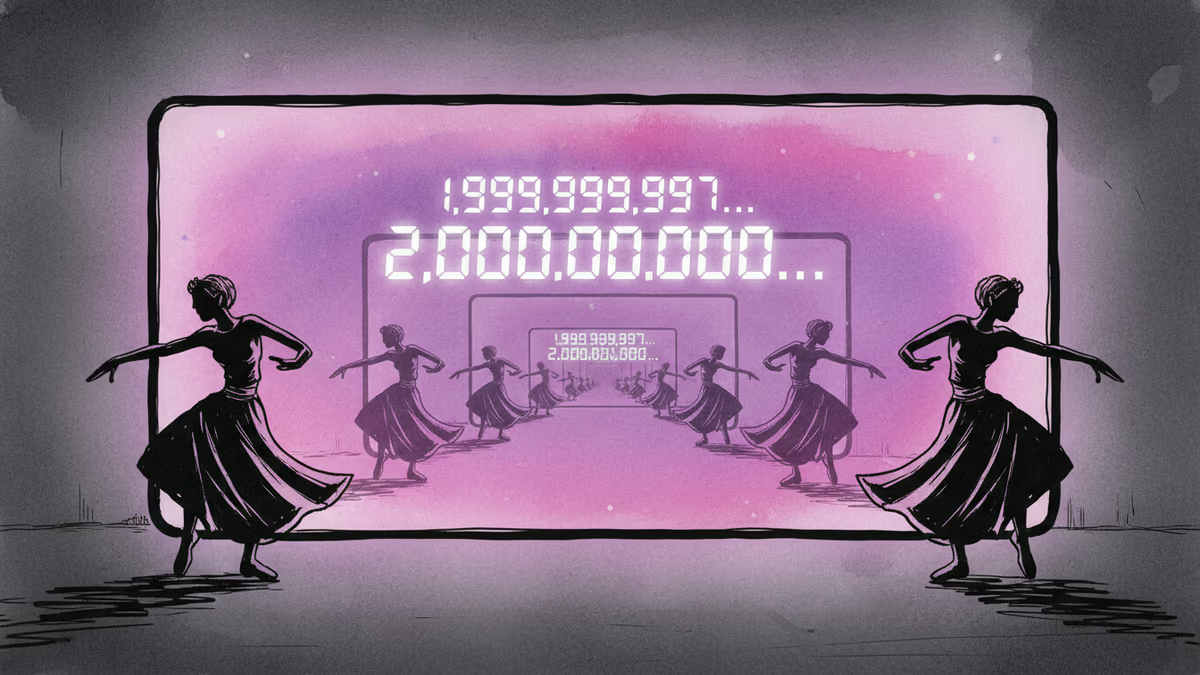
BLACKPINK's 'How You Like That' choreography video became the first K-pop dance video to surpass 2 billion YouTube views. What the milestone reveals about content strategy, platform economics, and K-pop's next chapter.
&TEAM's 'We on Fire' debuted on the Billboard 200 for the first time. Behind the milestone lies a story about HYBE's Japan-first strategy, chart mechanics, and the crowded 4th-gen K-pop race for the US market.
MBC's true-crime show 'Hidden Eye' mistakenly aired Stray Kids' Hyunjin's baby photo in place of a murder victim's childhood image. Five months later, an apology. What does that timeline reveal?
Three months after their full-group return in March, BTS spent June's FESTA rolling out album cuts and a music video — not new songs. Come Over cracked a global top 5 with zero new music behind it. Did the play work?
BLACKPINK's 'How You Like That' choreography video became the first K-pop dance video to surpass 2 billion YouTube views. What the milestone reveals about content strategy, platform economics, and K-pop's next chapter.
&TEAM's 'We on Fire' debuted on the Billboard 200 for the first time. Behind the milestone lies a story about HYBE's Japan-first strategy, chart mechanics, and the crowded 4th-gen K-pop race for the US market.
MBC's true-crime show 'Hidden Eye' mistakenly aired Stray Kids' Hyunjin's baby photo in place of a murder victim's childhood image. Five months later, an apology. What does that timeline reveal?
Thoughts
Share your thoughts on this article
Sign in to join the conversation