
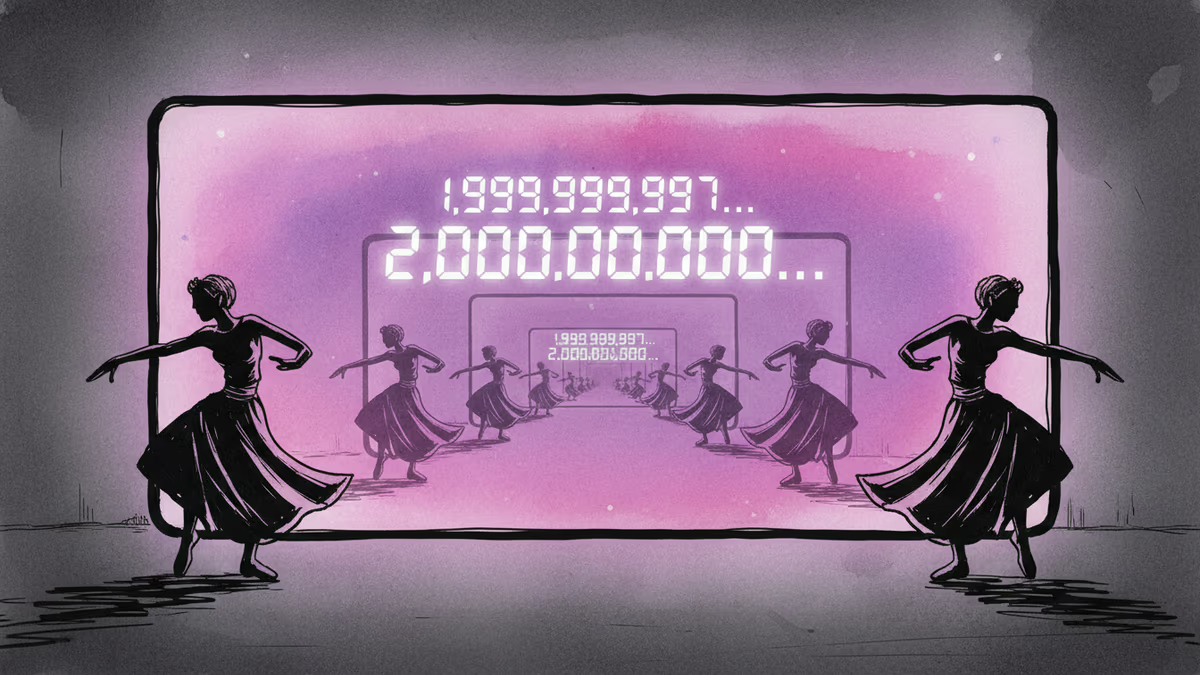
Why a Dance Practice Video Just Hit 2 Billion Views
BLACKPINK's 'How You Like That' choreography video became the first K-pop dance video to surpass 2 billion YouTube views. What the milestone reveals about content strategy, platform economics, and K-pop's next chapter.
It wasn't the music video. It wasn't a concert film. A dance practice video just crossed 2 billion YouTube views.
At approximately 2:32 p.m. KST on May 27, 2026, BLACKPINK's dance performance video for 'How You Like That' surpassed 2 billion views on YouTube — the first K-pop choreography video ever to reach that threshold. It's also the third video on BLACKPINK's official channel to cross the milestone, following the music videos for 'DDU-DU DDU-DU' and 'Kill This Love'.
The number is striking. But the more revealing question is: why a choreography video?
From Rehearsal Footage to Primary Content
When 'How You Like That' dropped in June 2020, the dance performance video was standard supplementary content — a clean, well-lit alternative to the music video, useful for fans learning the choreography and generating a secondary spike in engagement. It was a bonus, not a headliner.
That calculation has shifted. The rise of TikTok, Instagram Reels, and YouTube Shorts restructured how audiences engage with pop music. Dance challenges became a core distribution mechanism, and choreography videos — brighter, more legible, and shorter than typical music videos — turned out to be algorithmically advantaged. YouTube's recommendation engine weights watch completion rate heavily, and a 3-to-4-minute dance video tends to outperform a 5-minute cinematic music video on that metric.
The result: what was once a production afterthought is now a strategic content layer. Every major K-pop act since 2021 — BTS, aespa, TWICE, NewJeans — has treated choreography videos as a formal part of their release architecture, not an optional extra.

Where 2 Billion Actually Sits
Fewer than 30 videos in YouTube's entire history have crossed 2 billion views. The list is dominated by global pop crossovers — Luis Fonsi's 'Despacito', Ed Sheeran's 'Shape of You', 'Baby Shark' — and a handful of legacy viral phenomena. For a K-pop group to hold three entries in that tier is a data point that would have seemed implausible in 2012, when Psy's 'Gangnam Style' was still being described as an anomaly.
For context: BTS's 'Dynamite' music video — arguably the most commercially engineered K-pop release in history — sits at roughly 1.7 billion views. BLACKPINK's YouTube footprint is, by this measure, the deepest in the genre.
But there's a layer of complexity worth noting. BLACKPINK has been effectively dormant as a group since 2023, with all four members pursuing solo careers under separate label arrangements. Jennie signed with Columbia Records for the US market; Lisa operates under RCA Records. A video from six years ago, from a group that hasn't released new group music in years, just crossed 2 billion views. That tells two stories simultaneously: the durability of the BLACKPINK IP, and the structural shift in how streaming audiences consume pop content — not in release-window bursts, but in slow, continuous accumulation.
The Platform Timing Problem
The milestone landing in 2026 is worth contextualizing against where YouTube actually stands right now. The platform has spent the last two years recalibrating its monetization structure — tightening Shorts revenue sharing, adjusting long-form ad rates, and competing more directly with TikTok for creator loyalty. Meanwhile, K-pop labels have been quietly diversifying away from YouTube dependency. HYBE has doubled down on Weverse as a direct-to-fan platform. SM Entertainment has been restructuring its digital distribution strategy following its tie-up with Kakao Entertainment.
The era when YouTube was K-pop's singular global distribution channel is winding down. And yet the records being broken right now are products of that era's peak — the 2019–2022 window when K-pop and YouTube's algorithmic incentives were most tightly aligned. BLACKPINK's 2 billion is, in a sense, a monument to a strategy that the industry is already moving past.
For music industry analysts, this raises a practical question: can the next generation of K-pop acts replicate this kind of long-tail accumulation on a more fragmented platform landscape, or was BLACKPINK's YouTube dominance partly a function of being in the right place at the right algorithmic moment?
This content is AI-generated based on source articles. While we strive for accuracy, errors may occur. We recommend verifying with the original source.
Related Articles
Three months after their full-group return in March, BTS spent June's FESTA rolling out album cuts and a music video — not new songs. Come Over cracked a global top 5 with zero new music behind it. Did the play work?

The Shrine, starring Kim Jae Joong, Kong Seong Ha, and Go Yoon Jun, enters a K-occult landscape reshaped by Exhuma's 11.9M ticket milestone. What does the film's Japan setting signal?
&TEAM's 'We on Fire' debuted on the Billboard 200 for the first time. Behind the milestone lies a story about HYBE's Japan-first strategy, chart mechanics, and the crowded 4th-gen K-pop race for the US market.

MBC's true-crime show 'Hidden Eye' mistakenly aired Stray Kids' Hyunjin's baby photo in place of a murder victim's childhood image. Five months later, an apology. What does that timeline reveal?
Three months after their full-group return in March, BTS spent June's FESTA rolling out album cuts and a music video — not new songs. Come Over cracked a global top 5 with zero new music behind it. Did the play work?
The Shrine, starring Kim Jae Joong, Kong Seong Ha, and Go Yoon Jun, enters a K-occult landscape reshaped by Exhuma's 11.9M ticket milestone. What does the film's Japan setting signal?
&TEAM's 'We on Fire' debuted on the Billboard 200 for the first time. Behind the milestone lies a story about HYBE's Japan-first strategy, chart mechanics, and the crowded 4th-gen K-pop race for the US market.
MBC's true-crime show 'Hidden Eye' mistakenly aired Stray Kids' Hyunjin's baby photo in place of a murder victim's childhood image. Five months later, an apology. What does that timeline reveal?
Thoughts
Share your thoughts on this article
Sign in to join the conversation