
After Exhuma, K-Occult's Next Move Is Set in Kobe
The Shrine, starring Kim Jae Joong, Kong Seong Ha, and Go Yoon Jun, enters a K-occult landscape reshaped by Exhuma's 11.9M ticket milestone. What does the film's Japan setting signal?
The most dangerous moment in Korean horror isn't the jump scare—it's the second act, when the film has to justify why these people walked into that place.
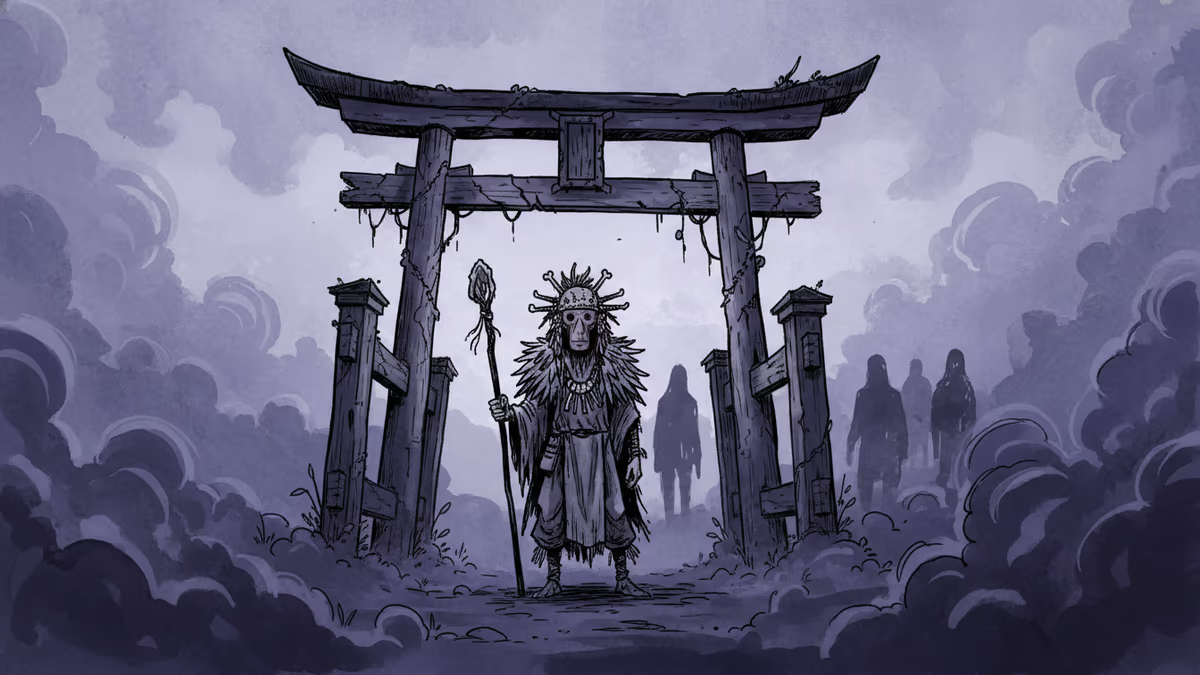
Occult horror film The Shrine has released character posters for its three leads: Kim Jae Joong, Kong Seong Ha, and Go Yoon Jun. The premise follows three college students who vanish during an expedition to an abandoned shrine in Kobe, Japan, with shaman Myung Jin (Kim Jae Joong) drawn into the investigation that follows. The posters lean hard into dread—pale faces, fractured compositions, the visual grammar of a film that knows exactly what genre it's operating in.
The Shadow of Exhuma
Timing matters here. The Shrine arrives in a K-horror landscape that Exhuma (2024) fundamentally recalibrated. That film—a shaman-versus-colonial-ghost narrative—pulled 11.91 million admissions domestically, making it one of the highest-grossing Korean horror films ever. It didn't just succeed commercially; it redefined audience expectations. Korean horror viewers now arrive at an occult film expecting historical layering, not just supernatural spectacle.
The Shrine appears to be navigating that expectation deliberately. Centering a shaman as the investigative protagonist is a direct inheritance of Exhuma's template. But where Exhuma's mudang was a vehicle for colonial trauma, The Shrine's Myung Jin—based on what's been released—reads closer to a detective archetype. Whether that's a meaningful evolution of the formula or a surface-level borrowing is a question the finished film will have to answer.
Why Kobe?

The choice of Kobe as the setting is the most analytically interesting decision the film has made public so far. K-horror rarely exports its fear to foreign soil—the genre's power has historically been rooted in specifically Korean spaces and social anxieties. Kobe is not a neutral backdrop. It's a city still marked by the 1995 Great Hanshin earthquake, and historically one of the most significant hubs of the Zainichi Korean community in Japan.
Pair that with an abandoned Shinto shrine, and the spatial symbolism becomes dense. A Korean shaman investigating supernatural events at a Japanese religious site carries the weight of a century of fraught history between the two countries—whether or not the screenplay chooses to engage with it. Exhuma showed that leaning into that history could turn a horror film into a cultural event. The question for The Shrine is whether Kobe is a setting or a subject.
The Kim Jae Joong Calculation
Kim Jae Joong's casting follows the established logic of idol-to-actor transitions in Korean entertainment, but with a specific wrinkle. As a former TVXQ member with nearly two decades of solo career behind him, he's not a new entrant to acting—he's a known quantity with a loyal international fanbase, particularly strong in Japan. Casting him in a film set in Japan, playing a character who crosses into that cultural space, is not an accident.
For the production, this is a dual-market play: domestic occult genre audience plus the Japanese hallyu fanbase that has followed Kim Jae Joong since the mid-2000s. Kong Seong Ha and Go Yoon Jun, both building momentum through recent drama work, round out a cast designed to capture newer viewers without alienating the core.
The risk is familiar: ensemble casts assembled for demographic reach can dilute the narrative focus that horror requires. The genre punishes films that spread their tension too thin.
This content is AI-generated based on source articles. While we strive for accuracy, errors may occur. We recommend verifying with the original source.
Related Articles
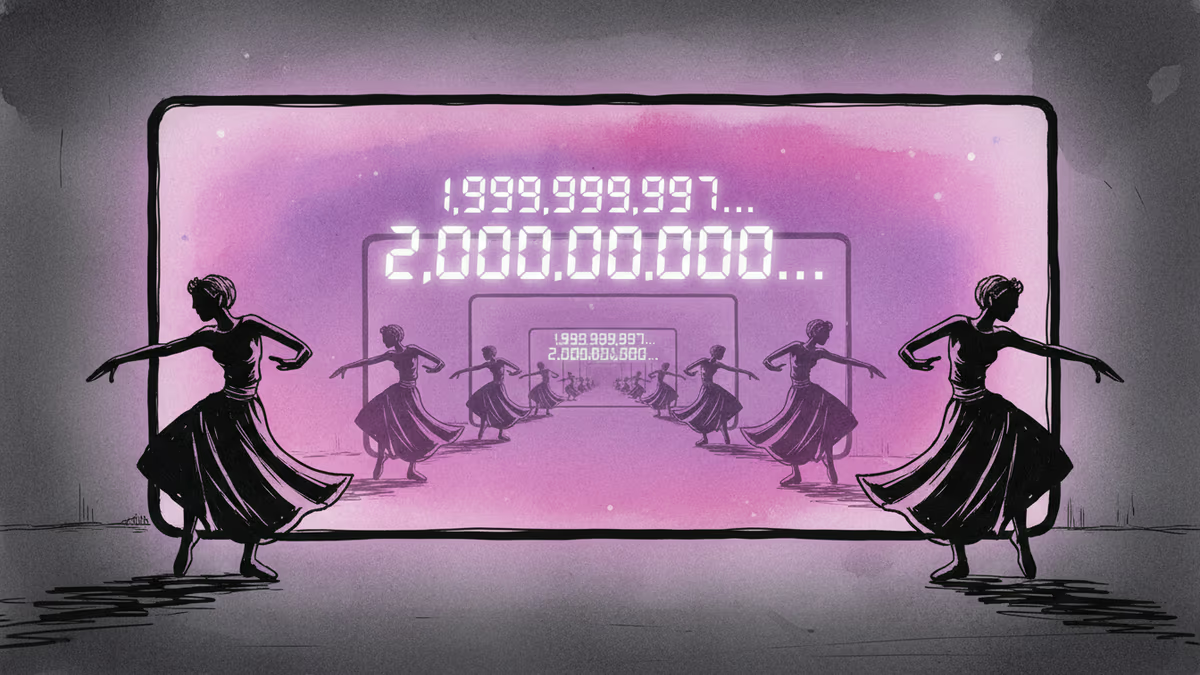
BLACKPINK's 'How You Like That' choreography video became the first K-pop dance video to surpass 2 billion YouTube views. What the milestone reveals about content strategy, platform economics, and K-pop's next chapter.

Jae Seok's B&B Rules!" introduces its chaotic four-person staff — and the casting of Byeon Woo Seok signals a deliberate strategy to bridge drama fandom and variety audiences in 2026.

MBC's Perfect Crown held the No. 1 spot on Korea's buzz rankings even in its final week on air, with Park Ji Hoon topping the actor chart. Here's what the numbers reveal about the K-drama market right now.

Korea's upcoming comedy film Wild Sing stars Kang Dong Won, Um Tae Goo, Park Ji Hyun, and Oh Jung Se as a disgraced idol trio attempting a comeback. Here's what the casting and Y2K aesthetic tell us about where Korean cinema is headed.
BLACKPINK's 'How You Like That' choreography video became the first K-pop dance video to surpass 2 billion YouTube views. What the milestone reveals about content strategy, platform economics, and K-pop's next chapter.
Jae Seok's B&B Rules!" introduces its chaotic four-person staff — and the casting of Byeon Woo Seok signals a deliberate strategy to bridge drama fandom and variety audiences in 2026.
MBC's Perfect Crown held the No. 1 spot on Korea's buzz rankings even in its final week on air, with Park Ji Hoon topping the actor chart. Here's what the numbers reveal about the K-drama market right now.
Korea's upcoming comedy film Wild Sing stars Kang Dong Won, Um Tae Goo, Park Ji Hyun, and Oh Jung Se as a disgraced idol trio attempting a comeback. Here's what the casting and Y2K aesthetic tell us about where Korean cinema is headed.
Thoughts
Share your thoughts on this article
Sign in to join the conversation