
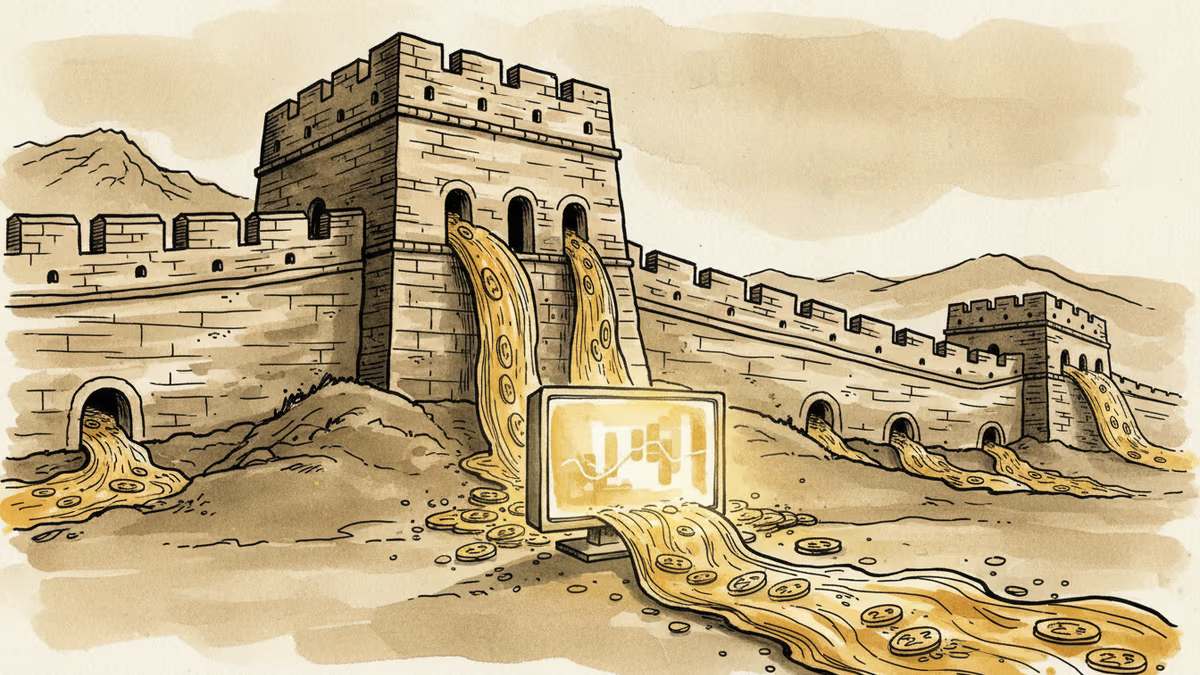
Banned in China, Betting Site Thrives with Hundreds of Millions Monthly
Polymarket hires Mandarin-speaking staff to target restricted Chinese market. Asian users generate hundreds of millions in monthly trading volume through VPNs.
The Great Wall Can't Stop the Great Bet
China bans cryptocurrency trading and online gambling with an iron fist. Yet hundreds of millions of dollars flow monthly from Chinese users to overseas prediction markets. Polymarket, the crypto betting platform that exploded during the 2024 U.S. election, is now hiring Mandarin-speaking staff to capture this massive shadow market.
Justin Yang, who handles Polymarket's Asia strategy, dropped out of Stanford to join the company in October. "China is becoming a very important geography for Polymarket," Yang told Rest of World. "They've just brought me in to do everything we can to serve our Chinese users better."
VPNs: The New Silk Road for Speculation
Polymarket and Kalshi are blocked by China's Great Firewall, but that hasn't stopped Chinese speculators from accessing these platforms through VPNs. Yang says Asian users generate millions of monthly visits and hundreds of millions in trading volume.
Chinese users aren't just betting on NBA games—they're wagering on culturally specific events like "Which robot dancer brands will feature at the 2026 Spring Festival Gala." That particular market has seen $74,000 in trading volume, with bettors giving Unitree a 99% chance of appearing.
The Government vs. The Market: A Losing Battle?

Beijing entrepreneur Jihong Zhou has developed an AI assistant that tracks Polymarket activity, including algorithms that calculate whether it's worth betting on NBA games in real-time. "Eventually, prediction markets will be able to complement the mainstream financial markets," he believes.
But China's government isn't amused. Patrick Tan, general counsel at blockchain firm ChainArgos, is blunt about the prospects: "China is not naive about these things. It looks like a duck, it walks like a duck, it quacks like a duck... I don't even think we're going to get to that regulatory conversation."
The Regulatory Paradox
Here's the irony: the stricter the ban, the bigger the underground market seems to grow. Polymarket and Kalshi are now valued at $9 billion and $11 billion respectively, fueled partly by users in restricted jurisdictions.
U.S. prediction markets are actively seeking international expansion, with Kalshi announcing availability in over 140 countries last year. But they're walking into legal gray zones everywhere, not just in China.
What This Means for Global Finance
The Chinese government has been intensifying its cryptocurrency crackdown, banning offshore entities from providing crypto services to Chinese individuals. Yet the money keeps flowing. This suggests either a fundamental failure of enforcement or an unstoppable shift in how people want to engage with financial markets.
Polymarket's Yang is hedging his bets too—literally. The company plans to include the Chinese diaspora in its growth strategy, potentially serving Chinese users living in jurisdictions where the platform is legal.
Authors
Related Articles

A US special forces soldier involved in the operation that captured Venezuela's Maduro allegedly used classified intel to bet on Polymarket, pocketing over $400,000. The case exposes a gaping hole in how prediction markets are regulated.
Despite fierce competition, the CEOs of Polymarket and Kalshi have co-invested in 5(c) Capital, a $35M VC fund targeting prediction market infrastructure. What this signals for the industry.
A class action lawsuit accuses Kalshi of changing payout rules after Iran's Supreme Leader Khamenei was killed. The case cuts to the heart of prediction market credibility.
As Polymarket and Kalshi expand news partnerships, insider trading concerns mount. The line between gambling and information is blurring dangerously.
A US special forces soldier involved in the operation that captured Venezuela's Maduro allegedly used classified intel to bet on Polymarket, pocketing over $400,000. The case exposes a gaping hole in how prediction markets are regulated.
Despite fierce competition, the CEOs of Polymarket and Kalshi have co-invested in 5(c) Capital, a $35M VC fund targeting prediction market infrastructure. What this signals for the industry.
A class action lawsuit accuses Kalshi of changing payout rules after Iran's Supreme Leader Khamenei was killed. The case cuts to the heart of prediction market credibility.
As Polymarket and Kalshi expand news partnerships, insider trading concerns mount. The line between gambling and information is blurring dangerously.
Thoughts
Share your thoughts on this article
Sign in to join the conversation