
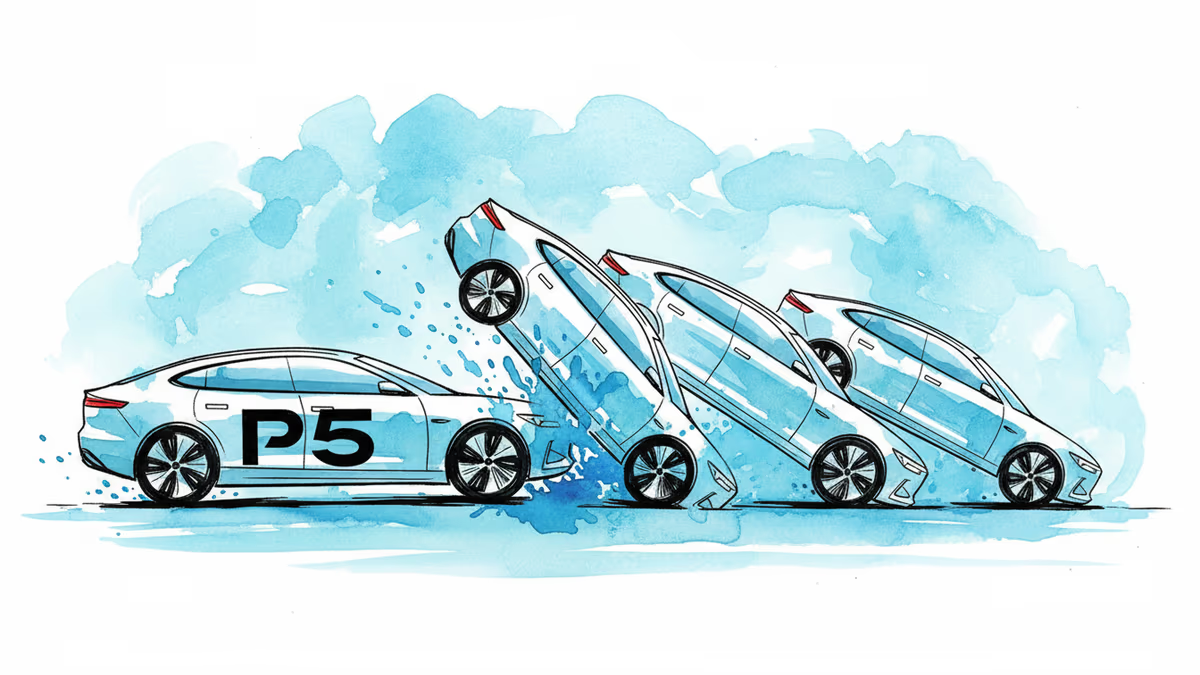
Polestar's Four-Model Blitz: Redefining Premium EV Strategy
Polestar announces four new electric models through 2028, from the Polestar 5 grand tourer to a compact SUV. How will this reshape the premium EV landscape?
Four Models in Three Years: More Than Just Product Expansion
Polestar just dropped its most ambitious roadmap yet: four new electric models rolling out through 2028. Fresh off strong 2025 sales growth, the Swedish-designed, Chinese-owned brand isn't just expanding its lineup—it's making a calculated play for premium EV dominance.
The timeline is aggressive. This summer brings the Polestar 5 grand tourer, followed by a long-roof Polestar 4 variant in Q4. Early 2027 sees a "new successor" to the current Polestar 2, and 2028 introduces the compact premium Polestar 7 SUV. That's essentially one major launch every nine months.
The Tesla Model S Problem
Polestar's Polestar 5 grand tourer enters a peculiar market moment. Tesla's Model S, once the flagship of luxury EVs, has seen sales plateau as buyers increasingly favor SUVs over sedans. Meanwhile, traditional luxury brands like Mercedes EQS and BMW i7 are struggling to match Tesla's charging infrastructure and software experience.
This creates an opening for Polestar's "third way"—Scandinavian minimalism meets Chinese manufacturing efficiency. The question: Can design philosophy alone justify premium pricing when buyers have more practical options?

The Compact SUV Gamble
The real test comes in 2028 with the Polestar 7. Compact premium SUVs represent the sweet spot of the EV market—think Tesla Model Y territory. But by 2028, this segment will be crowded with established players and new entrants, potentially including Apple's rumored vehicle.
Polestar's challenge: differentiate in a market where "premium compact SUV" might become as generic as "smartphone." The brand's Nordic design language and Google-based infotainment could be key differentiators, but only if they translate to measurable consumer benefits.
The Geely Factor: Strength or Liability?
Polestar's ownership by China's Geely creates an interesting dynamic. Geely's capital enables rapid model development and competitive pricing, but it also raises questions about brand authenticity and potential regulatory scrutiny in Western markets.
U.S. consumers increasingly associate Chinese ownership with concerns about data privacy and build quality, even when the actual design and engineering happen elsewhere. Polestar must navigate being simultaneously "Swedish" and "Chinese" in markets where those associations carry very different weight.
Authors
Related Articles
Waymo's new Ojai robotaxi isn't just a vehicle upgrade. It's the company's most serious attempt yet at cracking the cost problem that has kept autonomous vehicles from scaling. Here's what's really at stake.
The Ferrari Luce is finally here — 1,000 hp, a 122 kWh battery, and an interior designed by the team behind the iPhone. But the real story is what Ferrari risked to build it.
Mercedes-AMG's new GT 4-door coupe packs three YASA axial flux motors producing 1,153 hp and 1,475 lb-ft of torque. Here's what it means for the EV performance race—and who actually wins.
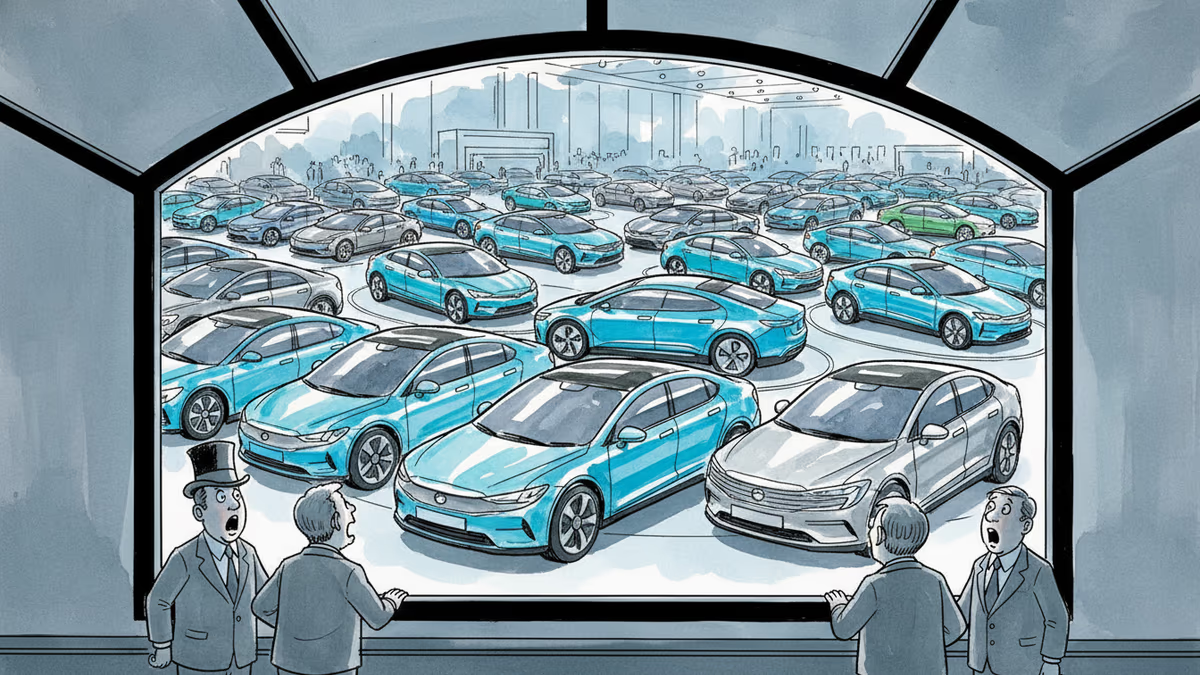
Auto China 2026 set records with 1,451 vehicles and 181 world premieres. But the real story isn't the size—it's how Chinese automakers stopped competing on price and started competing on brains.
Waymo's new Ojai robotaxi isn't just a vehicle upgrade. It's the company's most serious attempt yet at cracking the cost problem that has kept autonomous vehicles from scaling. Here's what's really at stake.
The Ferrari Luce is finally here — 1,000 hp, a 122 kWh battery, and an interior designed by the team behind the iPhone. But the real story is what Ferrari risked to build it.
Mercedes-AMG's new GT 4-door coupe packs three YASA axial flux motors producing 1,153 hp and 1,475 lb-ft of torque. Here's what it means for the EV performance race—and who actually wins.
Auto China 2026 set records with 1,451 vehicles and 181 world premieres. But the real story isn't the size—it's how Chinese automakers stopped competing on price and started competing on brains.
Thoughts
Share your thoughts on this article
Sign in to join the conversation