
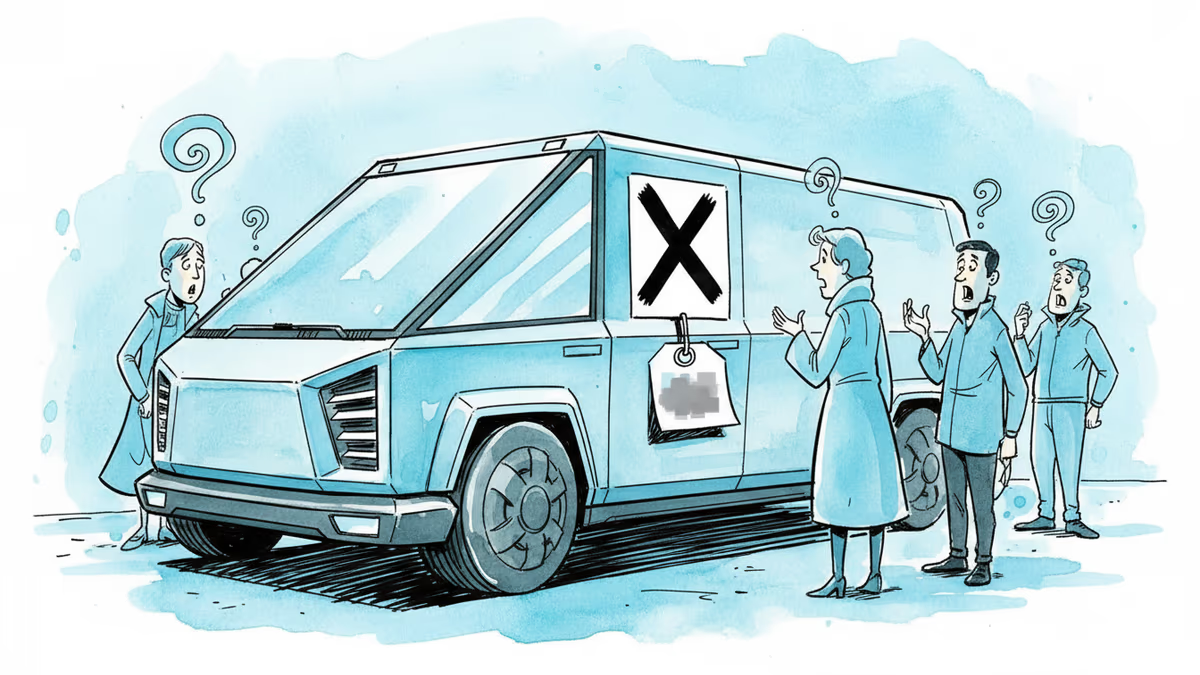
Tesla's Cybertruck Price Slash: Desperation or Strategy?
Tesla cuts Cybertruck prices by up to $15,000 and launches a new entry-level model at $59,990. Is this a response to weak sales or a calculated market move?
$15,000 Off Overnight: When Premium Goes Mainstream
Tesla just made its boldest Cybertruck move yet. The flagship Cyberbeast dropped $15,000 to $99,990, while a new entry-level model landed at $59,990. But here's the catch: those price cuts came with strings attached.
The premium features that were once free—Supercharging and Full Self-Driving—are now paid add-ons. The new base model packs dual motors, 325-mile range, and a 4.1-second 0-60 time, but towing capacity drops from 11,000 pounds to 7,000 pounds, and cargo space shrinks from 2,500 pounds to 2,006 pounds.
The Market Reality Check
This isn't Tesla's first Cybertruck pricing experiment. Last year's single-motor RWD variant at $69,990 flopped so badly it was quickly discontinued. The new dual-motor model costs $10,000 less while delivering more capability—a clear sign Tesla learned from that mistake.

Yet even at these "reduced" prices, we're still far from Elon Musk's original $39,900 starting price announced in 2019. Inflation and battery costs explain some of the increase, but 50%+ premium over initial promises raises questions about Tesla's pricing strategy.
The Electric Pickup Paradox
Tesla's price cuts reveal a broader industry challenge. Rivian's R1T and Ford's Lightning have both struggled with sales momentum, suggesting the electric pickup market isn't as ready as automakers hoped. Even Tesla, with its devoted fanbase and charging network advantage, is finding that futuristic design alone doesn't guarantee mass adoption.
For investors, this signals a shift from Tesla's traditional premium positioning toward volume play. The company that once commanded waiting lists for $100,000+ vehicles is now chasing the mainstream truck market—a fundamentally different game with thinner margins and fiercer competition.
Authors
Related Articles
Waymo's new Ojai robotaxi isn't just a vehicle upgrade. It's the company's most serious attempt yet at cracking the cost problem that has kept autonomous vehicles from scaling. Here's what's really at stake.
Mercedes-AMG's new GT 4-door coupe packs three YASA axial flux motors producing 1,153 hp and 1,475 lb-ft of torque. Here's what it means for the EV performance race—and who actually wins.
Auto China 2026 set records with 1,451 vehicles and 181 world premieres. But the real story isn't the size—it's how Chinese automakers stopped competing on price and started competing on brains.

Expiring leases will flood the US used car market with over a million electric vehicles by 2028. Could this do what subsidies couldn't — make EVs genuinely affordable?
Waymo's new Ojai robotaxi isn't just a vehicle upgrade. It's the company's most serious attempt yet at cracking the cost problem that has kept autonomous vehicles from scaling. Here's what's really at stake.
Mercedes-AMG's new GT 4-door coupe packs three YASA axial flux motors producing 1,153 hp and 1,475 lb-ft of torque. Here's what it means for the EV performance race—and who actually wins.
Auto China 2026 set records with 1,451 vehicles and 181 world premieres. But the real story isn't the size—it's how Chinese automakers stopped competing on price and started competing on brains.
Expiring leases will flood the US used car market with over a million electric vehicles by 2028. Could this do what subsidies couldn't — make EVs genuinely affordable?
Thoughts
Share your thoughts on this article
Sign in to join the conversation