
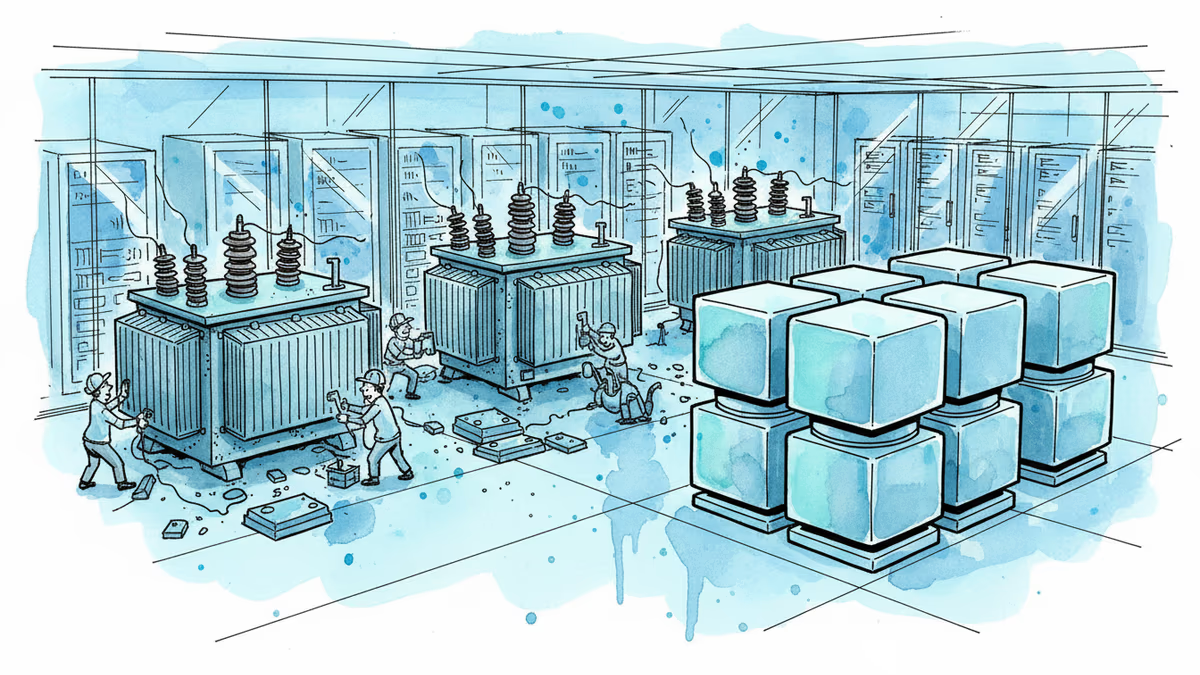
Why a Tesla Veteran's 'Transformer' Startup Just Raised $140M in 6 Months
Heron Power's rapid fundraising reveals how data centers are reshaping power infrastructure. Customers want 40 gigawatts of solid-state transformers. Here's why 100-year-old technology is finally changing.
Customers Want 40 Gigawatts. That Changes Everything.
Heron Power just raised $140 million — six months after its Series A. The startup, founded by Tesla's former powertrain chief Drew Baglino, didn't need the money. But when customers expressed interest in buying 40 gigawatts worth of solid-state transformers, the math became simple.
"If our customers are leaning in, we need to lean in as well," Baglino told TechCrunch. "We gotta go faster."
That 40 gigawatts isn't just a big number — it's half of Texas's peak power demand. It signals that data centers aren't just growing; they're fundamentally reshaping how we think about power infrastructure.
The 100-Year Problem Data Centers Can't Ignore
Traditional iron-core transformers have looked essentially the same for over a century. They're cheap and efficient, but they're massive heat generators that take up precious real estate. For data centers racing to deploy AI infrastructure, that's a dealbreaker.
Heron Power's solid-state transformers, branded as Heron Link, can handle 5 megawatts each while eliminating 70% of traditional gear. When a module fails, it takes 10 minutes to swap out — compared to hours for conventional transformers.

They're designed for Nvidia's 800-volt rack specifications and include lithium-ion batteries that provide 30 seconds of power during transitions, eliminating the need for uninterruptible power supplies.
Three Stakeholders, Three Different Calculations
Data center developers see cost savings "of an order of magnitude" in some applications, according to Baglino. Less equipment means fewer failure points and faster deployment.
Grid operators get intelligent power management that can handle wind, solar, and battery sources dynamically — something passive metal transformers simply can't do.
Investors led by Andreessen Horowitz's American Dynamism Fund and Breakthrough Energy Ventures see both climate impact and national infrastructure resilience in one technology.
The 2027 Timeline Everyone's Watching
Heron Power plans to begin pilot production in early 2027, ramping to 40 gigawatts of annual capacity. That's 10-15% of global production outside China — enough to supply half of Texas's peak demand.
But they're not alone. With many grid transformers approaching replacement age, competition will be fierce. Baglino's Tesla scaling experience could prove decisive. "We will push as hard as we can," he said.
Data centers currently represent only a third of Heron Power's business, with solar and grid-scale batteries making up the rest. But as AI infrastructure demands surge, that balance may shift dramatically.
Authors
Related Articles
Palantir co-founder Peter Thiel and other Silicon Valley investors have poured $140 million into Panthalassa, a startup building wave-powered floating AI data centers in the open ocean. Here's what that actually means.
Elon Musk confirmed on Tesla's Q1 2026 earnings call that Hardware 3 vehicles will never receive unsupervised Full Self-Driving — locking out millions who paid for the feature.
Tesla expanded its driverless robotaxi to Dallas and Houston, even after reporting 14 crashes in Austin. What does this tell us about how autonomous vehicles actually get built?
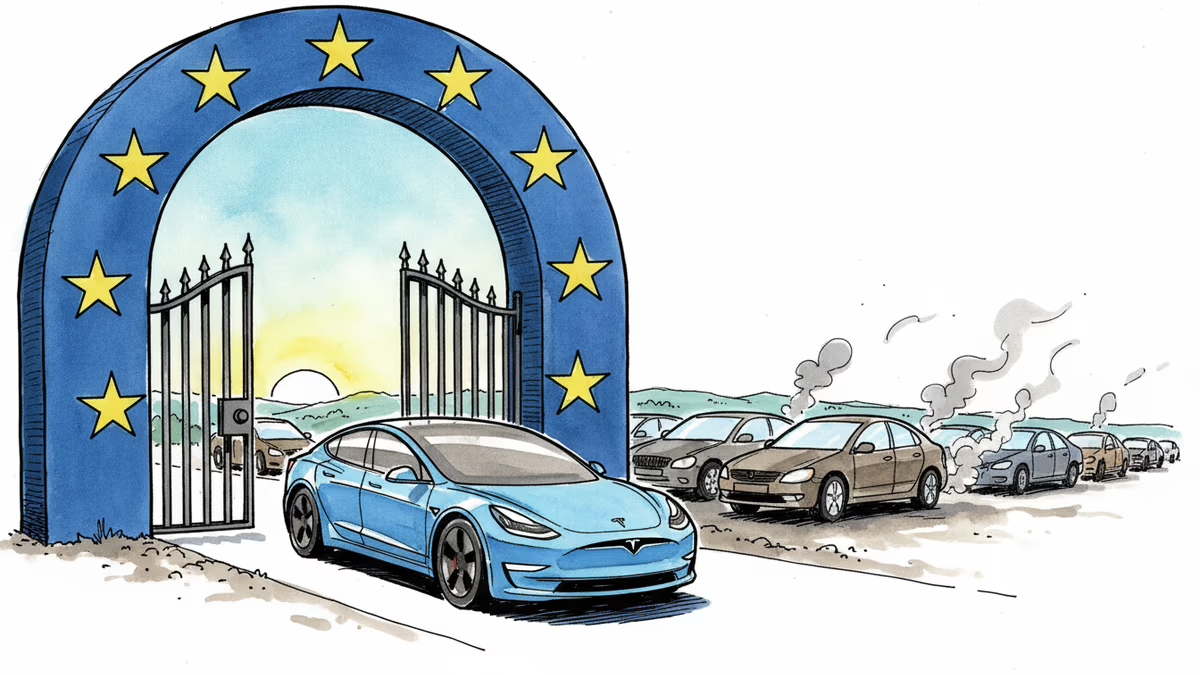
The Netherlands became the first European country to officially approve Tesla's FSD Supervised. With EU's type-approval framework, this could ripple across 27 member states fast.
Palantir co-founder Peter Thiel and other Silicon Valley investors have poured $140 million into Panthalassa, a startup building wave-powered floating AI data centers in the open ocean. Here's what that actually means.
Elon Musk confirmed on Tesla's Q1 2026 earnings call that Hardware 3 vehicles will never receive unsupervised Full Self-Driving — locking out millions who paid for the feature.
Tesla expanded its driverless robotaxi to Dallas and Houston, even after reporting 14 crashes in Austin. What does this tell us about how autonomous vehicles actually get built?
The Netherlands became the first European country to officially approve Tesla's FSD Supervised. With EU's type-approval framework, this could ripple across 27 member states fast.
Thoughts
Share your thoughts on this article
Sign in to join the conversation