
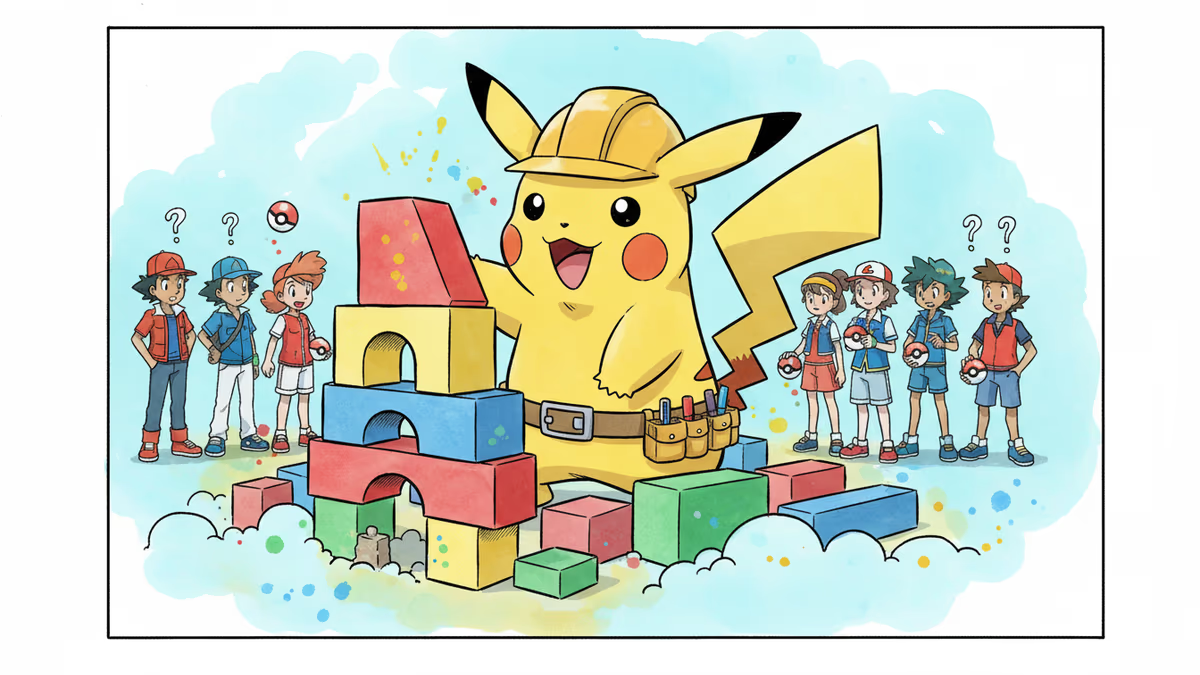
Pokémon's 30th Anniversary Gamble: Why Switch 2 Exclusivity Matters
Pokémon Pokopia debuts exclusively on Nintendo Switch 2. This isn't just a celebration—it's a calculated move that could reshape how we think about franchise expansion.
The $90 Billion Question
Pokémon turns 30 this year, and Nintendo just made its boldest franchise bet in decades. Pokémon Pokopia, launching March 5th exclusively on the Nintendo Switch 2, isn't just another anniversary game—it's a complete genre pivot that removes humans entirely from the Pokémon world.
This matters because Pokémon has never strayed this far from its core formula. No trainers, no battles, no gym leaders. Instead, players build and customize towns with Pokémon as collaborative partners. It's part Animal Crossing, part Minecraft, part social experiment.
Nintendo's Calculated Risk
Why make this radical departure a Switch 2 exclusive? The strategy is surprisingly sophisticated. Nintendo needs a killer app that showcases new hardware without alienating existing fans. Pokopia solves both problems elegantly.
First, the Pokémon brand guarantees initial sales—the franchise has moved over 440 million units globally. Second, by positioning this as an "experimental spinoff," Nintendo creates a safety net. If traditional fans reject it, they can always return to the mainline formula.
But there's a deeper play here. The construction and customization elements naturally highlight the Switch 2's improved graphics and processing power. Every detailed building block and smooth animation becomes a hardware showcase.

Industry Implications
Game developers worldwide are watching this launch closely. Epic Games has been experimenting with Fortnite Creative modes. Microsoft continues expanding Minecraft into new territories. The question isn't whether established franchises should evolve—it's how far they can stretch before breaking.
Early reviews suggest Pokopia succeeds where many franchise experiments fail. Instead of feeling like a cash grab, it creates genuine value for players who might never touch a traditional Pokémon game. That's a template other publishers will likely follow.
The timing also matters. With mobile gaming revenues plateauing and console competition intensifying, Nintendo needs differentiation beyond hardware specs. Pokopia represents a content strategy that competitors can't easily replicate.
The Broader Franchise Evolution
This launch reflects a fundamental shift in how entertainment properties expand. Traditional thinking said you protect your core audience first, then maybe experiment. Pokopia flips that logic—it uses the core brand to attract new audiences while giving longtime fans something genuinely different to consider.
Compare this to Disney's approach with Marvel or Warner Bros' handling of DC properties. Safe expansions often feel redundant. Risky ones can revitalize entire franchises or spectacularly fail.
Authors
Related Articles
Sony is pulling its major single-player PlayStation games from PC. After six years of multiplatform expansion, the reversal raises hard questions about exclusivity, hardware sales, and who really controls gaming's future.
Xbox hardware revenue dropped 33% in Q1 2026, yet Microsoft posted $82.9B in total revenue. What this tells us about the future of gaming—and who actually loses.
Pokémon Champions launched on Switch with bugs breaking core battle mechanics. But the deeper issue isn't the bugs — it's whether a game trying to please all players can satisfy any of them.
The EasySMX S10 Lite challenges Nintendo's official Switch 2 Pro Controller at less than half the price. What happens when third-party gear outperforms the original?
Sony is pulling its major single-player PlayStation games from PC. After six years of multiplatform expansion, the reversal raises hard questions about exclusivity, hardware sales, and who really controls gaming's future.
Xbox hardware revenue dropped 33% in Q1 2026, yet Microsoft posted $82.9B in total revenue. What this tells us about the future of gaming—and who actually loses.
Pokémon Champions launched on Switch with bugs breaking core battle mechanics. But the deeper issue isn't the bugs — it's whether a game trying to please all players can satisfy any of them.
The EasySMX S10 Lite challenges Nintendo's official Switch 2 Pro Controller at less than half the price. What happens when third-party gear outperforms the original?
Thoughts
Share your thoughts on this article
Sign in to join the conversation