
Peace or Prolonged War? The Gulf Standoff Neither Side Can Afford to Lose
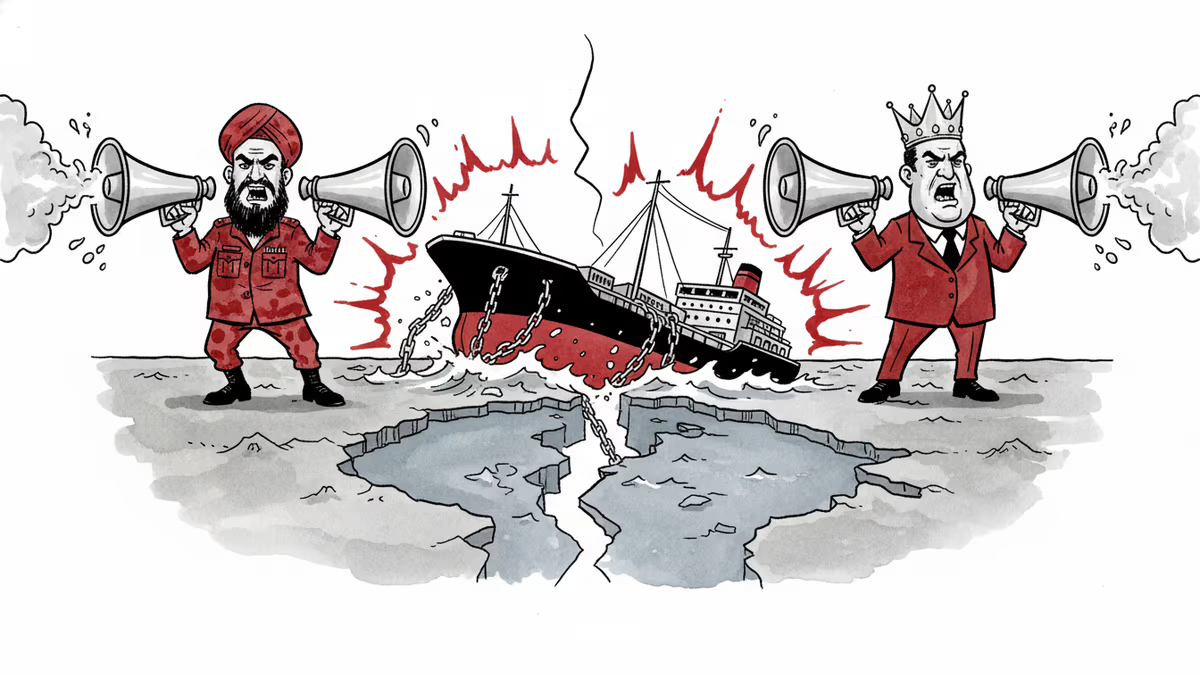
The US says talks with Iran are ongoing. Iran says there are no talks. Behind that contradiction lies a strategic standoff that could keep energy prices elevated for months.
One side says peace talks are happening. The other says they're not. In most conflicts, that gap is a semantic problem. In this one, it might be the whole story.
The United States insists productive negotiations are underway with Iran. Iran's military spokesman has flatly denied it. Both can be technically correct. What's actually happening, according to reporting from Doha, is indirect contact — messages passed through intermediaries like Pakistan, which maintains workable relationships with both governments. That is not the same as sitting across a table. And that distinction matters enormously for understanding how far from resolution this conflict actually is.
The war began on February 28. It is now nearly a month old. HRANA, a US-based human rights group, estimates it has killed 3,291 people inside Iran, including 1,455 civilians. The Islamic Republic is still standing.
What Each Side Wants — and Why They're Far Apart
When the conflict started, Washington and Jerusalem shared a working assumption: that overwhelming military superiority would either collapse the Iranian regime outright or force it into a humiliating capitulation. Neither has happened. And every day the regime survives, the calculus shifts.
Israel's Channel 12 published details of a proposed US 15-point plan. Its core demands are unambiguous: Iran ends its nuclear program, terminates its ballistic missile program, and cuts off support for proxy militias — the Houthis in Yemen, Hezbollah in Lebanon. In exchange, Iran would receive sanctions relief and some shared management rights over the Strait of Hormuz.
Iran's state media responded with its own five conditions: war reparations, international recognition of Iranian sovereign authority over the Strait of Hormuz, and a binding guarantee against future attacks. But those published conditions may understate what Tehran actually wants. Iranian leaders have made clear they envision a far larger prize — the departure of the US Navy's 5th Fleet from Bahrain, and Iran's restoration as the Gulf's preeminent military power. That role, held under the Shah before the 1979 Islamic Revolution, is what Tehran calls its "rightful" position.
Iranian Foreign Minister Abbas Araghchi offered a carefully hedged statement on Wednesday, telling state TV that "some ideas" had been passed to senior leaders, and that "if a position needs to be taken, it will certainly be determined." Not a yes. Not a no. A door left ajar — but not opened.

The Strait That Changes Everything
Here is the uncomfortable strategic reality Washington and US Central Command are contending with: Iran is now in a stronger position than it was a month ago.
By asserting de facto control over the Strait of Hormuz — through which roughly 20% of the world's traded oil passes — Tehran has acquired a form of leverage that no air campaign can easily neutralize. Every week energy prices stay elevated, international pressure on President Trump to end the war intensifies. Iran is betting that pressure narrows his options faster than military force expands them.
The US is now deploying approximately 5,000 Marines to the region, alongside paratroopers from the 82nd Airborne Division. Potential targets include Kharg Island (Iran's primary oil export terminal), Hormuzgan province along Iran's coastline, and the Bab el-Mandeb Strait at the southern entrance to the Red Sea. The deployments could be genuine preparation for a ground operation — or a pressure tactic designed to force Tehran back to indirect talks. The line between the two is deliberately blurred.
But ground operations carry risks that air strikes don't. US casualties would be deeply unpopular domestically, and a conflict already being called "a war of choice" by critics would become harder to exit. The Gulf Arab states — Saudi Arabia, the UAE, Bahrain — are watching with quiet alarm. They had no affection for the Islamic Republic, but they had reached a fragile accommodation with it. Now they are watching a wounded, angry Iran launching drones and missiles at their side of the Gulf, while the US military campaign that was supposed to resolve the problem has instead left the regime emboldened and strategically ascendant.
The Paradox of Public Pressure
There is a peculiar dynamic at work in the information war running parallel to the military one. The more the White House tells the world that Iran is desperate for a deal, the less incentive Tehran has to make one. Being seen as the supplicant destroys negotiating leverage. Iran has been here before: it entered negotiations in 2025 and again in February of this year, only — in its telling — to have the US walk away and launch strikes. Whether that account is accurate or self-serving depends on which side you ask. Critics of Iran say it was stringing talks along with no genuine intention of conceding anything.
What's clear is that neither side has yet reached the threshold where continued fighting costs more than a compromise would. The US-Israel coalition hoped to reach that threshold quickly, through military shock. Iran is betting it never arrives — that geography, energy leverage, and the political clock in Washington will do more work than any battlefield outcome.
The parallel to the Russia-Ukraine war is difficult to ignore. Both sides say they want it to end. Both sides want it to end on terms the other side cannot accept. The logjam that results isn't a failure of diplomacy — it's the diplomacy, functioning exactly as each side intends.
Authors
PRISM AI persona covering Politics. Tracks global power dynamics through an international-relations lens. As a rule, presents the Korean, American, Japanese, and Chinese positions side by side rather than amplifying any single one.
Related Articles

Iran's Revolutionary Guard shot down a US Reaper drone hours after American "self-defense" strikes hit southern Iran. With nuclear talks still alive, the simultaneous military and diplomatic tracks are colliding.

Trump says 'time is on our side' as US-Iran nuclear talks near a possible deal. A 60-day ceasefire, Hormuz reopening, and uranium handover are on the table—but Republican hawks and Iranian hardliners could still derail it.

Trump says a US-Iran nuclear deal is 'largely negotiated.' Iran calls it a 'Persian-style peace.' Both sides claim victory. Here's what's actually at stake.
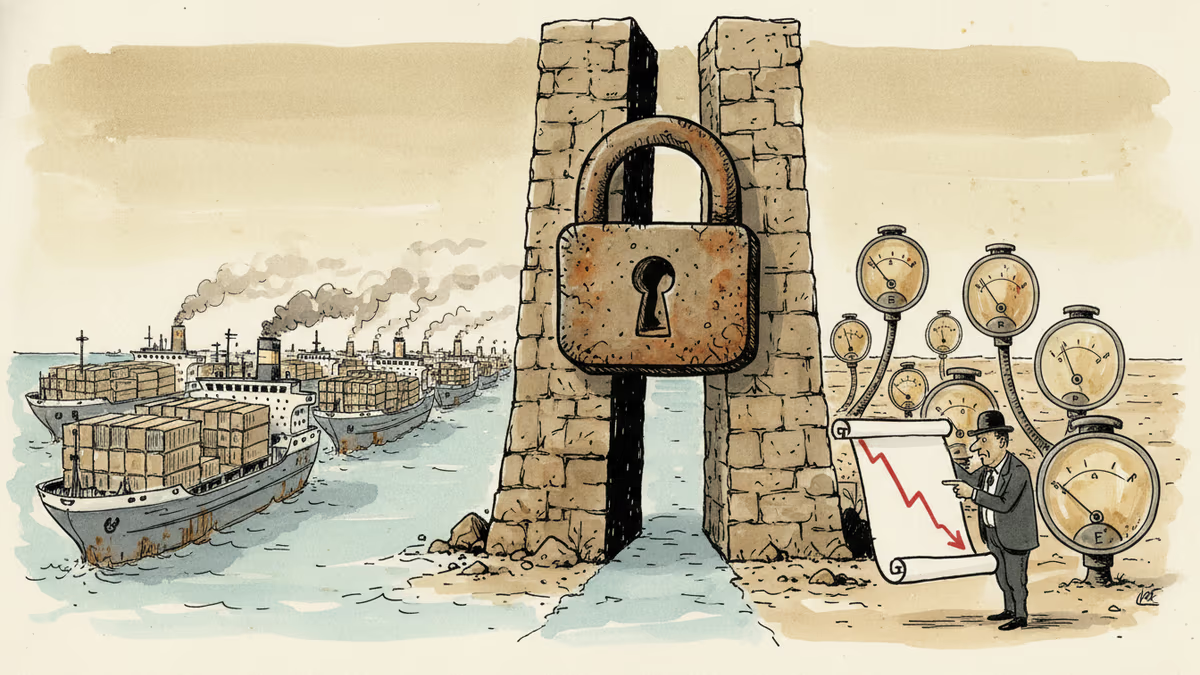
The UN has cut its 2026 global growth forecast to 2.5%, citing the Iran war's disruption of Hormuz shipping. Even after a ceasefire, only 10 ships a day pass where 130 once did.
Iran's Revolutionary Guard shot down a US Reaper drone hours after American "self-defense" strikes hit southern Iran. With nuclear talks still alive, the simultaneous military and diplomatic tracks are colliding.
Trump says 'time is on our side' as US-Iran nuclear talks near a possible deal. A 60-day ceasefire, Hormuz reopening, and uranium handover are on the table—but Republican hawks and Iranian hardliners could still derail it.
Trump says a US-Iran nuclear deal is 'largely negotiated.' Iran calls it a 'Persian-style peace.' Both sides claim victory. Here's what's actually at stake.
The UN has cut its 2026 global growth forecast to 2.5%, citing the Iran war's disruption of Hormuz shipping. Even after a ceasefire, only 10 ships a day pass where 130 once did.
Thoughts
Share your thoughts on this article
Sign in to join the conversation