

Palantir's Reckoning: When the Tool Becomes the Machine
Palantir has become the tech backbone of Trump's immigration enforcement. Former employees are calling it a 'descent into fascism.' What happens when the people who build surveillance tools start asking uncomfortable questions?
"Are you tracking Palantir's descent into fascism?"
That was the greeting. No hello, no small talk. Just that question, the moment the call connected. Two former Palantir employees, reconnecting after some time apart, and that's what one of them led with. The other remembers the feeling precisely: "It wasn't 'this is unpopular and hard.' It was 'this feels wrong.'"
What Palantir Is Actually Doing
Palantir Technologies has become the data infrastructure behind the Trump administration's immigration enforcement operations. The company provides software to the Department of Homeland Security that helps identify, track, and facilitate the deportation of immigrants. This isn't a minor contract or a peripheral role — current and former employees describe it as Palantir becoming the technological nervous system of a federal enforcement apparatus operating at unprecedented scale.
The timing matters. Trump's second term began in January 2025, and within months, Palantir's role in immigration enforcement had expanded visibly enough that people who built the company's tools felt compelled to speak out. The concerns didn't emerge from outside critics or advocacy groups first — they came from inside.
Palantir was founded in 2003 with early backing from the CIA's venture arm, In-Q-Tel. Its original pitch was counterterrorism analytics. Over time, it expanded into commercial markets, but government contracts — defense, intelligence, law enforcement — have always been the core. Peter Thiel, the libertarian co-founder, has long positioned the company as a defender of Western democracy against authoritarian threats. The irony of that framing is not lost on former employees today.
The Word They're Using: Fascism
It would be easy to dismiss "fascism" as rhetorical overreach. But the choice of that specific word by people who worked inside the company deserves attention rather than dismissal.
What these former employees are describing isn't merely a distasteful contract or a PR problem. They're pointing at a structural dynamic: a private technology company providing the tools that allow a government to classify, locate, and remove a specific population at scale. The efficiency that makes Palantir's software valuable in counterterrorism contexts is the same efficiency that makes it powerful — and, critics argue, dangerous — in domestic enforcement.
Meanwhile, Palantir's stock has performed strongly through 2025. Government contracts, especially those tied to defense and homeland security, are recession-proof revenue. Investors are reading the same news as the former employees and reaching entirely different conclusions.

Three Ways to See This
The government's view is straightforward: immigration enforcement is legal policy, and technology that makes enforcement more efficient is a legitimate procurement. There's nothing unusual about federal agencies using commercial software. The alternative — less efficient enforcement — isn't obviously more humane, just slower.
The investor's view is also coherent: Palantir has a durable competitive moat in government data analytics. The contracts are sticky, the revenue is predictable, and the current administration is an eager customer. The ethical concerns are real but priced in — or rather, priced out, because they don't show up in the earnings.
The former employees' view is harder to quantify but harder to ignore. These are people who understand the system's architecture. When engineers say something feels wrong, they're not just expressing discomfort — they're making a technical and moral judgment about what the system is capable of doing and who it will be used against.
The Bigger Pattern
This isn't only about Palantir. It's about a question the tech industry has deferred for years: at what point does a company become responsible for the downstream use of its tools?
Amazon Web Services faced similar pressure over its facial recognition software, Rekognition, sold to law enforcement. Microsoft had internal protests over military AI contracts. Google employees revolted over Project Maven, a Pentagon drone AI initiative, forcing the company to withdraw. In each case, the pattern is similar: the company signs a contract, internal dissent surfaces, public pressure mounts, and the company either doubles down or retreats.
Palantir appears to be doubling down. And unlike the cases above, its entire business model is built around government clients. There's no consumer division to retreat to, no ad revenue to fall back on. The government is the product.
What This Means Going Forward
For policy makers, the Palantir case is a test of whether existing procurement rules are adequate for AI-powered enforcement tools. The EU's AI Act explicitly classifies real-time biometric surveillance and AI used in migration management as high-risk, requiring strict oversight. The US has no equivalent framework.
For civil liberties advocates, the question is whether internal dissent — former employees speaking out — can create meaningful accountability when financial incentives point the other direction.
For the tech industry broadly, Palantir is a stress test of the "we just build tools" defense. That argument has always been philosophically weak. It's becoming politically untenable.
Authors
Related Articles

The FTC fined Cox Media and two ad firms $930,000 — not for actually eavesdropping on users, but for falsely claiming they could. The case raises uncomfortable questions about surveillance capitalism.
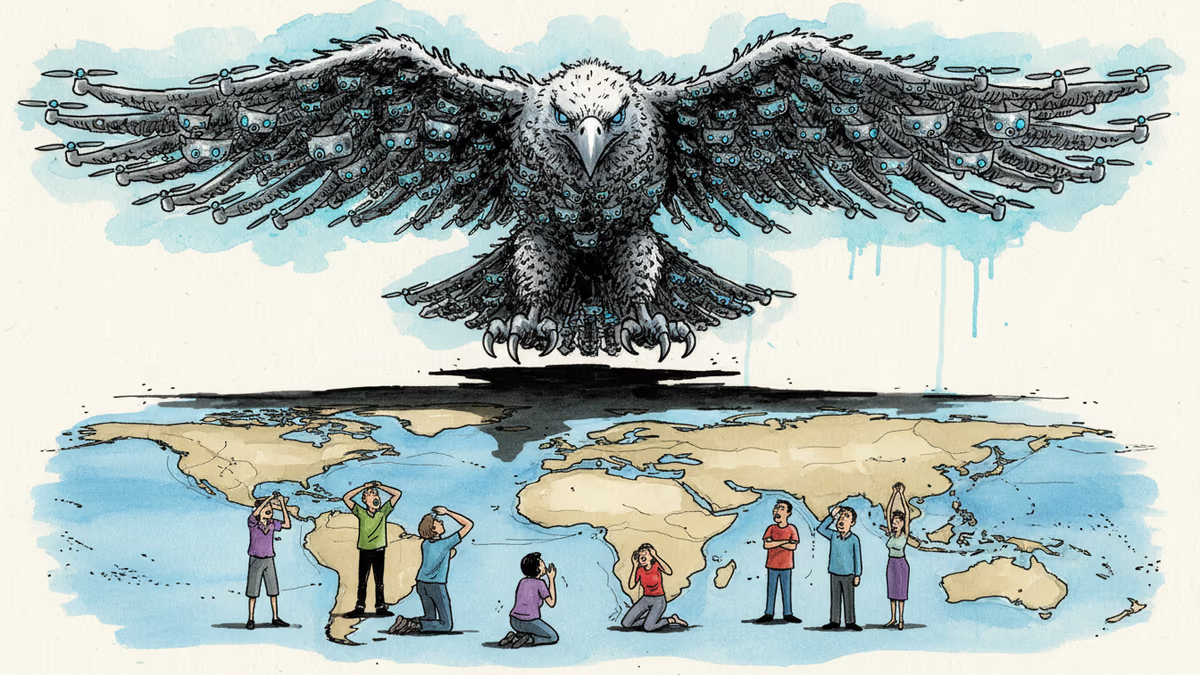
The US defense budget request for FY2027 includes $53.6 billion for drone and autonomous warfare—more than most nations spend on their entire military. What does this mean for global security and the future of war?

After two months of bitter conflict, Anthropic and the Trump administration may be thawing—thanks to a new cybersecurity AI model. What does it mean when principle meets political pressure?
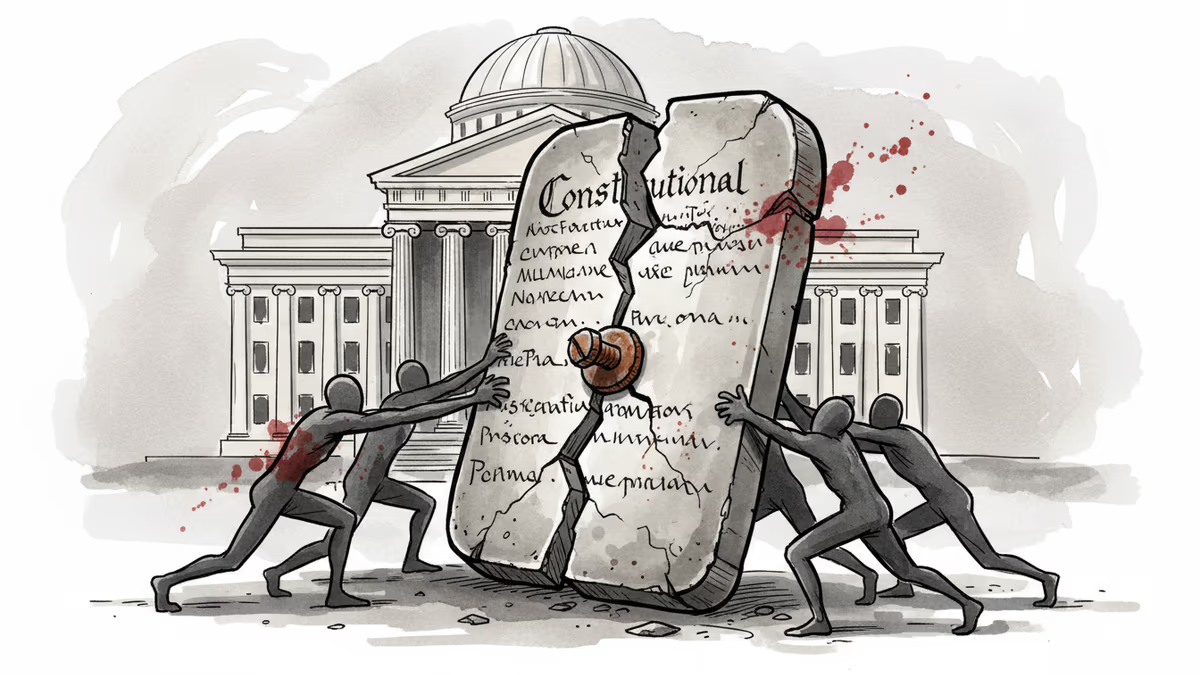
The Supreme Court heard arguments over Trump's birthright citizenship order. The justices seemed skeptical—but the fact that this case made it to the highest court signals something bigger.
The FTC fined Cox Media and two ad firms $930,000 — not for actually eavesdropping on users, but for falsely claiming they could. The case raises uncomfortable questions about surveillance capitalism.
The US defense budget request for FY2027 includes $53.6 billion for drone and autonomous warfare—more than most nations spend on their entire military. What does this mean for global security and the future of war?
After two months of bitter conflict, Anthropic and the Trump administration may be thawing—thanks to a new cybersecurity AI model. What does it mean when principle meets political pressure?
The Supreme Court heard arguments over Trump's birthright citizenship order. The justices seemed skeptical—but the fact that this case made it to the highest court signals something bigger.
Thoughts
Share your thoughts on this article
Sign in to join the conversation