
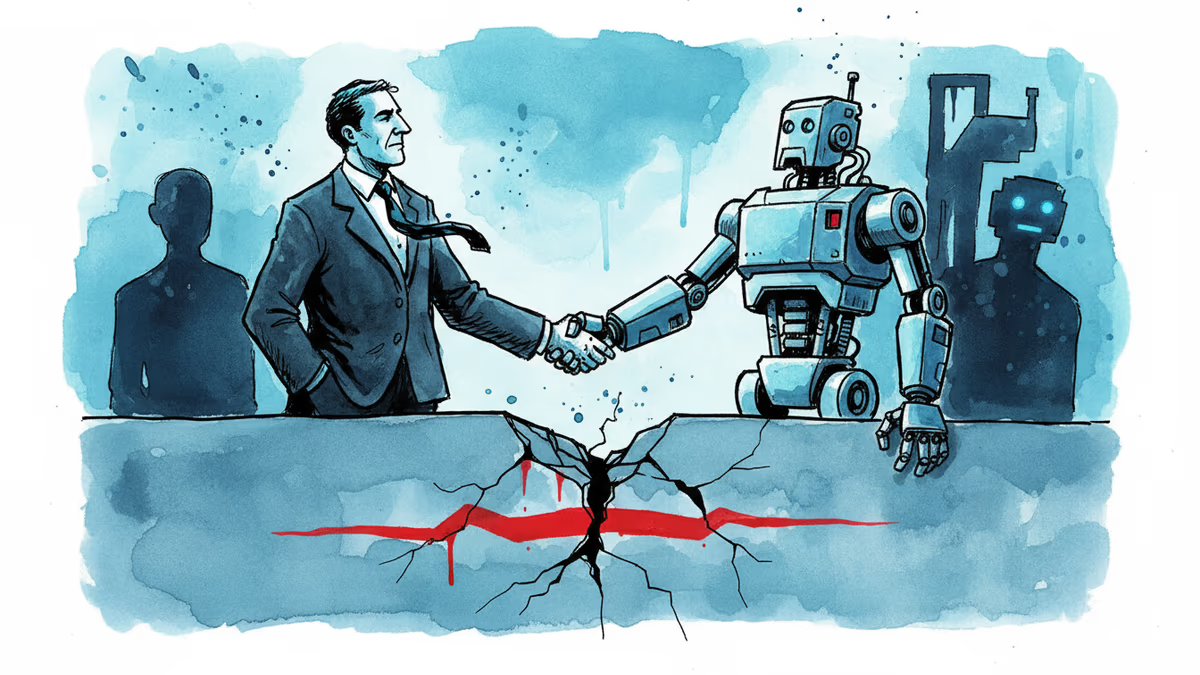
Anthropic Was 'Woke.' Now It Might Be the Pentagon's AI Partner.
After two months of bitter conflict, Anthropic and the Trump administration may be thawing—thanks to a new cybersecurity AI model. What does it mean when principle meets political pressure?
Two months ago, the Trump administration called Anthropic a "RADICAL LEFT, WOKE COMPANY" and a threat to national security. Today, the two may be on speaking terms again—and a cybersecurity AI model is the reason.
What Happened
The falling-out began in late February. The Trump administration wanted access to Anthropic's AI technology for two specific purposes: domestic mass surveillance and fully autonomous lethal weapons with no human in the loop. Anthropic refused both. Flatly.
The response from Washington was sharp. Administration officials labeled the company a nest of "Leftwing nut jobs," publicly attacked its leadership, and framed its refusal as a national security liability. For a company that counts the U.S. government among its key stakeholders—and competes in a market where federal contracts matter enormously—this was not a comfortable place to be.
Now, nearly two months later, reporting suggests the relationship may be thawing. The catalyst: Claude Mythos Preview, Anthropic's newly unveiled AI model built specifically for cybersecurity applications. According to The Verge, the Pentagon and intelligence community are taking notice—and this time, the use case doesn't collide with Anthropic's two stated red lines.
Why This Moment Matters

The timing is not accidental. The U.S. is navigating an increasingly hostile cyber threat environment. State-sponsored hacking groups linked to China, Russia, and North Korea are probing government and private infrastructure with growing sophistication. The Salt Typhoon breach—in which Chinese actors penetrated major U.S. telecom networks—demonstrated that the threat is not theoretical.
In that context, a cybersecurity-specialized AI looks less like a weapon and more like a shield. For the Defense Department, the distinction matters legally and politically. For Anthropic, it's an opening: cooperate with government on defense without crossing the lines it drew on offense.
This is also happening against a broader backdrop. The race between American and Chinese AI capabilities has become a stated national priority. Excluding a leading domestic AI lab from federal partnerships—over ideological friction—carries its own strategic cost. Pragmatism has a way of reasserting itself.
Three Ways to Read This
For AI ethics researchers, the thaw raises an uncomfortable question. The line between cyber defense and cyber offense is notoriously blurry. Tools built to detect intrusions can be repurposed to conduct them. Anthropic's red lines—no mass surveillance, no autonomous lethal weapons—remain formally intact. But critics will ask whether "cybersecurity" is a category that could gradually expand to accommodate things that don't look so clean.
For competitors like OpenAI, Google DeepMind, and Palantir—which has no such ethical constraints—the dynamic is worth watching. If Anthropic re-enters the government market through a cybersecurity door, it changes the competitive landscape for federal AI contracts, a sector projected to grow substantially through the decade.
For investors and the broader tech industry, this episode is a case study in how AI companies navigate political risk. The question isn't whether to engage with government—it's on what terms, with what safeguards, and who decides when a line has moved.
Authors
Related Articles
Anthropic shipped Claude Sonnet 5, its mid-tier agent model, on June 30. Behind the 'Opus-class power, budget price' headline sits a tokenizer catch and a three-horse race that's only half real. Here's what developers should actually run the numbers on.
China is restricting AI researchers and startup founders from traveling abroad as the U.S.-China AI performance gap narrows to just 2.7%. What Beijing's talent lockdown means for the global AI race.
A critical vulnerability in Starlette—downloaded 325 million times per week—puts millions of AI agent servers at risk, exposing stored credentials for email, databases, and third-party services.
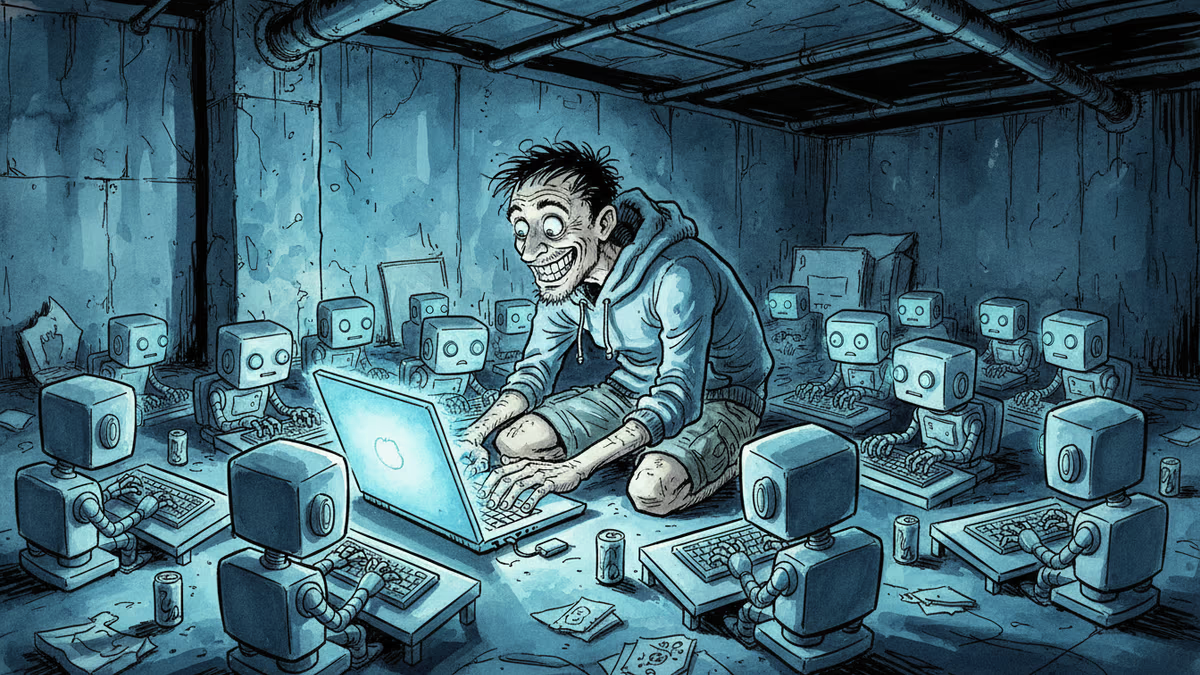
A small but growing group of developers has gone all-in on AI coding agents like Claude Code and OpenClaw. History suggests the rest of us won't be far behind.
Anthropic shipped Claude Sonnet 5, its mid-tier agent model, on June 30. Behind the 'Opus-class power, budget price' headline sits a tokenizer catch and a three-horse race that's only half real. Here's what developers should actually run the numbers on.
China is restricting AI researchers and startup founders from traveling abroad as the U.S.-China AI performance gap narrows to just 2.7%. What Beijing's talent lockdown means for the global AI race.
A critical vulnerability in Starlette—downloaded 325 million times per week—puts millions of AI agent servers at risk, exposing stored credentials for email, databases, and third-party services.
A small but growing group of developers has gone all-in on AI coding agents like Claude Code and OpenClaw. History suggests the rest of us won't be far behind.
Thoughts
Share your thoughts on this article
Sign in to join the conversation