
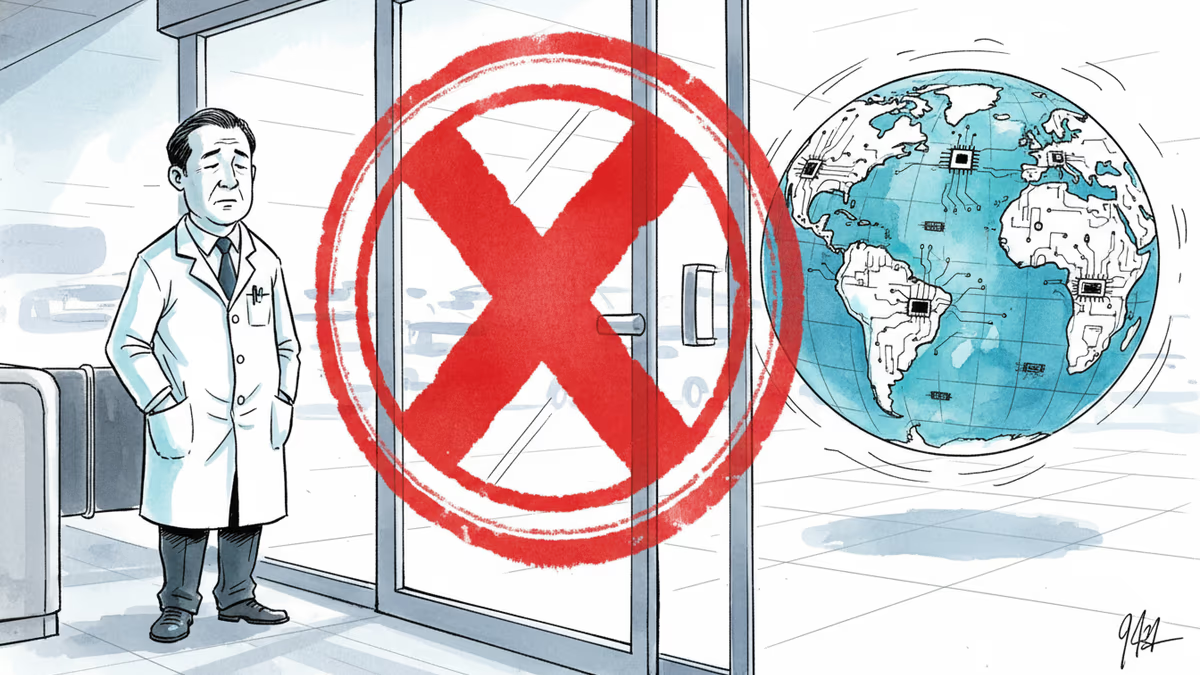
China Is Locking In Its AI Talent — Literally
China is restricting AI researchers and startup founders from traveling abroad as the U.S.-China AI performance gap narrows to just 2.7%. What Beijing's talent lockdown means for the global AI race.
In 2023, the best American AI models outperformed their Chinese counterparts by 31%. By March 2026, that gap had collapsed to 2.7%. Around the same time, Beijing started controlling something it had never formally regulated before: where its AI researchers are allowed to go.
What's Actually Happening
China's top AI researchers, startup founders, and private-sector executives now reportedly need government approval before traveling abroad. What began as informal guidance — the Wall Street Journal reported in March 2025 that Chinese authorities were advising prominent AI figures to avoid trips to the U.S. — has since hardened into explicit restriction.
The clearest illustration involves Manus, an AI startup that Meta agreed to acquire for $2 billion. While Chinese regulators investigate whether the deal violates foreign investment rules, the company's two co-founders have been barred from leaving the country, according to the Financial Times. They're now reportedly exploring a buyback — raising roughly $1 billion from external investors to unwind the acquisition entirely.
The controls aren't limited to people. Bloomberg reported in April that companies including Moonshot AI, StepFun, and ByteDance must now obtain government sign-off before accepting American capital. The message from Beijing is consistent: both the talent and the money flowing in and out of China's AI sector are now strategic assets to be managed.
Why This Moment, Why This Speed
The timing tracks closely with China's competitive position. Stanford's AI Index shows China is already ahead of the U.S. in research publications, citations, and patent volume. The U.S. still leads in model quality and high-impact patents — but the quantitative gap has flipped. When you're catching up, openness is an advantage. When you're nearly level, the calculus changes.

Beijing has been building this infrastructure of control for a while. In 2025, China imposed two rounds of export controls on 14 rare earth materials essential to advanced military manufacturing. It separately banned state-funded data centers from deploying foreign AI chips. The travel restrictions are the latest layer of the same strategy: treating AI capability as a national security asset rather than a commercial one.
The Manus-Meta case appears to have accelerated the timeline. A $2 billion foreign acquisition of a domestic AI startup was, in Beijing's reading, a data point that needed a policy response — fast.
Three Ways to Read This
From Washington's perspective, there's an uncomfortable symmetry here. The U.S. has spent years tightening visa screening for Chinese AI researchers, restricting chip exports, and scrutinizing Chinese investment in American tech. China's exit controls are, in structural terms, a mirror image. The question of who built the first wall is now genuinely contested.
For researchers and founders inside China, the implications are concrete. International conferences, joint research programs, and the informal knowledge-sharing that drives AI progress all become harder. AI, unlike nuclear technology, evolved as an open-collaboration field. GitHub, arXiv, and academic exchange have been as important to Chinese AI's rise as state funding. Restricting that pipeline may protect short-term gains while eroding the conditions that produced them.
For global tech companies — particularly those with R&D operations or investment exposure in China — the Manus case sets a precedent worth studying. A deal that would have been unremarkable two years ago is now a regulatory flashpoint. The implicit assumption that capital could flow freely while geopolitics played out in the background no longer holds.
The Talent Question Nobody Has Answered
The global AI industry is built on a relatively small pool of researchers who can train and fine-tune frontier models. That pool is international by nature — Chinese-born researchers trained at American universities, working at labs in London, Singapore, and San Francisco. Beijing's restrictions don't just affect people inside China; they reshape where the next generation of researchers chooses to be.
If Chinese researchers face exit controls at home and tightening visa scrutiny abroad, the rational response for many will be to make the choice earlier — before restrictions apply. The talent war may accelerate precisely because of the walls being built around it.
This content is AI-generated based on source articles. While we strive for accuracy, errors may occur. We recommend verifying with the original source.
Related Articles
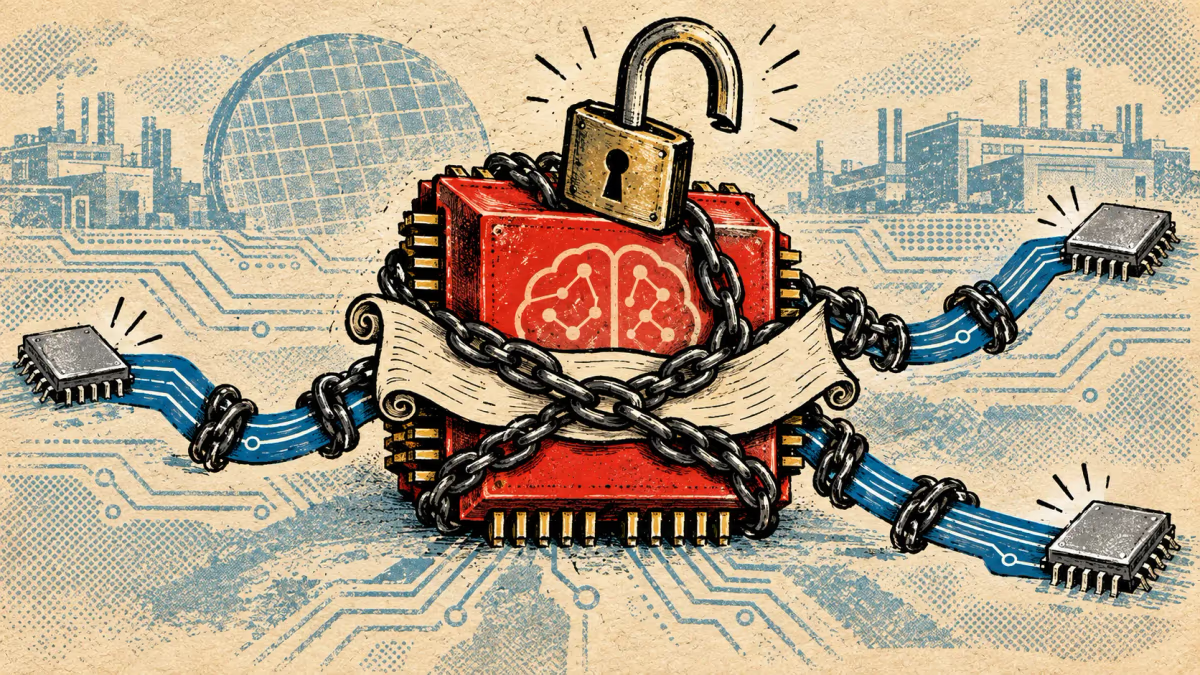
Huawei's CANN is open source under a license barring software for non-Ascend chips. Inside China's second CUDA, and the two links still outside it: pre-training compute and 5nm capacity.
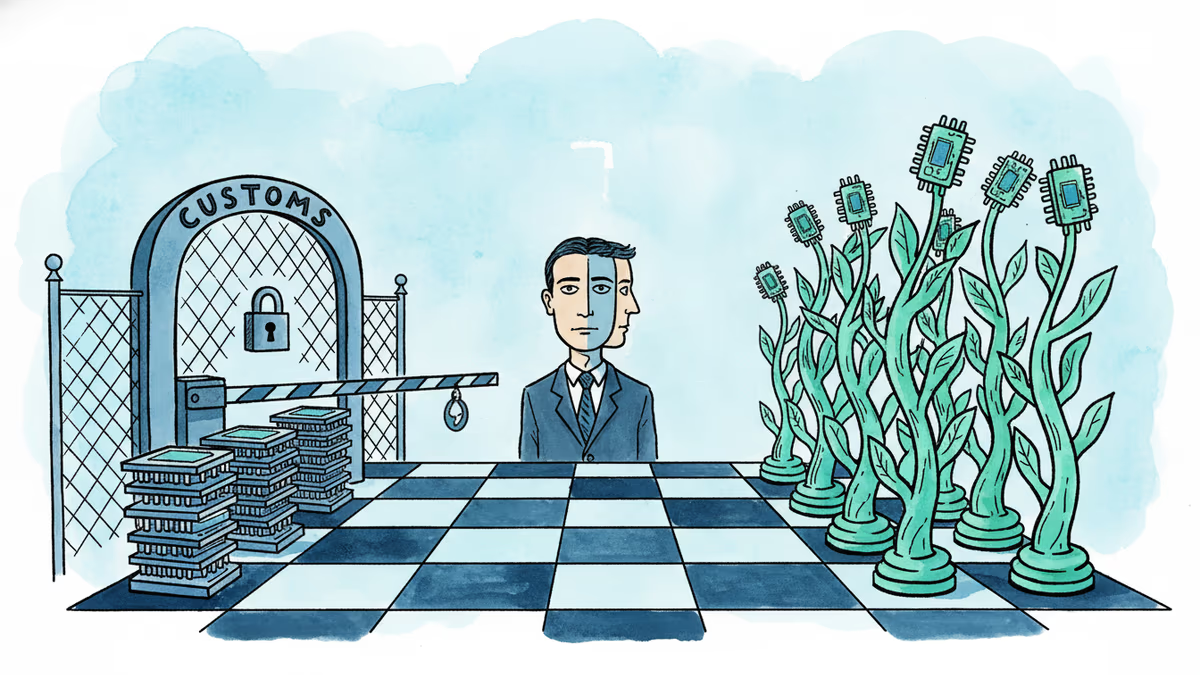
Beijing added an Nvidia gaming chip to its customs ban list the same week Jensen Huang visited China with Trump. Here's what it means for the chip war—and who actually wins.
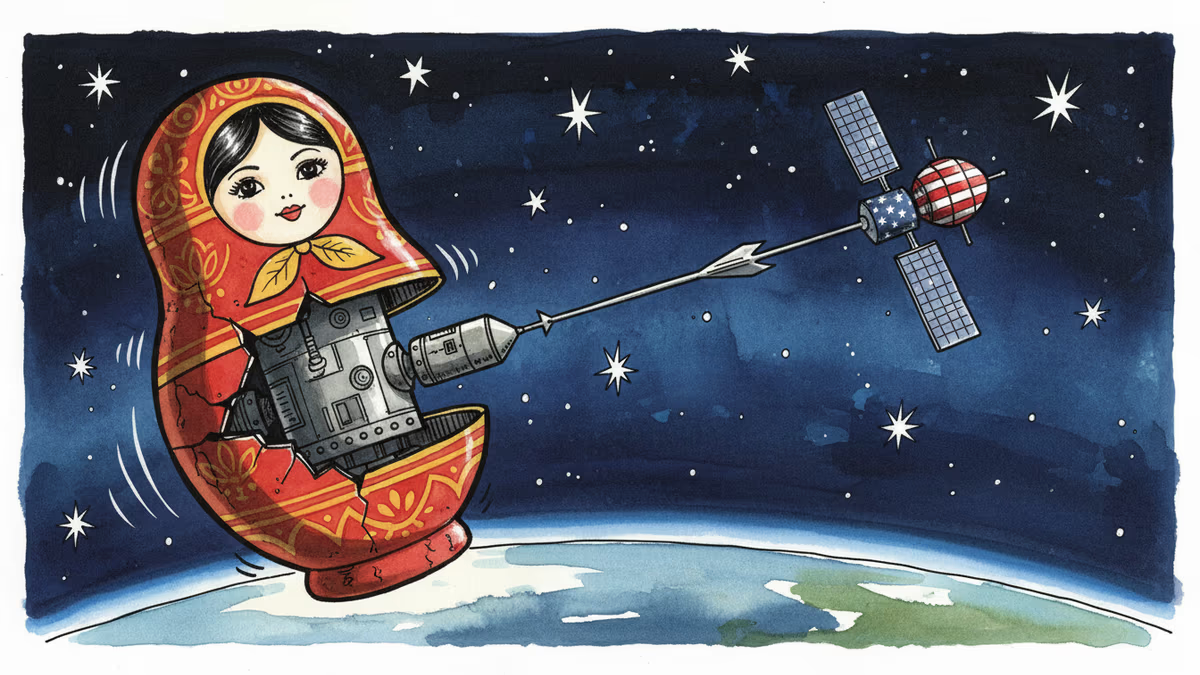
US Space Command confirms Russia has deployed operational anti-satellite weapons tracking American spy satellites in low-Earth orbit. What does this mean for space security?
Scammers posing as Iranian authorities are demanding bitcoin and tether from ships near the Strait of Hormuz—exploiting the fact that Iran already does exactly this.
Huawei's CANN is open source under a license barring software for non-Ascend chips. Inside China's second CUDA, and the two links still outside it: pre-training compute and 5nm capacity.
Beijing added an Nvidia gaming chip to its customs ban list the same week Jensen Huang visited China with Trump. Here's what it means for the chip war—and who actually wins.
US Space Command confirms Russia has deployed operational anti-satellite weapons tracking American spy satellites in low-Earth orbit. What does this mean for space security?
Scammers posing as Iranian authorities are demanding bitcoin and tether from ships near the Strait of Hormuz—exploiting the fact that Iran already does exactly this.
Thoughts
Share your thoughts on this article
Sign in to join the conversation