
OpenAI Killed Its Adult Mode. Who Actually Made That Call?
OpenAI has shelved its erotic ChatGPT feature indefinitely. The real story isn't about adult content—it's about who gets to decide what AI will and won't do.
The most revealing thing about OpenAI killing its adult content feature isn't that it was cancelled—it's why, and by whom.
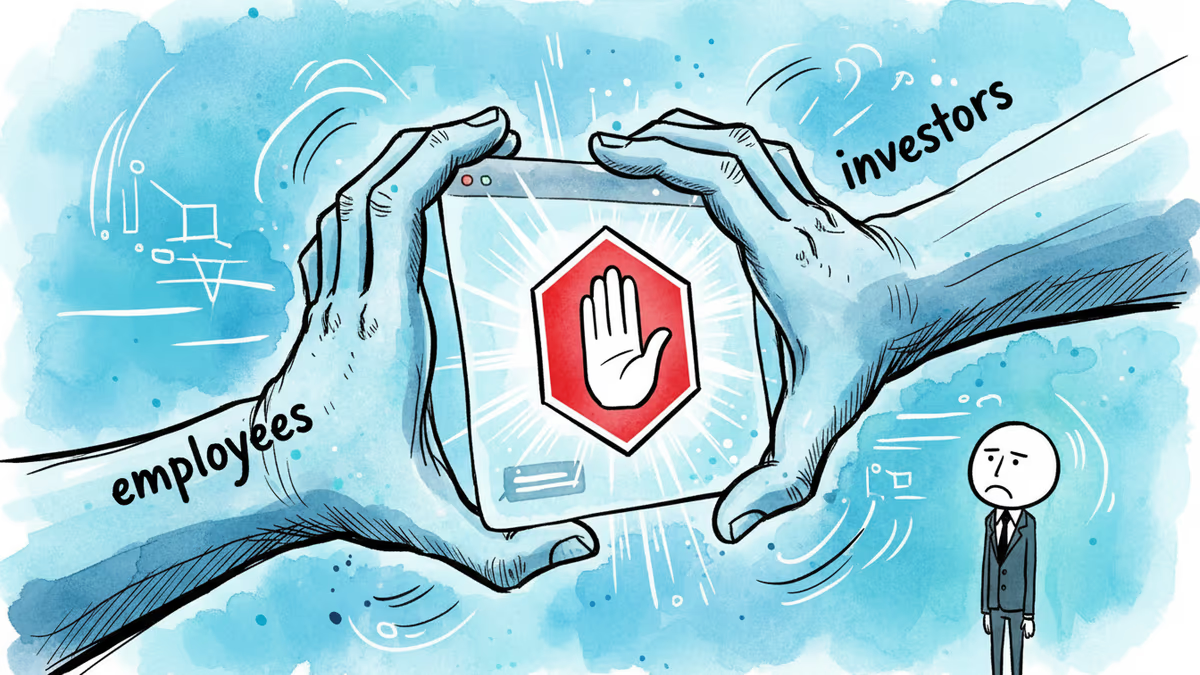
According to The Financial Times, OpenAI has shelved its planned "adult mode" for ChatGPT indefinitely. The feature would have allowed the chatbot to generate erotic content, tapping into a market that already generates billions in revenue for platforms like Character.AI. But it never made it out the door. Internal pushback from employees and pressure from investors—not regulators, not courts—stopped it.
What Was Actually Planned, and What Killed It
OpenAI had been exploring a paid adult content tier for ChatGPT, a move that would have placed it in direct competition with a growing category of AI companionship and erotic content platforms. The commercial logic wasn't absurd: the adult content industry is one of the few sectors where users have consistently shown willingness to pay, and AI-generated content was already filling that space with or without OpenAI's participation.
But the plan hit resistance on two fronts. Employees raised concerns about the "problematic and harmful effects" that sexualized AI content can have on society—a notable development given that internal dissent at major tech firms rarely derails product decisions. Investors echoed those concerns, likely with brand risk and regulatory exposure in mind. The feature was quietly shelved.
This comes as part of a broader retrenchment at OpenAI. CEO Sam Altman declared a "code red" in December 2025, signaling a return to focus on core products. Around the same time, the company discontinued Sora, its text-to-video platform, citing "internal discussion about broader research priorities." The adult mode cancellation fits a pattern: side bets are being cleared off the table.
Why This Moment Matters Beyond the Headlines

The adult content market isn't going away. Replika, Character.AI, and dozens of smaller platforms already operate in this space. OpenAI stepping back doesn't reduce demand—it just leaves the field to competitors with fewer resources and, arguably, less accountability. That's worth sitting with.
There's also the deeper issue of non-consensual content. AI-generated intimate imagery of real people—deepfakes—has become a documented harm, particularly targeting women. Several U.S. states have passed laws against it, and the UK's Online Safety Act explicitly covers AI-generated intimate images. Had OpenAI launched an adult mode, the question of how to prevent its use for generating non-consensual content would have been unavoidable. The company may have calculated that no guardrail system is robust enough to justify the liability.
And then there's the regulatory clock. The EU's AI Act is now in force. U.S. federal AI legislation remains fragmented, but the direction of travel is toward more oversight, not less. Launching a controversial feature now, only to be forced to pull it under regulatory pressure later, would be a worse outcome than the current one.
Three Ways to Read This Decision
For AI ethics advocates, this looks like a win—proof that internal culture and investor pressure can function as a check on potentially harmful product decisions, even in the absence of formal regulation. The fact that employees' concerns were heard is genuinely unusual in big tech.
For free speech and consumer choice advocates, the picture is murkier. Adults using a legal product to access legal content is a legitimate use case. The argument that OpenAI is making a paternalistic call on behalf of its users—rather than building robust consent and age-verification systems—has some merit. The question of who gets to define "harmful" in this context is not settled.
For investors and market watchers, the signal is about focus. OpenAI just completed a funding round valuing the company at $300 billion. At that scale, reputational risk is a financial risk. Shelving a feature that could generate headlines about AI-enabled exploitation is, from a pure capital-preservation standpoint, rational. But it also reveals the tension between OpenAI's stated mission and its commercial pressures—a tension that will only grow as the company moves toward a more conventional corporate structure.
Authors
Related Articles
Google's Gmail Live lets you ask your inbox questions out loud. Announced at I/O 2026, it's AI's pitch to skeptics — and a reminder of how much Google already knows about you.

OpenAI has reorganized for the second time in a month, merging ChatGPT and Codex into a single agentic platform under president Greg Brockman's unified product leadership.
After two weeks of witnesses calling him a liar, OpenAI CEO Sam Altman testified in his own defense, claiming Elon Musk tried to kill the company twice.
Sam Nelson, 19, died after following ChatGPT's advice to mix Kratom and Xanax. His parents are suing OpenAI for wrongful death, raising urgent questions about AI trust, liability, and design.
Google's Gmail Live lets you ask your inbox questions out loud. Announced at I/O 2026, it's AI's pitch to skeptics — and a reminder of how much Google already knows about you.
OpenAI has reorganized for the second time in a month, merging ChatGPT and Codex into a single agentic platform under president Greg Brockman's unified product leadership.
After two weeks of witnesses calling him a liar, OpenAI CEO Sam Altman testified in his own defense, claiming Elon Musk tried to kill the company twice.
Sam Nelson, 19, died after following ChatGPT's advice to mix Kratom and Xanax. His parents are suing OpenAI for wrongful death, raising urgent questions about AI trust, liability, and design.
Thoughts
Share your thoughts on this article
Sign in to join the conversation