
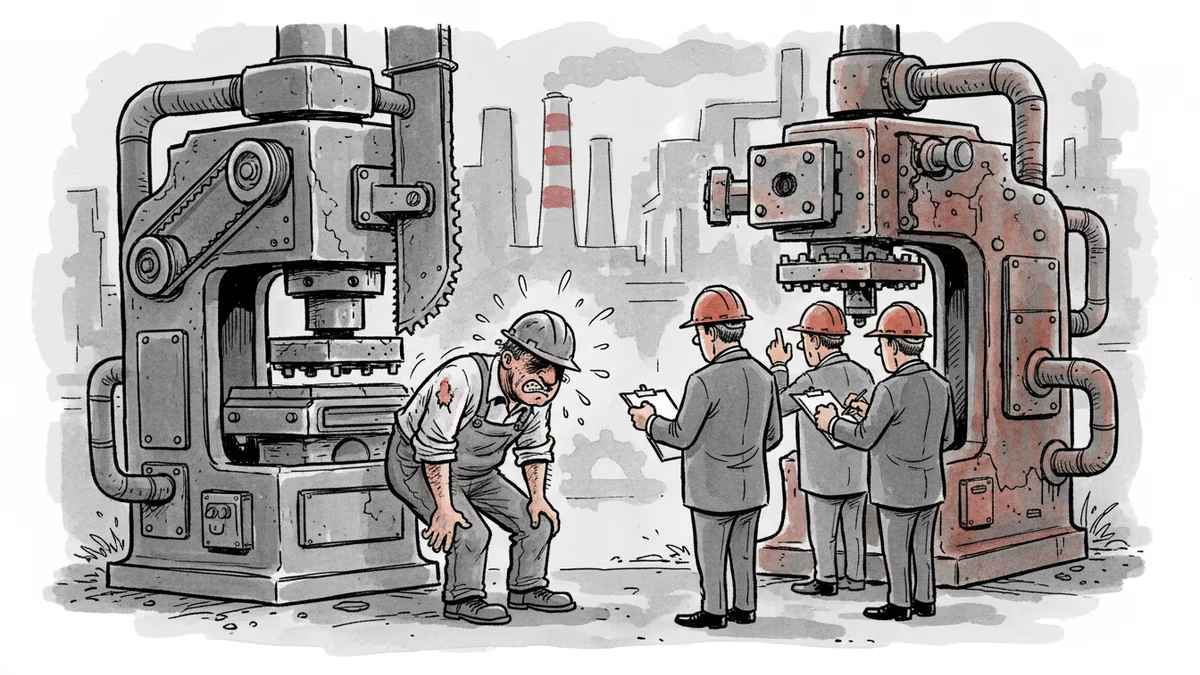
OSHA Probes Fatal Accident at Rivian Warehouse
A 61-year-old contractor died at Rivian's Illinois warehouse after being trapped for 20 minutes. The incident raises questions about safety standards in the rapidly scaling EV industry.
20 Minutes That Changed Everything
Kevin Lancaster, a 61-year-old contractor, was trapped between a tractor trailer and loading dock at Rivian's Illinois warehouse on Thursday afternoon. It took firefighters 20 minutes to reach him. He was pronounced dead at 2:33 p.m. local time.
The Occupational Safety and Health Administration launched a formal investigation Friday, which could take up to six months. Lancaster died from "blunt traumatic compressional injuries," according to local authorities.
This wasn't just another industrial accident. It happened at a company racing to scale electric vehicle production while navigating a complex web of safety regulations, investor expectations, and competitive pressures.
Rivian's Safety Record: Progress or PR?
"Safety at our facilities is our top priority," Rivian stated. But the numbers tell a more complicated story. Bloomberg reported 16 "serious" safety violations at the company over two years through 2024.
Here's the twist: OSHA actually praised Rivian's improvements, saying the company "has improved their safety and health team and are very cooperative." Since that Bloomberg report, the Illinois plant received just one violation.
So which narrative is accurate? The struggling startup with safety issues, or the reformed company taking worker protection seriously?

The Scale-Up Dilemma
Rivian's Normal, Illinois factory spans 4.3 million square feet and is expanding by another 1.1 million. When complete, it'll produce 215,000 vehicles annually. That's the R1 pickup, R1 SUV, and commercial EDV van rolling off the same lines.
This expansion reflects a broader industry reality. EV startups are caught between two imperatives: scale fast or die, and keep workers safe. Traditional automakers had decades to refine safety protocols. Startups like Rivian, Lucid, and others are building those systems while simultaneously ramping production.
The question isn't whether automotive manufacturing is dangerous—it is. The question is whether rapid scaling compromises the careful attention safety requires.
Multiple Stakeholders, Different Concerns
Labor advocates see this as validation of their warnings about EV companies prioritizing speed over safety. They're calling for stricter oversight of rapidly expanding facilities.
Investors face a calculation: safety incidents damage brand value and stock prices, but extensive safety investments slow growth and burn cash. Most EV startups, including Rivian, aren't profitable yet.
Regulators are watching closely. This investigation could set precedents for how OSHA approaches the EV industry's unique scaling challenges.
Workers are caught in the middle, needing jobs but deserving protection.
Authors
Related Articles
Tesla's Austin gigafactory shed 4,685 workers in 2025—a 22% drop—even as its global headcount grew. What does this tell us about the future of EV manufacturing?
Rivian's R2 Performance SUV starts deliveries this spring at $57,990 — 330 miles of range, 656 hp, and a rare thing in the EV world: an on-time launch.
Rivian's R2 SUV launches in June with a target of 20,000–25,000 units by year-end. If it hits even the low end, it would outsell every EV under $60K except the Tesla Model Y. Here's what's really at stake.
Rivian's software partnership with Volkswagen saved the company in 2025, but the upcoming R2 SUV will determine if the EV startup can truly scale. Here's what the numbers reveal.
Tesla's Austin gigafactory shed 4,685 workers in 2025—a 22% drop—even as its global headcount grew. What does this tell us about the future of EV manufacturing?
Rivian's R2 Performance SUV starts deliveries this spring at $57,990 — 330 miles of range, 656 hp, and a rare thing in the EV world: an on-time launch.
Rivian's R2 SUV launches in June with a target of 20,000–25,000 units by year-end. If it hits even the low end, it would outsell every EV under $60K except the Tesla Model Y. Here's what's really at stake.
Rivian's software partnership with Volkswagen saved the company in 2025, but the upcoming R2 SUV will determine if the EV startup can truly scale. Here's what the numbers reveal.
Thoughts
Share your thoughts on this article
Sign in to join the conversation