
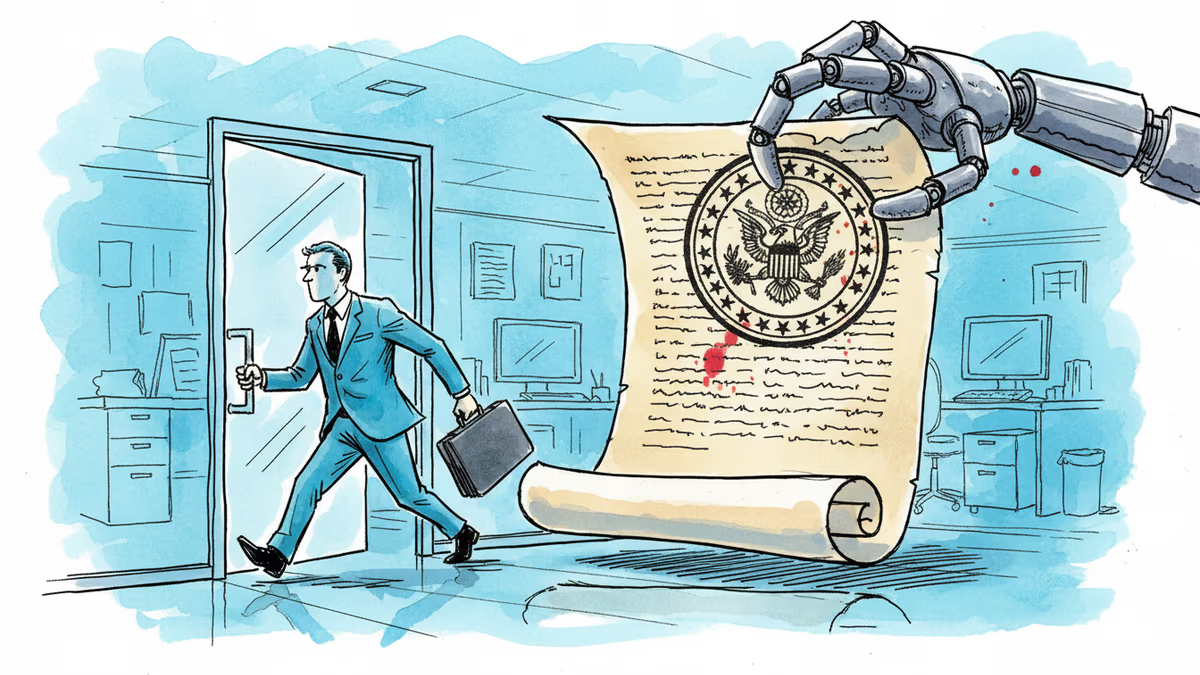
She Quit OpenAI Over a Pentagon Deal. Here's Why That Matters.
Caitlin Kalinowski resigned from OpenAI's robotics team over its rushed Pentagon agreement. Her departure raises hard questions about AI governance, speed, and who holds the line inside big tech.
She'd been on the job for four months.
Caitlin Kalinowski — the hardware executive OpenAI hired to lead its robotics team after years building AR glasses at Meta — announced her resignation this week, citing the company's newly inked agreement with the Pentagon. "The announcement was rushed without the guardrails defined," she wrote on X. "These are too important for deals or announcements to be rushed."
It's a quiet exit that carries a loud message.
What Actually Happened
The chain of events started just over a week ago, when OpenAI announced a deal allowing its AI technology to be used in classified military environments. The company framed it as a "more expansive, multi-layered approach" — one that relies not just on contract language but also technical safeguards to enforce two red lines: no domestic surveillance, no autonomous weapons.
But the deal didn't emerge in a vacuum. The Pentagon had originally been negotiating with Anthropic, which pushed for explicit contractual protections against mass domestic surveillance and fully autonomous weapons. When those negotiations collapsed, the Pentagon designated Anthropic a supply-chain risk — an unusual move that Anthropic has said it will fight in court. Microsoft, Google, and Amazon have since confirmed they'll continue offering Anthropic's Claude to non-defense customers.
OpenAI stepped in quickly after, signing its own agreement. The speed of that move is precisely what Kalinowski objected to.
"My issue is that the announcement was rushed without the guardrails defined," she wrote in a follow-up post. "It's a governance concern first and foremost." She was careful to add that her decision was "about principle, not people" and that she holds "deep respect" for CEO Sam Altman and the team she's leaving behind.

OpenAI confirmed her departure and stood by the deal.
The Market Voted With Its Fingers
Kalinowski isn't the only one uneasy. Since the Pentagon deal was announced, ChatGPT uninstalls surged 295%. As of this weekend, Claude sits at #1 on the U.S. App Store. ChatGPT is #2.
That's a remarkable reversal for a product that has dominated the consumer AI market. Whether it reflects a lasting shift in user sentiment or a momentary protest is an open question — but the signal is hard to ignore.
For investors, the timing is awkward. OpenAI is reportedly in the middle of a fundraising cycle that values the company at over $300 billion. A reputational hit — even a temporary one — lands differently when you're trying to close a round.
Three Ways to Read This
From inside the company, the deal arguably makes strategic sense. If the U.S. military is going to use AI regardless, better to have an ethically-minded company at the table than cede the space entirely to less scrupulous vendors. OpenAI's statement reflects this logic: the agreement creates "a workable path for responsible national security uses."
From Kalinowski's chair, the problem isn't the destination — it's the process. She didn't say the Pentagon partnership was inherently wrong. She said the decision was made before the guardrails were built. That's a governance failure, not just an ethical one. The sequence matters: principles first, contracts second.
From a user's perspective, the discomfort is more visceral than logical. The idea that a conversational AI tool — one people use to draft emails, process grief, brainstorm business ideas — could be connected, even tangentially, to military infrastructure triggers a kind of instinctive recoil. The 295% uninstall spike isn't a policy argument. It's a gut reaction. And gut reactions shape markets.
For policymakers, this episode also highlights a structural gap. Anthropic tried to negotiate hard limits into its contract and got labeled a supply-chain risk for the effort. OpenAI moved fast and got the deal — but lost an executive and #1 on the App Store. There's no regulatory framework that currently governs how AI companies should engage with defense contracts, what disclosures are required, or what internal deliberation processes should look like before signing.
Authors
Related Articles

OpenAI has reorganized for the second time in a month, merging ChatGPT and Codex into a single agentic platform under president Greg Brockman's unified product leadership.
After two weeks of witnesses calling him a liar, OpenAI CEO Sam Altman testified in his own defense, claiming Elon Musk tried to kill the company twice.

Sam Nelson, 19, died after following ChatGPT's advice to mix Kratom and Xanax. His parents are suing OpenAI for wrongful death, raising urgent questions about AI trust, liability, and design.
OpenAI's new Daybreak initiative uses the Codex AI agent to find and patch security vulnerabilities before attackers do—putting it in direct competition with Anthropic's secretive Claude Mythos.
OpenAI has reorganized for the second time in a month, merging ChatGPT and Codex into a single agentic platform under president Greg Brockman's unified product leadership.
After two weeks of witnesses calling him a liar, OpenAI CEO Sam Altman testified in his own defense, claiming Elon Musk tried to kill the company twice.
Sam Nelson, 19, died after following ChatGPT's advice to mix Kratom and Xanax. His parents are suing OpenAI for wrongful death, raising urgent questions about AI trust, liability, and design.
OpenAI's new Daybreak initiative uses the Codex AI agent to find and patch security vulnerabilities before attackers do—putting it in direct competition with Anthropic's secretive Claude Mythos.
Thoughts
Share your thoughts on this article
Sign in to join the conversation