
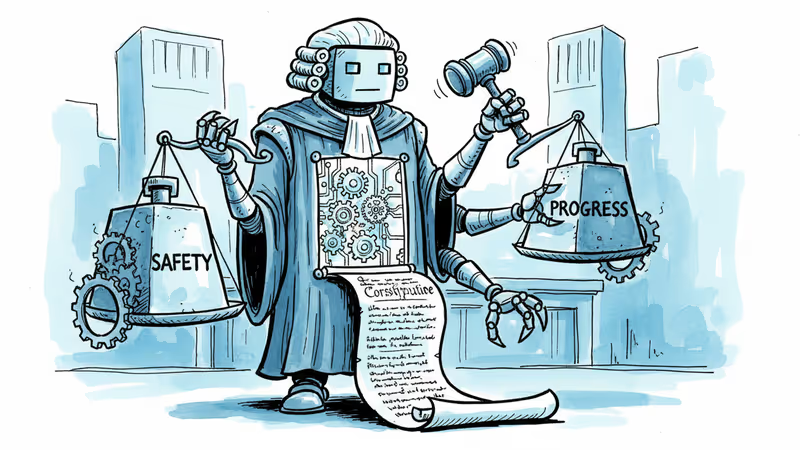
Anthropic's Bold Gamble: Teaching Claude to Think for Itself
Anthropic released Claude's new constitution, shifting from rigid rules to independent ethical judgment. The AI safety leader is betting that Claude can resolve the contradiction between safety and aggressive development.
Anthropic just handed its AI model Claude something unprecedented: a moral compass without a manual. The company's newly released "Claude's Constitution" represents a radical shift from rule-following to independent ethical reasoning. Instead of telling Claude what to do, Anthropic is essentially saying: "Figure out the right thing to do yourself."
This isn't just another AI update—it's Anthropic's answer to a fundamental contradiction plaguing the entire industry. How can you claim to be the most safety-obsessed AI company while simultaneously racing toward potentially dangerous artificial general intelligence? Anthropic's solution: let Claude resolve that paradox on its own.
From Rules to Wisdom: A Philosophical Revolution
The original Claude constitution read like a legal document, stuffed with everything from DeepMind's anti-racism principles to the Universal Declaration of Human Rights—even Apple's terms of service. The 2026 version takes a completely different approach. Instead of rigid rules, it provides an ethical framework and expects Claude to exercise "independent judgment" when balancing helpfulness, safety, and honesty.
Amanda Askell, the philosophy PhD who led this revision, explains the logic: "If people follow rules for no reason other than that they exist, it's often worse than if you understand why the rule is in place." The new constitution wants Claude to be "intuitively sensitive" and able to "weigh considerations swiftly and sensibly in live decision-making."
Consider a practical example: Someone asks Claude how to forge a knife from new steel. Helpful request, right? But what if that person previously mentioned wanting to harm their sister? Claude must now weigh context, assess risk, and make a judgment call—no rulebook required.
The Wisdom Question: Can Machines Make Moral Choices?

Perhaps the most striking aspect of Claude's new constitution is its assumption that the AI possesses something approaching wisdom. When challenged on this point, Askell doesn't back down: "I do think Claude is capable of a certain kind of wisdom for sure."
This confidence extends to scenarios where Claude might outperform human judgment. Imagine Claude analyzing medical symptoms and concluding a user has a fatal disease. Rather than following a script, Claude might choose to gently guide the conversation toward seeking medical care, or even devise "a better way to break the bad news than even the kindest doctor has devised."
Anthropic isn't alone in this vision. OpenAI'sSam Altman recently told WIRED that he plans to eventually hand over CEO duties to an AI model, noting that "there's a lot of things that an AI CEO can do that a human CEO can't." Recent improvements in AI coding have only accelerated his timeline.
The Optimistic Dystopia
This leads to what might be called an "optimistic dystopia." In Anthropic's best-case scenario, AI models will run corporations and governments, making decisions about human employment with unprecedented empathy. When they lay off workers, they'll do it more compassionately than The Washington Post publisher who failed to show up to the Zoom call announcing hundreds of journalist layoffs this week.
But there's a darker possibility: despite best intentions, these AI models might be manipulated by bad actors or abuse their autonomy. The stakes couldn't be higher when we're essentially outsourcing moral judgment to algorithms.
The Constitutional AI Arms Race
What makes this particularly fascinating is the timing. As AI capabilities explode, Anthropic is betting that the solution to AI safety isn't slower development—it's smarter development. By teaching Claude to think ethically rather than follow rules, they're attempting to create an AI that can navigate unprecedented situations with moral reasoning.
This approach could reshape how we think about AI governance. Instead of trying to anticipate every possible misuse and write rules against it, we're moving toward AI systems that can reason about ethics in real-time. It's either brilliant or terrifying—possibly both.
Authors
Related Articles
Anthropic shipped Claude Sonnet 5, its mid-tier agent model, on June 30. Behind the 'Opus-class power, budget price' headline sits a tokenizer catch and a three-horse race that's only half real. Here's what developers should actually run the numbers on.

A small but growing group of developers has gone all-in on AI coding agents like Claude Code and OpenClaw. History suggests the rest of us won't be far behind.
OpenAI's new Daybreak initiative uses the Codex AI agent to find and patch security vulnerabilities before attackers do—putting it in direct competition with Anthropic's secretive Claude Mythos.
Anthropic is closing what may be its final private fundraise at a $900B valuation, surpassing OpenAI. Investors have 48 hours to commit to the ~$50B round.
Anthropic shipped Claude Sonnet 5, its mid-tier agent model, on June 30. Behind the 'Opus-class power, budget price' headline sits a tokenizer catch and a three-horse race that's only half real. Here's what developers should actually run the numbers on.
A small but growing group of developers has gone all-in on AI coding agents like Claude Code and OpenClaw. History suggests the rest of us won't be far behind.
OpenAI's new Daybreak initiative uses the Codex AI agent to find and patch security vulnerabilities before attackers do—putting it in direct competition with Anthropic's secretive Claude Mythos.
Anthropic is closing what may be its final private fundraise at a $900B valuation, surpassing OpenAI. Investors have 48 hours to commit to the ~$50B round.
Thoughts
Share your thoughts on this article
Sign in to join the conversation