

Anthropic's Claude Opus 4.6 Promises Less Back-and-Forth
Anthropic launches Claude Opus 4.6 with improved first-try accuracy for complex tasks, targeting enterprise workflows and agentic coding applications.
What if your AI assistant could nail complex tasks on the first try instead of requiring multiple rounds of corrections? Anthropic is betting that's exactly what enterprise users want with the launch of Claude Opus 4.6, positioning it as a "direct upgrade" that promises to dramatically reduce the iterative back-and-forth that has plagued AI-powered workflows.
The Promise of First-Try Accuracy
Anthropic claims Claude Opus 4.6 represents a significant leap in production-ready quality, particularly for complex, multi-step tasks. The company emphasizes that documents, spreadsheets, and presentations will require "less back-and-forth on iterations" – a pain point that has limited AI adoption in professional settings.
The model launches today with the same pricing structure as its predecessor, maintaining accessibility while promising enhanced capabilities in four key areas: agentic coding, tool use, search functionality, and financial analysis. This targeted improvement suggests Anthropic has identified specific enterprise use cases where accuracy matters more than speed or cost.
Reading the Enterprise Tea Leaves
The timing of this release reveals Anthropic's strategic positioning in an increasingly crowded AI market. While competitors like OpenAI and Google focus on consumer applications and general capabilities, Anthropic is doubling down on enterprise reliability – the difference between an AI that can write a decent email and one that can handle mission-critical financial analysis.

The emphasis on "production-ready quality" signals a maturation of AI expectations. Early adopters may have tolerated multiple iterations and manual corrections, but as AI tools move from experimental to essential, accuracy becomes paramount. A financial model that's 80% correct isn't just unhelpful – it's dangerous.
The Iteration Problem
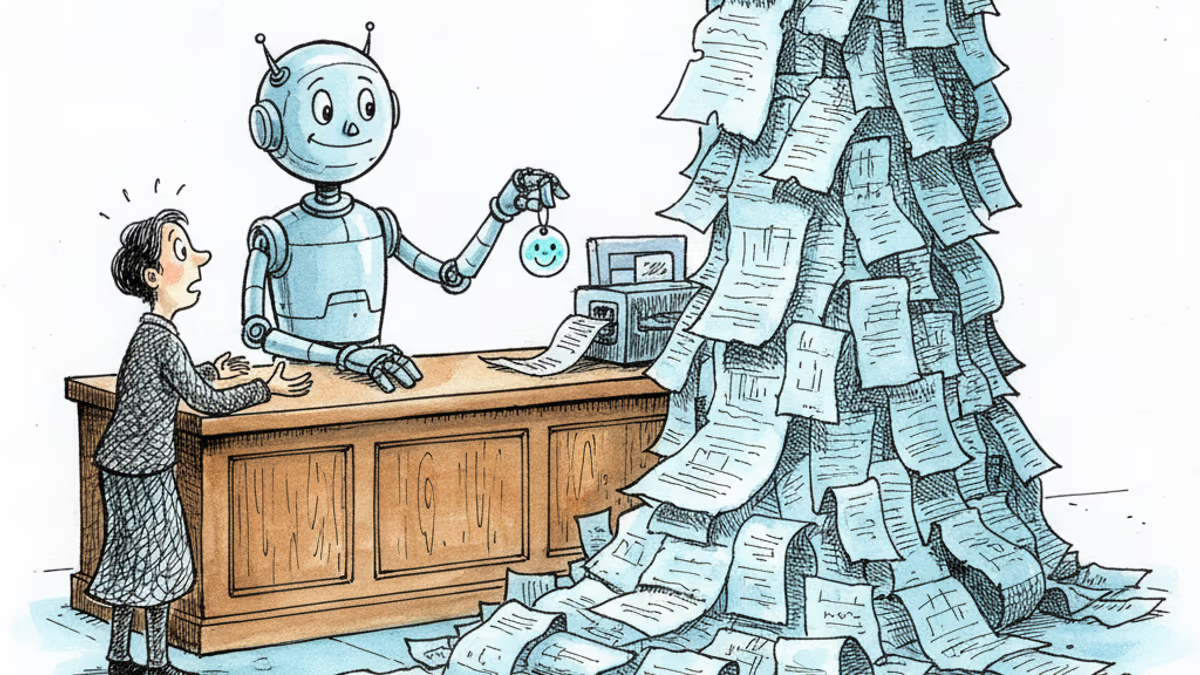
The promise of reduced back-and-forth touches on a fundamental challenge in AI deployment. Current workflows often involve multiple rounds of refinement: an initial AI output, human review, corrections, regeneration, and repeat. This process, while eventually producing quality results, undermines AI's core value proposition of efficiency.
For enterprise users, iteration costs compound quickly. A document that requires five rounds of corrections doesn't just take longer to complete – it requires sustained human attention, breaking the promise of AI as a force multiplier. If Claude Opus 4.6 can consistently deliver acceptable results on the first attempt, it could fundamentally change how organizations integrate AI into their workflows.
Market Positioning and Competitive Response
Anthropic's focus on enterprise applications reflects broader market dynamics. While consumer AI applications grab headlines, enterprise contracts provide stable, high-value revenue streams. The company's emphasis on financial analysis and agentic coding suggests they're targeting specific professional niches where accuracy commands premium pricing.
This positioning also reveals potential vulnerabilities for competitors. OpenAI's ChatGPT dominates consumer mindshare, but enterprise adoption requires different priorities: reliability over creativity, consistency over surprise, and integration over innovation. By focusing on first-try accuracy, Anthropic is essentially arguing that their competitors still require too much human oversight for serious business applications.
Authors
Related Articles
Anthropic shipped Claude Sonnet 5, its mid-tier agent model, on June 30. Behind the 'Opus-class power, budget price' headline sits a tokenizer catch and a three-horse race that's only half real. Here's what developers should actually run the numbers on.

A small but growing group of developers has gone all-in on AI coding agents like Claude Code and OpenClaw. History suggests the rest of us won't be far behind.

OpenAI's new Daybreak initiative uses the Codex AI agent to find and patch security vulnerabilities before attackers do—putting it in direct competition with Anthropic's secretive Claude Mythos.

Anthropic is closing what may be its final private fundraise at a $900B valuation, surpassing OpenAI. Investors have 48 hours to commit to the ~$50B round.
Anthropic shipped Claude Sonnet 5, its mid-tier agent model, on June 30. Behind the 'Opus-class power, budget price' headline sits a tokenizer catch and a three-horse race that's only half real. Here's what developers should actually run the numbers on.
A small but growing group of developers has gone all-in on AI coding agents like Claude Code and OpenClaw. History suggests the rest of us won't be far behind.
OpenAI's new Daybreak initiative uses the Codex AI agent to find and patch security vulnerabilities before attackers do—putting it in direct competition with Anthropic's secretive Claude Mythos.
Anthropic is closing what may be its final private fundraise at a $900B valuation, surpassing OpenAI. Investors have 48 hours to commit to the ~$50B round.
Thoughts
Share your thoughts on this article
Sign in to join the conversation