
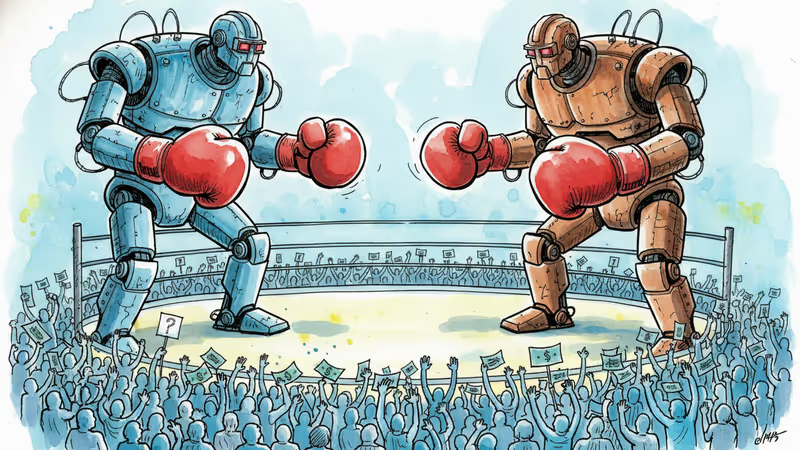
When AI Giants Fight Over Ads, Who Really Wins?
OpenAI and Anthropic clash over AI chatbot advertising as Super Bowl commercials expose deeper tensions about the future of artificial intelligence monetization.
The AI industry's most public feud yet erupted on Wednesday when OpenAI CEO Sam Altman fired back at rival Anthropic's Super Bowl commercials that mock the idea of ads in AI chatbots. What started as a marketing campaign has become a philosophical battle over the soul of artificial intelligence.
Anthropic's four commercials, titled "A Time and a Place," will air during Sunday's Super Bowl with a clear message: AI should remain pure, untainted by commercial interests. Each ad opens with words like "Betrayal," "Violation," "Deception," and "Treachery" before showing scenarios where people seek personal advice from AI, only to get blindsided by product pitches.
The timing couldn't be more pointed. Just weeks ago, OpenAI began testing advertisements in a lower-cost tier of ChatGPT, marking a significant shift in how the company monetizes its flagship product.
The Gloves Come Off
Altman's response was swift and uncharacteristically harsh. He called Anthropic's campaign "clearly dishonest," accused the company of being "authoritarian," and claimed it "serves an expensive product to rich people." OpenAI's Chief Marketing Officer Kate Rouch added her own jab: "Real betrayal isn't ads. It's control."
The exchange reveals more than just corporate rivalry. It exposes fundamental disagreements about how AI companies should balance user experience, accessibility, and profitability. OpenAI argues that ads enable lower-cost access to AI tools, democratizing technology that might otherwise remain expensive. Anthropic positions itself as the premium alternative that refuses to compromise user trust for revenue.
But there's an irony here that neither company wants to acknowledge: Anthropic can afford to take the high road partly because it's backed by $4 billion from Amazon and significant funding from Google. Meanwhile, OpenAI faces pressure to justify its $157 billion valuation to investors who expect returns.

The Real Stakes
This isn't just about ads in chatbots. It's about who controls the narrative as AI becomes central to how we work, learn, and make decisions. The advertising model that OpenAI is testing could fundamentally change how AI systems influence human behavior.
Consider the implications: if your AI assistant recommends a restaurant, suggests a product, or advises on a financial decision, how will you know whether that recommendation serves your interests or an advertiser's? The line between helpful AI and sophisticated manipulation could become increasingly blurred.
Anthropic's commercials tap into genuine user anxieties about this future. But their solution—premium, ad-free AI for those who can afford it—creates its own problems. It risks creating a two-tiered system where quality, unbiased AI assistance becomes a luxury good.
Beyond the Super Bowl
The broader AI industry is watching this fight closely. Google has already integrated ads into some AI-powered search features. Microsoft is experimenting with commercial partnerships in Copilot. The question isn't whether AI will become commercialized, but how.
European regulators are already scrutinizing AI companies' data practices and market power. This public spat between OpenAI and Anthropic provides ammunition for those arguing that the AI industry needs stronger oversight before these tools become even more embedded in daily life.
The fight also highlights a uncomfortable truth: despite all the talk about AI safety and alignment, the real alignment challenge might be aligning AI systems with user interests rather than business interests.
Authors
Related Articles
Anthropic shipped Claude Sonnet 5, its mid-tier agent model, on June 30. Behind the 'Opus-class power, budget price' headline sits a tokenizer catch and a three-horse race that's only half real. Here's what developers should actually run the numbers on.
A small but growing group of developers has gone all-in on AI coding agents like Claude Code and OpenClaw. History suggests the rest of us won't be far behind.

OpenAI has reorganized for the second time in a month, merging ChatGPT and Codex into a single agentic platform under president Greg Brockman's unified product leadership.
After two weeks of witnesses calling him a liar, OpenAI CEO Sam Altman testified in his own defense, claiming Elon Musk tried to kill the company twice.
Anthropic shipped Claude Sonnet 5, its mid-tier agent model, on June 30. Behind the 'Opus-class power, budget price' headline sits a tokenizer catch and a three-horse race that's only half real. Here's what developers should actually run the numbers on.
A small but growing group of developers has gone all-in on AI coding agents like Claude Code and OpenClaw. History suggests the rest of us won't be far behind.
OpenAI has reorganized for the second time in a month, merging ChatGPT and Codex into a single agentic platform under president Greg Brockman's unified product leadership.
After two weeks of witnesses calling him a liar, OpenAI CEO Sam Altman testified in his own defense, claiming Elon Musk tried to kill the company twice.
Thoughts
Share your thoughts on this article
Sign in to join the conversation