
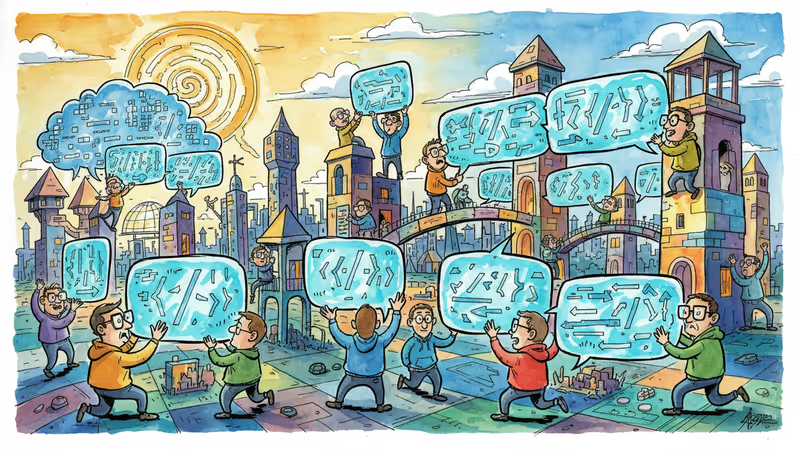
Why Claude Code Became Developers' New Playground
Anthropic's Claude Code exploded in popularity over the holidays as developers built everything from MRI viewers to Goodreads alternatives. Is this the new paradigm of coding?
Boris Cherny gets recognized in public relatively often these days. At bars, airports, and pretty much any public space, people want selfies with the creator and head of Claude Code.
For the past few months, Anthropic'sClaude and its coding platform have been having a moment—on social media, in engineering circles, and in C-suite offices. Claude Code reached newfound popularity over the holidays, when people spent days or weeks building everything from MRI result viewers to Goodreads alternatives to AI-generated T-shirt design contests with complex judicial systems.
When Coding Becomes Play
The rise of Claude Code represents more than just another tool's success. It signals a fundamental shift in what coding means. Traditionally, development required mastering complex syntax and architectural patterns. But Claude Code lets you build programs through natural conversation.
Look at the holiday projects that flooded social media. There's a fascinating pattern: people aren't asking "how do I build this?" anymore. They're asking "what should I build?" The technical implementation barrier has lowered, making creativity and ideation the primary constraints.
January X posts proclaimed "we are winning." But are we? What does this shift mean for developers, and more broadly, for the tech industry itself?
The Developer Identity Crisis
Boris Cherny becoming a street-recognizable figure is symbolic. When the creator of a coding tool draws public attention, it shows how mainstream this field has become. But it also triggers complex emotions among existing developers.
Years of accumulated expertise potentially becoming obsolete overnight. Simultaneously, the promise of focusing on more creative and meaningful work. The developer community is splitting between these two realities.

Major tech companies are watching closely. Microsoft, Google, and Amazon are already integrating AI coding tools into their workflows, while startups are betting their entire existence on this paradigm shift. The question isn't whether AI will change coding—it's how quickly and completely.
Democratization or Quality Degradation?
The possibilities Claude Code demonstrates are undeniably compelling. Non-technical people can build sophisticated applications in days. Anyone with an idea can become a creator.
But concerns are mounting. Will programs built without understanding fundamental principles be stable and scalable? How do we ensure security? Who handles maintenance when the original "developer" doesn't understand the underlying code?
There's a deeper question too: if coding is merely about producing output, AI can handle that. But what about problem decomposition, logical thinking, and system design? These cognitive skills might remain distinctly human.
The Unintended Consequences
The Claude Code phenomenon reveals something unexpected about human nature. Given powerful tools, people don't just solve existing problems more efficiently—they create entirely new categories of projects. The MRI viewers and Goodreads clones weren't responses to market demands. They were expressions of curiosity unleashed.
This creative explosion has economic implications. If building software becomes as accessible as writing documents, what happens to software pricing? To professional developers' salaries? To the entire consulting industry built around technical complexity?
We're potentially witnessing the early stages of software becoming a commodity. Not the valuable, differentiated products companies spend millions developing, but basic utilities anyone can create.
What happens when everyone can code, but few understand why they should?
Authors
Related Articles
Anthropic shipped Claude Sonnet 5, its mid-tier agent model, on June 30. Behind the 'Opus-class power, budget price' headline sits a tokenizer catch and a three-horse race that's only half real. Here's what developers should actually run the numbers on.
A small but growing group of developers has gone all-in on AI coding agents like Claude Code and OpenClaw. History suggests the rest of us won't be far behind.
OpenAI's new Daybreak initiative uses the Codex AI agent to find and patch security vulnerabilities before attackers do—putting it in direct competition with Anthropic's secretive Claude Mythos.
Anthropic is closing what may be its final private fundraise at a $900B valuation, surpassing OpenAI. Investors have 48 hours to commit to the ~$50B round.
Anthropic shipped Claude Sonnet 5, its mid-tier agent model, on June 30. Behind the 'Opus-class power, budget price' headline sits a tokenizer catch and a three-horse race that's only half real. Here's what developers should actually run the numbers on.
A small but growing group of developers has gone all-in on AI coding agents like Claude Code and OpenClaw. History suggests the rest of us won't be far behind.
OpenAI's new Daybreak initiative uses the Codex AI agent to find and patch security vulnerabilities before attackers do—putting it in direct competition with Anthropic's secretive Claude Mythos.
Anthropic is closing what may be its final private fundraise at a $900B valuation, surpassing OpenAI. Investors have 48 hours to commit to the ~$50B round.
Thoughts
Share your thoughts on this article
Sign in to join the conversation