
When AI Agents Work in Teams: Anthropic's Opus 4.6 Changes the Game
Anthropic launches Opus 4.6 with agent teams that can split complex tasks and work in parallel. This isn't just an upgrade—it's a fundamental shift in how we think about AI collaboration.
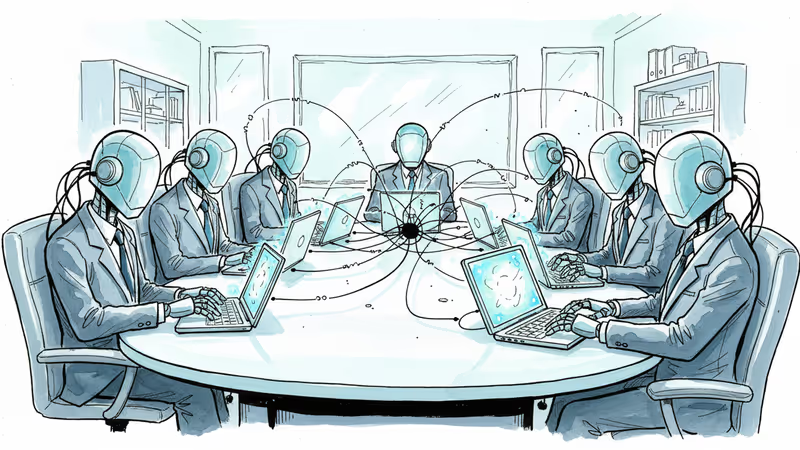
What if your AI assistant could clone itself and work as a team? Anthropic's latest release, Opus 4.6, makes this science fiction scenario a reality with "agent teams"—multiple AI agents that can divide complex tasks and coordinate directly with each other.
From Solo Act to Orchestra
The breakthrough isn't just technical; it's conceptual. Instead of one AI grinding through tasks sequentially, Opus 4.6 can deploy multiple agents simultaneously, each handling different aspects of the same project.
"Think of it like having a talented team of humans working for you," explains Scott White, Head of Product at Anthropic. "Each agent owns its piece and coordinates directly with the others, allowing them to work in parallel and deliver results faster."
Currently available in research preview for API users and subscribers, this feature represents a fundamental shift from the traditional one-user-one-AI model. Imagine one agent analyzing data while another creates visualizations and a third drafts the final report—all happening simultaneously.
Enhanced Memory and Seamless Integration
Opus 4.6 also extends its context window to 1 million tokens, matching the capacity of Anthropic'sSonnet models. This expanded memory allows the system to handle larger codebases and process extensive documents without losing track of earlier information.

Perhaps more immediately practical is the enhanced PowerPoint integration. Previously, users had to ask Claude to create a presentation, then transfer the file to edit it. Now, Claude appears as an accessible side panel within PowerPoint, allowing real-time collaboration during presentation creation.
Beyond the Developer's Toolkit
White reveals an interesting trend: "We noticed a lot of people who are not professional software developers using Claude Code simply because it was a really amazing engine to do tasks." The user base now includes product managers, financial analysts, and professionals across various industries—not just software engineers.
This evolution reflects Anthropic's broader ambition. Opus has transformed from a specialized coding tool into what White calls a program "really useful for a broader set" of knowledge workers. The agent teams feature accelerates this transition by making AI collaboration more intuitive and powerful.
The Coordination Challenge
But here's where it gets interesting: if AI agents can now work as teams, what does this mean for human collaboration? The technology raises questions about management, accountability, and the nature of teamwork itself.
When multiple AI agents coordinate on a project, who's responsible for the final output? How do we ensure quality control across parallel processes? And perhaps most importantly, what happens when AI teams become more efficient than human teams?
Authors
Related Articles
Anthropic shipped Claude Sonnet 5, its mid-tier agent model, on June 30. Behind the 'Opus-class power, budget price' headline sits a tokenizer catch and a three-horse race that's only half real. Here's what developers should actually run the numbers on.

A small but growing group of developers has gone all-in on AI coding agents like Claude Code and OpenClaw. History suggests the rest of us won't be far behind.

OpenAI's new Daybreak initiative uses the Codex AI agent to find and patch security vulnerabilities before attackers do—putting it in direct competition with Anthropic's secretive Claude Mythos.

Anthropic is closing what may be its final private fundraise at a $900B valuation, surpassing OpenAI. Investors have 48 hours to commit to the ~$50B round.
Anthropic shipped Claude Sonnet 5, its mid-tier agent model, on June 30. Behind the 'Opus-class power, budget price' headline sits a tokenizer catch and a three-horse race that's only half real. Here's what developers should actually run the numbers on.
A small but growing group of developers has gone all-in on AI coding agents like Claude Code and OpenClaw. History suggests the rest of us won't be far behind.
OpenAI's new Daybreak initiative uses the Codex AI agent to find and patch security vulnerabilities before attackers do—putting it in direct competition with Anthropic's secretive Claude Mythos.
Anthropic is closing what may be its final private fundraise at a $900B valuation, surpassing OpenAI. Investors have 48 hours to commit to the ~$50B round.
Thoughts
Share your thoughts on this article
Sign in to join the conversation