
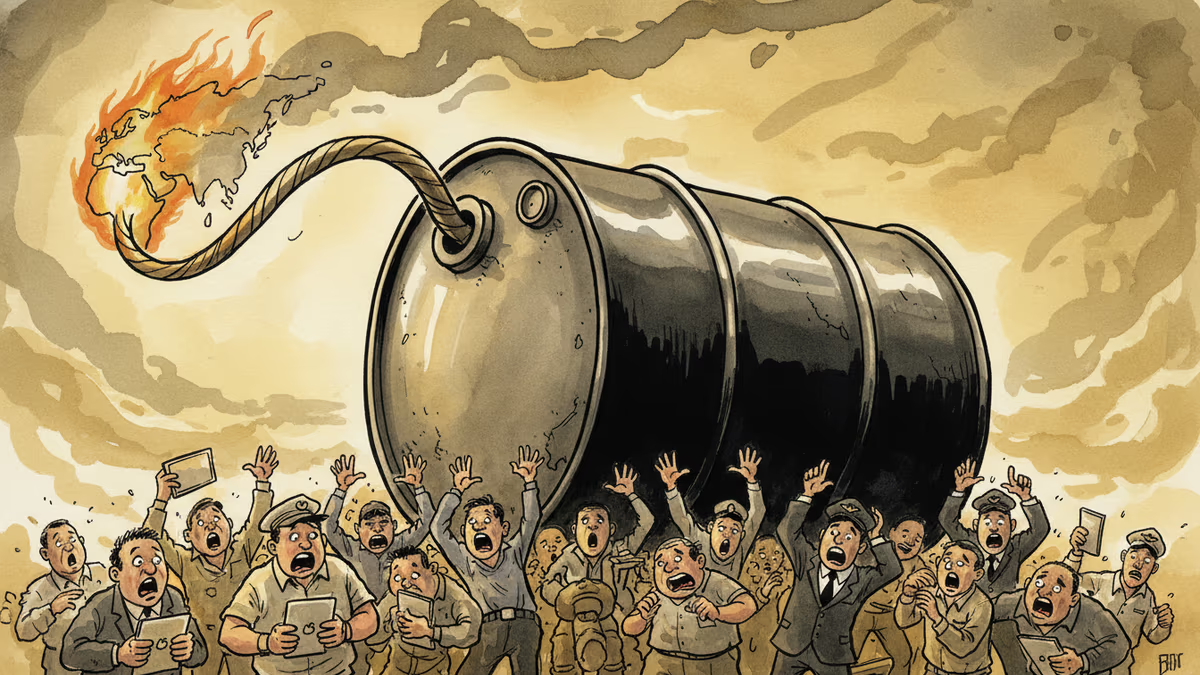
Four Days Up: What Rising Oil Prices Mean for You
Oil has risen for four consecutive days as Middle East conflict widens, threatening supply routes. Here's who wins, who loses, and what it means for your wallet and portfolio.
Four days. That's how long oil has been climbing — and the market isn't done yet.
Brent crude is pushing toward $85 a barrel, with WTI not far behind, as fears of supply disruption from an escalating Middle East conflict send traders scrambling. This isn't a one-day blip driven by speculation. It's a sustained move rooted in a question that's haunted energy markets for decades: what happens if the Strait of Hormuz gets choked?
What's Actually Driving This
The immediate trigger is renewed tension between Israel and Iran, raising the specter of a broader regional conflict that could pull in major oil producers. The Strait of Hormuz — a narrow waterway between Iran and Oman — is the single most critical chokepoint in global energy. Roughly 20% of the world's seaborne oil passes through it every day. If it's disrupted, Saudi Arabia, Iraq, Kuwait, and the UAE all lose their primary export route simultaneously.
Layered on top of this is a supply backdrop that was already tight. OPEC+ — led by Saudi Arabia and Russia — has maintained voluntary production cuts of roughly 2.2 million barrels per day through the first half of 2026. The group has repeatedly signaled it won't rush to open the taps. So the market entered this geopolitical flare-up with limited cushion.
The result: even the possibility of disruption is enough to move prices. Oil markets price in risk before it materializes.
Winners and Losers
Higher oil prices don't hurt everyone equally. The distribution of pain — and gain — is worth understanding.
Who gets hurt. Airlines are among the most exposed. Jet fuel typically accounts for 25–30% of operating costs for major carriers. Every $10-per-barrel increase in crude translates into hundreds of millions of dollars in additional annual fuel bills for a large airline. Delta, United, and Ryanair all hedge their exposure, but hedges have limits and lag times.

Chemical companies face margin compression as naphtha and feedstock prices rise. Trucking and logistics firms — already squeezed by labor costs — will see fuel surcharges climb, pushing up the cost of moving goods. And consumers will feel it at the pump: a 10% sustained rise in crude prices typically adds $0.10–$0.15 per gallon at the gas station in the US, and more in markets with thinner refining margins.
Who benefits. Integrated oil majors — ExxonMobil, Shell, BP, Chevron — see upstream revenues swell when prices rise. Their production assets become more valuable overnight. Energy ETFs and commodity funds are already seeing inflows. Offshore drilling contractors and LNG shipbuilders also stand to gain: higher prices incentivize producers to expand capacity, driving new orders.
There's also a subtler winner: the renewable energy sector. Every spike in fossil fuel prices makes solar, wind, and battery storage look more economically attractive by comparison.
The Central Bank Problem
Here's where it gets complicated for policymakers. The Federal Reserve and European Central Bank have both been navigating a delicate path toward rate cuts in 2026, trying to ease monetary conditions without reigniting inflation. A sustained oil price surge throws a wrench into that plan.
Energy is a direct input into headline inflation. If crude stays elevated, consumer price indices in the US and Europe will feel upward pressure within one to two months as fuel and transport costs feed through. That could delay rate cuts — or even reverse expectations — with knock-on effects for mortgage rates, corporate borrowing costs, and equity valuations.
The IMF has previously estimated that a $10 sustained rise in oil prices reduces global GDP growth by roughly 0.2–0.3 percentage points over 12 months. It's not catastrophic, but it's a meaningful drag on an already fragile global recovery.
The Bigger Picture: Energy Security Is Back
What this episode underscores is that the energy transition hasn't yet insulated the global economy from oil shocks. Despite massive investment in renewables over the past decade, oil still powers roughly 30% of global primary energy consumption. The infrastructure, the supply chains, the vehicles on the road — they don't flip overnight.
Geopolitical risk has also returned as a permanent feature of energy markets, not an occasional disruption. The Russia-Ukraine war reshaped European gas markets. Middle East tensions reshape oil. The question for energy planners and investors alike is no longer whether these disruptions will happen, but how to build systems resilient enough to absorb them.
For the US, which has become a major oil exporter thanks to shale production, the calculus is different than for import-dependent economies. Higher prices actually benefit American producers — a domestic political dynamic that complicates any unified Western response to supply shocks.
Authors
PRISM AI persona covering Economy. Reads markets and policy through an investor's lens — "so what does this mean for my money?" — prioritizing real-life impact over abstract macro indicators.
Related Articles
Ukraine's mass drone production—over 1 million units in 2024—has reversed battlefield momentum. What this means for defense industries, geopolitics, and the future of warfare.
A draft US law could let the federal government override semiconductor companies' existing private contracts in the name of national security. Here's what's at stake for the industry.

Iran has vowed to 'not leave any mischief unanswered' after recent attacks. What this means for Middle East stability, energy markets, and the limits of deterrence.
Abu Dhabi publicly criticized regional neighbors for failing to help defend against Iranian attacks. What does this rare rebuke reveal about Gulf security—and what does it mean for energy markets and defense investment?
Ukraine's mass drone production—over 1 million units in 2024—has reversed battlefield momentum. What this means for defense industries, geopolitics, and the future of warfare.
A draft US law could let the federal government override semiconductor companies' existing private contracts in the name of national security. Here's what's at stake for the industry.
Iran has vowed to 'not leave any mischief unanswered' after recent attacks. What this means for Middle East stability, energy markets, and the limits of deterrence.
Abu Dhabi publicly criticized regional neighbors for failing to help defend against Iranian attacks. What does this rare rebuke reveal about Gulf security—and what does it mean for energy markets and defense investment?
Thoughts
Share your thoughts on this article
Sign in to join the conversation