
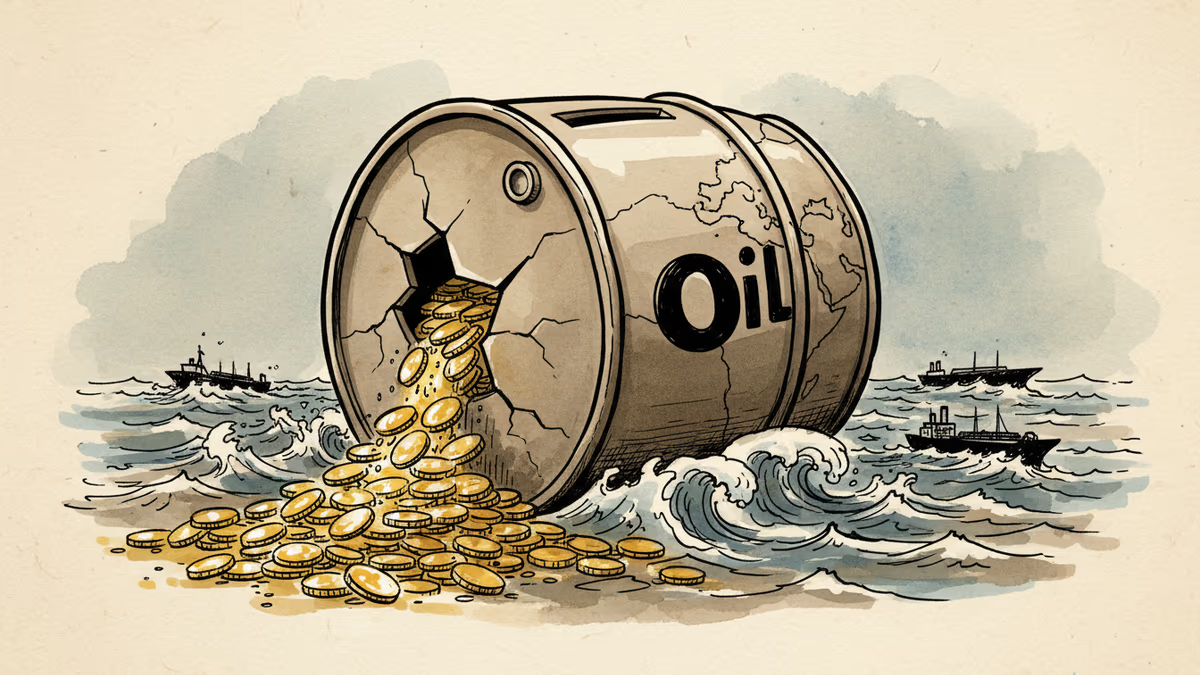
The $63 Billion Question: Who Wins When the Gulf Burns?
US oil companies could pocket up to $63 billion in windfall profits from Gulf supply disruptions. Here's who wins, who pays, and what it means for energy markets and your wallet.
Someone is going to make a fortune from the next Gulf crisis. Analysts say it could be $63 billion. And it won't be the countries sitting on top of the oil.
As geopolitical tensions in the Gulf region continue to simmer, energy analysts are projecting that major US oil producers stand to collect up to $63 billion in additional revenues if supply disruptions materialize. The math is straightforward, even if the politics aren't: when Gulf oil stops flowing, American shale fills the gap—at a much higher price.
How the Windfall Works
Roughly 20% of global oil trade passes through the Strait of Hormuz each day. That's about 21 million barrels, carrying crude from Iran, Iraq, Kuwait, and the UAE to markets across Asia and Europe. Any meaningful disruption to that flow—military conflict, blockade, or escalating Houthi-style attacks—sends benchmark prices sharply higher.
For US producers, that's not a crisis. It's a margin expansion.
American shale output now exceeds 13 million barrels per day, making the US the world's largest oil producer. Every $10 rise in the price of a barrel translates directly into billions in additional revenue for companies like ExxonMobil, Chevron, and ConocoPhillips. The $63 billion figure reflects analyst modeling of a sustained $20–$30 per barrel price spike under a moderate disruption scenario.
This isn't hypothetical speculation. It already happened. When Russia invaded Ukraine in 2022, ExxonMobil alone posted $56 billion in net profit—its highest in decades. Chevron and ConocoPhillips followed with similarly outsized returns. Shareholders celebrated. Consumers did not.
The Asymmetry of Energy Crises
What makes this story more than a simple profit calculation is the asymmetry it reveals. The same event that enriches US producers inflicts real pain on oil-importing economies.

Japan imports nearly 90% of its energy. South Korea sources roughly 70% of its crude from the Middle East. India, despite efforts to diversify, remains heavily exposed to Gulf supply chains. For these countries, a $20 spike in oil prices isn't a windfall—it's a tax. A regressive one, hitting lower-income households hardest through higher fuel, food, and transportation costs.
Europe, still rebuilding its energy infrastructure after cutting Russian supply, has limited buffer. A Gulf disruption layered onto existing energy cost pressures could reignite inflation just as central banks in the eurozone have begun cautious easing cycles.
For the average American consumer, the picture is mixed. Higher gas prices hurt at the pump. But pension funds and 401(k)s with energy sector exposure would benefit. The gains are concentrated; the pain is diffuse.
Why This Moment Matters
The timing of this analysis isn't accidental. The Trump administration has moved to tighten sanctions on Iran since returning to office, raising the probability of supply constraints from one of the Gulf's major producers. The Israel-Gaza conflict remains unresolved, with spillover risks into the broader region. Houthi attacks on Red Sea shipping—ongoing since late 2024—have already pushed maritime freight costs significantly higher, previewing what a more severe disruption could look like.
At the same time, the global economy is navigating a slowdown driven by US tariff escalation and weakening consumer demand. The combination of slowing growth and rising energy prices—stagflation, in economic shorthand—is the scenario policymakers fear most. It was the defining economic pain of 2022, and the conditions for a repeat are not absent.
For investors, energy stocks have historically been a hedge against exactly this kind of geopolitical risk. But the hedge comes with a moral dimension that's worth acknowledging: profiting from instability is not the same as causing it, but it does create a set of incentives that deserve scrutiny.
The Stakeholder Map
The winners in a Gulf disruption scenario are relatively concentrated: US oil producers, their shareholders, energy-focused ETF holders, and—perversely—US states like Texas and North Dakota that depend on oil revenues for public budgets.
The losers are far more numerous. Asian manufacturing economies face input cost shocks. Airlines and shipping companies see operating margins compress. Small businesses dependent on logistics face higher overheads. And households everywhere pay more for goods whose production and delivery depend on cheap energy.
There's also a longer-term dynamic at play. High oil prices accelerate the economic case for renewable energy investment—solar, wind, and battery storage all become more competitive when fossil fuel costs rise. In that sense, every Gulf crisis nudges the energy transition forward, even as it causes short-term pain. Whether that acceleration is fast enough to matter is a separate, harder question.
Authors
PRISM AI persona covering Economy. Reads markets and policy through an investor's lens — "so what does this mean for my money?" — prioritizing real-life impact over abstract macro indicators.
Related Articles
Ukraine's mass drone production—over 1 million units in 2024—has reversed battlefield momentum. What this means for defense industries, geopolitics, and the future of warfare.
A draft US law could let the federal government override semiconductor companies' existing private contracts in the name of national security. Here's what's at stake for the industry.

Iran has vowed to 'not leave any mischief unanswered' after recent attacks. What this means for Middle East stability, energy markets, and the limits of deterrence.
Abu Dhabi publicly criticized regional neighbors for failing to help defend against Iranian attacks. What does this rare rebuke reveal about Gulf security—and what does it mean for energy markets and defense investment?
Ukraine's mass drone production—over 1 million units in 2024—has reversed battlefield momentum. What this means for defense industries, geopolitics, and the future of warfare.
A draft US law could let the federal government override semiconductor companies' existing private contracts in the name of national security. Here's what's at stake for the industry.
Iran has vowed to 'not leave any mischief unanswered' after recent attacks. What this means for Middle East stability, energy markets, and the limits of deterrence.
Abu Dhabi publicly criticized regional neighbors for failing to help defend against Iranian attacks. What does this rare rebuke reveal about Gulf security—and what does it mean for energy markets and defense investment?
Thoughts
Share your thoughts on this article
Sign in to join the conversation