
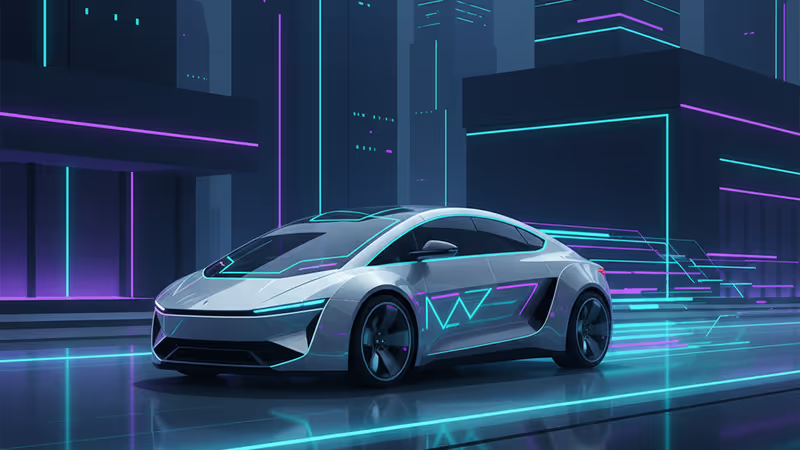
Nvidia Robotaxi Service 2027: Shifting Gears from AI Chips to the Open Road
Nvidia announces plans for a robotaxi service launching in 2027. CEO Jensen Huang highlights Level 4 autonomy and robotics as the next major growth engine for the AI chip giant.
AI isn't the final destination for Nvidia. The chip giant is now shifting gears to take over the world's roads. On Monday at CES 2026, CEO Jensen Huang unveiled plans to launch a Nvidia robotaxi service 2027 in partnership with a major industry player.
The Nvidia Robotaxi Service 2027 Vision and Level 4 Autonomy
The upcoming service aims for Level 4 autonomy, meaning these vehicles will operate without human intervention in predefined urban areas. While Nvidia hasn't named the specific operating city or its primary fleet partner yet, the company's existing alliance with Uber and its deep integration with Mercedes-Benz signal a massive scaling effort. Mercedes models arriving in late 2026 are already slated to use Nvidia's technology for navigating complex cities like San Francisco.

Robotics: Nvidia's Second Growth Pillar
Automotive and robotics chips currently account for just 1% of total revenue, bringing in $592 million in the most recent quarter. However, Huang views this as the company's most critical expansion area after AI. Nvidia is leveraging its Drive AGX Thor computer, priced at roughly $3,500 per chip, to provide the massive computational power required for generative AI on wheels.
The tech stack uses a dual-system approach for safety. An end-to-end vision-language model handles the bulk of driving tasks, while a secondary rule-based safety stack takes over during high-uncertainty scenarios. Nvidia's goal is to achieve seamless point-to-point self-driving in consumer cars by 2028.
Authors
Related Articles
Waymo's new Ojai robotaxi isn't just a vehicle upgrade. It's the company's most serious attempt yet at cracking the cost problem that has kept autonomous vehicles from scaling. Here's what's really at stake.
Tesla expanded its driverless robotaxi to Dallas and Houston, even after reporting 14 crashes in Austin. What does this tell us about how autonomous vehicles actually get built?
A U.S. Senate investigation found that seven autonomous vehicle companies — including Waymo and Tesla — refused to disclose how often remote operators intervene in their vehicles. Here's why that silence matters.
Uber and WeRide have launched fully driverless robotaxi service in Dubai — no safety operator, real fares. Here's what it means for the global AV race and your next ride.
Waymo's new Ojai robotaxi isn't just a vehicle upgrade. It's the company's most serious attempt yet at cracking the cost problem that has kept autonomous vehicles from scaling. Here's what's really at stake.
Tesla expanded its driverless robotaxi to Dallas and Houston, even after reporting 14 crashes in Austin. What does this tell us about how autonomous vehicles actually get built?
A U.S. Senate investigation found that seven autonomous vehicle companies — including Waymo and Tesla — refused to disclose how often remote operators intervene in their vehicles. Here's why that silence matters.
Uber and WeRide have launched fully driverless robotaxi service in Dubai — no safety operator, real fares. Here's what it means for the global AV race and your next ride.
Thoughts
Share your thoughts on this article
Sign in to join the conversation