

Nvidia-OpenAI Rift Reports: Much Ado About Nothing?
Nvidia CEO Jensen Huang dismissed friction reports as 'nonsense,' but the $100B partnership shows signs of evolution. What this means for AI's power dynamics and your investments.
A $100 billion handshake might be losing its grip. When The Wall Street Journal dropped a bombshell Friday night about growing friction between Nvidia and OpenAI, it took less than 24 hours for CEO Jensen Huang to fire back, calling the reports "nonsense."
But behind Huang's emphatic denial lies a more nuanced story. The September partnership that promised to reshape AI infrastructure is showing signs of evolution—and that evolution could redefine the entire AI ecosystem's power structure.
The Friction Report
The Wall Street Journal's Friday evening report painted a picture of a relationship under strain. According to their sources, Nvidia was looking to scale back its investment in OpenAI, stepping away from the ambitious $100 billion commitment and 10 gigawatts of computing infrastructure announced just months earlier.
The alleged shift wasn't just about money. Huang reportedly began emphasizing the "non-binding" nature of their deal while privately criticizing OpenAI's business strategy. More telling, he expressed concerns about competitors like Anthropic and Google—suggesting Nvidia might be hedging its bets in the AI race.
The numbers tell their own story. What started as a $100 billion infrastructure partnership was reportedly being reconsidered as an equity investment "of a mere tens of billions of dollars." That's still enormous money, but it represents a fundamental shift in scope and commitment.
Huang's Counterattack
Speaking to reporters during a Taipei visit Saturday, Huang didn't just deny the reports—he doubled down on OpenAI. "We will definitely participate" in OpenAI's latest funding round "because it's such a good investment," he declared. "We will invest a great deal of money."

His language was notably effusive: "I believe in OpenAI. The work that they do is incredible. They're one of the most consequential companies of our time." Yet when pressed for specifics, he deflected: "Let [OpenAI CEO Sam Altman] announce how much he's going to raise—it's for him to decide."
OpenAI responded in kind, with a spokesperson telling WSJ that the companies are "actively working through the details of our partnership," emphasizing that Nvidia "has underpinned our breakthroughs from the start, powers our systems today, and will remain central as we scale what comes next."
Reading Between the Lines
The public harmony masks a more complex reality. The New York Times reported this week that Nvidia, Amazon, Microsoft, and SoftBank are all discussing potential investments in OpenAI's rumored $100 billion funding round. That's a crowded field for what was once seen as Nvidia's exclusive territory.
This shift reflects broader changes in AI's landscape. When Nvidia and OpenAI first announced their partnership, OpenAI needed Nvidia's chips desperately, while Nvidia needed OpenAI's validation of AI's commercial potential. Today, both companies have more options.
OpenAI can court multiple hardware partners and cloud providers. Nvidia can bet on multiple AI companies, reducing its dependence on any single player. What looked like a marriage of necessity now resembles a more transactional relationship.
The Bigger Picture
These partnership dynamics matter beyond Silicon Valley boardrooms. They signal how AI's value chain is evolving and where future profits might flow. If Nvidia reduces its OpenAI commitment while maintaining strong rhetoric, it suggests the chip giant sees better diversification opportunities elsewhere.
For investors, this represents both risk and opportunity. Nvidia's dominance in AI chips remains unchallenged, but its relationships with AI companies are becoming more complex. OpenAI's ability to attract multiple billion-dollar investors shows the market's continued faith in generative AI, even as competition intensifies.
The timing also matters. As AI moves from experimental to essential technology, partnerships are shifting from exclusive alliances to strategic portfolios. Both companies are positioning for a future where AI success requires multiple bets, not single big ones.
Authors
Related Articles

Five stories from late September, traced to where the paper trail stops: Korea's export record, Nvidia's Hugging Face 8-K, a US-China AI channel, the UN on AI, and rising births.
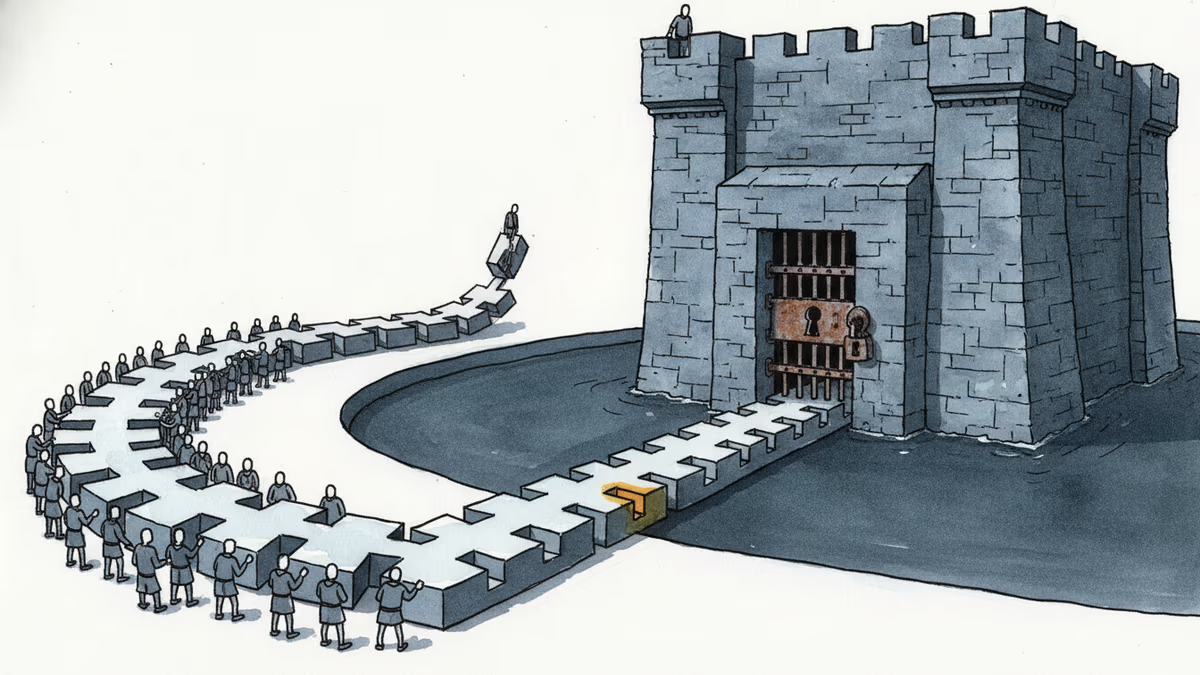
Nvidia shipped roughly a billion RISC-V cores in 2024, then announced it would run CUDA on the open standard. We break down how royalty-free instruction sets and open software stacks are trying to route around CUDA's lock-in. Part 2 of the Semiconductor Sovereignty series.
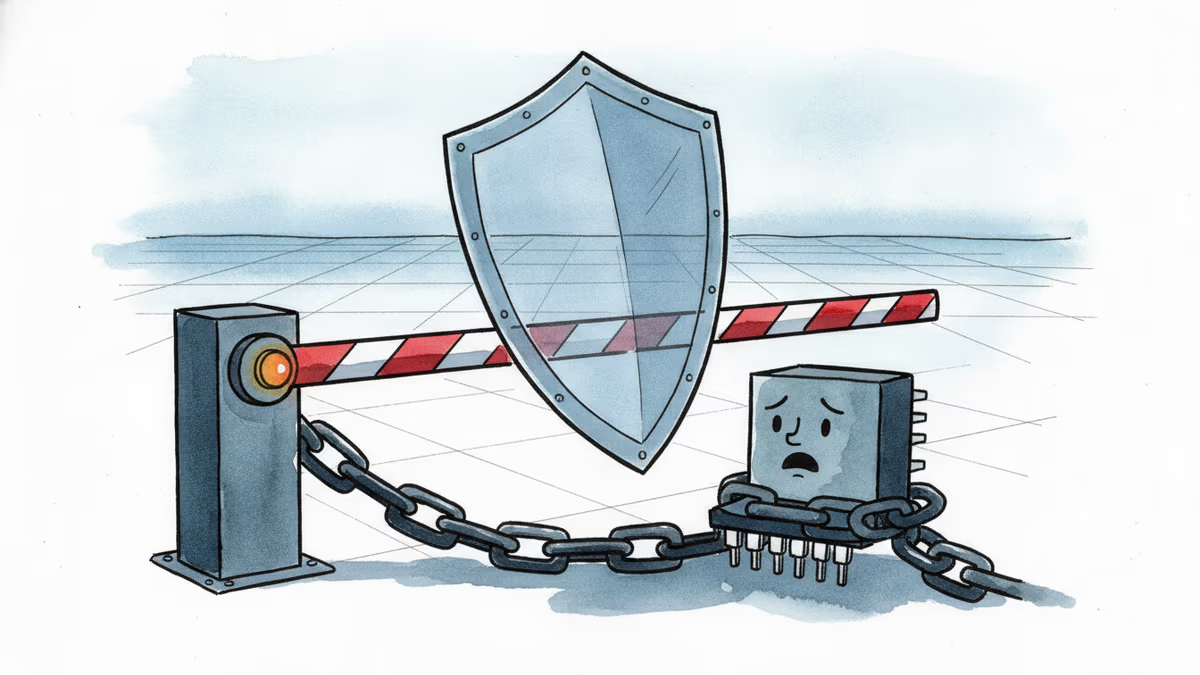
US AI-chip export controls split into three layers in the first half of 2026 — January easing, a May crackdown on circumvention, and a pending bill. Nvidia erased China from its guidance and still posted a record $81.6 billion quarter. A look at the export policy that both shields and cages it.
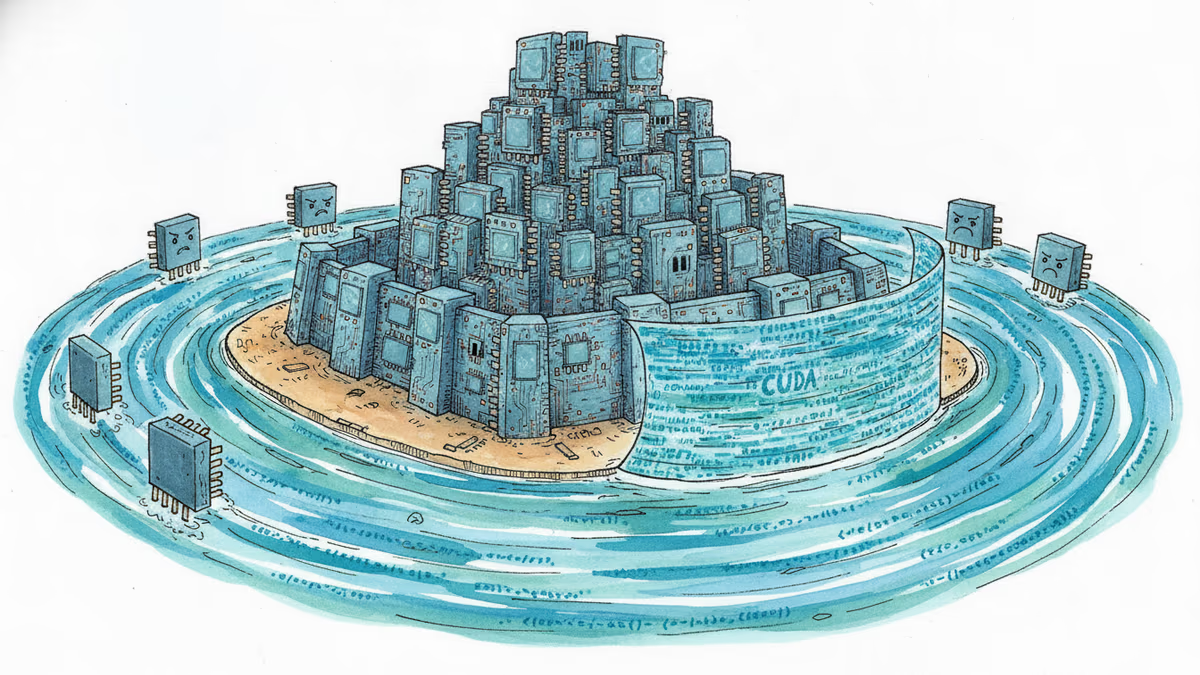
AMD's MI325X matches or beats Nvidia on memory and bandwidth — yet Nvidia's 86-92% share holds. The real moat is CUDA, 20 years in the making. Part 1 of 4.
Five stories from late September, traced to where the paper trail stops: Korea's export record, Nvidia's Hugging Face 8-K, a US-China AI channel, the UN on AI, and rising births.
Nvidia shipped roughly a billion RISC-V cores in 2024, then announced it would run CUDA on the open standard. We break down how royalty-free instruction sets and open software stacks are trying to route around CUDA's lock-in. Part 2 of the Semiconductor Sovereignty series.
US AI-chip export controls split into three layers in the first half of 2026 — January easing, a May crackdown on circumvention, and a pending bill. Nvidia erased China from its guidance and still posted a record $81.6 billion quarter. A look at the export policy that both shields and cages it.
AMD's MI325X matches or beats Nvidia on memory and bandwidth — yet Nvidia's 86-92% share holds. The real moat is CUDA, 20 years in the making. Part 1 of 4.
Thoughts
Share your thoughts on this article
Sign in to join the conversation