
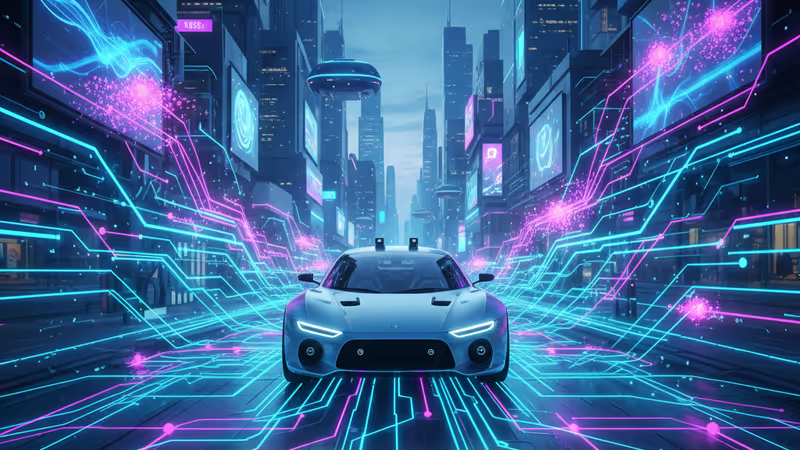
Nvidia Alpamayo Physical AI Models Launch at CES 2026 to Spark 'ChatGPT Moment'
Nvidia unveils Alpamayo at CES 2026, a 10B parameter physical AI model family for autonomous vehicles, featuring open-source tools and reasoning capabilities.
The "ChatGPT moment" for physical AI has arrived. At CES 2026, Nvidia CEO Jensen Huang announced the launch of 'Alpamayo,' a new family of open-source AI models and simulation tools designed to give autonomous vehicles (AVs) the ability to reason through complex, real-world scenarios just like humans do.
How Nvidia Alpamayo Physical AI Models Redefine Driving
At the heart of this rollout is Alpamayo 1, a 10-billion-parameter vision language action (VLA) model. Unlike traditional AV systems that rely on rigid programming, Alpamayo 1 utilizes a chain-of-thought reasoning process. This allows vehicles to navigate "edge cases"—such as a traffic light outage at a busy intersection—without needing prior specific experience in that exact situation.
Ali Kani, Nvidia’s VP of automotive, stated during a press briefing that the model breaks down problems into logical steps to select the safest path. Jensen Huang emphasized that the system doesn't just activate the brakes or steering; it can actually explain the reasoning behind its decisions and the predicted trajectory, adding a layer of transparency to AI-driven transportation.

An Open Ecosystem for Autonomous Innovation
Nvidia's strategy centers on openness. The underlying code for Alpamayo 1 is now available on Hugging Face, enabling developers to fine-tune it for specific vehicle types. To support this, Nvidia also released a massive dataset featuring over 1,700 hours of real-world driving data and AlpaSim, an open-source simulation framework available on GitHub.
Furthermore, developers can leverage Cosmos, Nvidia’s generative world models, to create synthetic environments for testing. This combination of real and synthetic data is expected to accelerate the safety validation of AV applications, potentially shortening development cycles across the industry.
Authors
Related Articles
Waymo's new Ojai robotaxi isn't just a vehicle upgrade. It's the company's most serious attempt yet at cracking the cost problem that has kept autonomous vehicles from scaling. Here's what's really at stake.
Tesla expanded its driverless robotaxi to Dallas and Houston, even after reporting 14 crashes in Austin. What does this tell us about how autonomous vehicles actually get built?
A U.S. Senate investigation found that seven autonomous vehicle companies — including Waymo and Tesla — refused to disclose how often remote operators intervene in their vehicles. Here's why that silence matters.

Uber and WeRide have launched fully driverless robotaxi service in Dubai — no safety operator, real fares. Here's what it means for the global AV race and your next ride.
Waymo's new Ojai robotaxi isn't just a vehicle upgrade. It's the company's most serious attempt yet at cracking the cost problem that has kept autonomous vehicles from scaling. Here's what's really at stake.
Tesla expanded its driverless robotaxi to Dallas and Houston, even after reporting 14 crashes in Austin. What does this tell us about how autonomous vehicles actually get built?
A U.S. Senate investigation found that seven autonomous vehicle companies — including Waymo and Tesla — refused to disclose how often remote operators intervene in their vehicles. Here's why that silence matters.
Uber and WeRide have launched fully driverless robotaxi service in Dubai — no safety operator, real fares. Here's what it means for the global AV race and your next ride.
Thoughts
Share your thoughts on this article
Sign in to join the conversation