
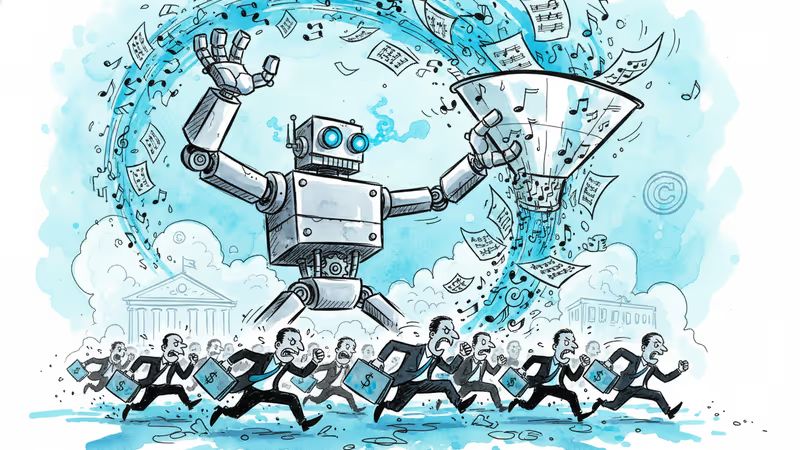
The $3 Billion Music Piracy Case That Could Reshape AI Training
Music publishers sue Anthropic for $3 billion over alleged copyright infringement, following a pattern of AI companies facing legal challenges over training data acquisition methods.
$3 billion—that's what music publishers are demanding from Anthropic in what could become one of the largest non-class action copyright cases in U.S. history. But this isn't just another tech lawsuit. It's a window into how AI companies have been building their empires, and the bill is finally coming due.
Concord Music Group and Universal Music Group are leading a coalition of publishers claiming that Anthropic illegally downloaded more than 20,000 copyrighted songs, including sheet music, lyrics, and musical compositions. The lawsuit, filed Wednesday, follows the same legal playbook that already cost Anthropic$1.5 billion in a separate case involving fiction and nonfiction authors.
The Pattern Emerges
This music lawsuit didn't appear in a vacuum. It's the direct result of discoveries made during the Bartz v. Anthropic case, where authors successfully argued that the AI company used their copyrighted works to train products like Claude. While Judge William Alsup ruled that training AI models on copyrighted content is legal, he drew a clear line: acquiring that content through piracy is not.
The publishers initially sued Anthropic over about 500 copyrighted works. But during the discovery process in the authors' case, they uncovered evidence of thousands more allegedly pirated songs. When they tried to amend their original lawsuit to include these findings, the court denied the motion in October, ruling they had failed to investigate the piracy claims earlier. So they filed this separate, much larger case.
The legal strategy is telling. By naming Anthropic CEO Dario Amodei and co-founder Benjamin Mann as defendants, the publishers are targeting the individuals who made the strategic decisions, not just the corporate entity. It's a move that signals they're playing for keeps.
The Economics of AI Piracy

Here's where the numbers get interesting. The $1.5 billion settlement in the authors' case might sound massive, but for a company valued at $183 billion, it's essentially a cost of doing business. Individual writers received about $3,000 per work for roughly 500,000 copyrighted pieces—a fraction of what their intellectual property might be worth in the AI training market.
This creates a perverse incentive structure. If the penalty for piracy is lower than the cost of legitimate licensing, why wouldn't AI companies take the risk? The publishers seem aware of this calculation, which explains why they're seeking $3 billion for 20,000 songs—roughly $150,000 per work, fifty times what authors received.
Anthropic has positioned itself as an AI "safety and research" company, but the lawsuit paints a different picture. "Its record of illegal torrenting of copyrighted works makes clear that its multibillion-dollar business empire has in fact been built on piracy," the filing states.
The Broader Implications
This case represents more than a dispute over music rights. It's a test of whether the traditional copyright system can adapt to the AI era without stifling innovation. The music industry, having survived the digital disruption of the early 2000s, is now applying those hard-learned lessons to AI.
Unlike the Napster era, where individual consumers were sharing files, this involves corporate entities with deep pockets systematically acquiring content for commercial AI training. The scale is different, the stakes are higher, and the legal precedents are still being written.
For AI developers, the message is becoming clear: the "ask for forgiveness, not permission" approach that worked in social media's early days may not fly in the AI era. Regulators and courts are paying attention, and the penalties are escalating.
Authors
Related Articles
Anthropic shipped Claude Sonnet 5, its mid-tier agent model, on June 30. Behind the 'Opus-class power, budget price' headline sits a tokenizer catch and a three-horse race that's only half real. Here's what developers should actually run the numbers on.

A small but growing group of developers has gone all-in on AI coding agents like Claude Code and OpenClaw. History suggests the rest of us won't be far behind.

OpenAI's new Daybreak initiative uses the Codex AI agent to find and patch security vulnerabilities before attackers do—putting it in direct competition with Anthropic's secretive Claude Mythos.

Anthropic is closing what may be its final private fundraise at a $900B valuation, surpassing OpenAI. Investors have 48 hours to commit to the ~$50B round.
Anthropic shipped Claude Sonnet 5, its mid-tier agent model, on June 30. Behind the 'Opus-class power, budget price' headline sits a tokenizer catch and a three-horse race that's only half real. Here's what developers should actually run the numbers on.
A small but growing group of developers has gone all-in on AI coding agents like Claude Code and OpenClaw. History suggests the rest of us won't be far behind.
OpenAI's new Daybreak initiative uses the Codex AI agent to find and patch security vulnerabilities before attackers do—putting it in direct competition with Anthropic's secretive Claude Mythos.
Anthropic is closing what may be its final private fundraise at a $900B valuation, surpassing OpenAI. Investors have 48 hours to commit to the ~$50B round.
Thoughts
Share your thoughts on this article
Sign in to join the conversation