
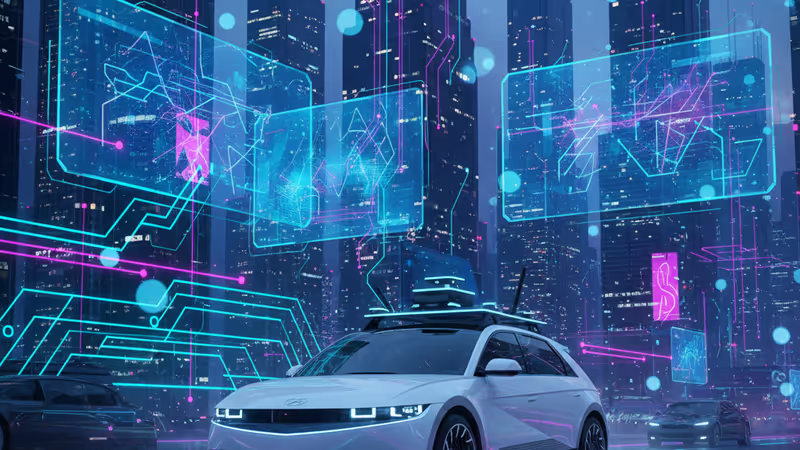
Motional AI-first Robotaxi 2026 Roadmap: Hyundai’s Pivot to Foundation Models
Motional reveals its 2026 roadmap for driverless robotaxis in Las Vegas, powered by a new AI-first foundation model. Learn how Hyundai's $1B investment saved the startup.
Motional isn't just surviving; it's rebuilding its entire brain. After nearly two years at a crossroads, the autonomous vehicle startup backed by Hyundai Motor Group has emerged with an 'AI-first' strategy. By ditching classic robotics for foundation models, the company aims to prove that its 2026 commercial deadline is more than just a promise—it's a technical reality.
Motional AI-first Robotaxi 2026 Launch Roadmap
The company announced it plans to launch a commercial driverless service in Las Vegas by the end of 2026. According to reports from TechCrunch, Motional has already rebooted its internal operations, currently offering robotaxi rides to its employees with a safety operator behind the wheel. The public will get its first taste later this year when Motional partners with a ride-hailing firm to launch limited services in Nevada.

The path to this point was grueling. Originally a $4 billion joint venture between Hyundai and Aptiv, Motional faced missed deadlines and a withdrawal of financial backing from Aptiv. A massive restructuring in May 2024 saw its workforce slashed by 40%, dropping from 1,400 employees to fewer than 600. However, a recent $1 billion injection from Hyundai has given the team the runway needed to pivot toward a more scalable AI architecture.
Ditching Hand-Coded Rules for Foundation Models
CEO Laura Major explained that the company shifted from a complex web of individual machine learning models to a unified backbone based on Transformer architectures. This end-to-end approach allows the system to generalize more easily to new cities without needing manual redevelopment for every new scenario or traffic light variation. During a 30-minute demo in a Hyundai Ioniq 5, the vehicle successfully navigated busy hotel pickup areas, showing significant progress over previous iterations.
Authors
Related Articles
Waymo's new Ojai robotaxi isn't just a vehicle upgrade. It's the company's most serious attempt yet at cracking the cost problem that has kept autonomous vehicles from scaling. Here's what's really at stake.
Tesla expanded its driverless robotaxi to Dallas and Houston, even after reporting 14 crashes in Austin. What does this tell us about how autonomous vehicles actually get built?
A U.S. Senate investigation found that seven autonomous vehicle companies — including Waymo and Tesla — refused to disclose how often remote operators intervene in their vehicles. Here's why that silence matters.

Uber and WeRide have launched fully driverless robotaxi service in Dubai — no safety operator, real fares. Here's what it means for the global AV race and your next ride.
Waymo's new Ojai robotaxi isn't just a vehicle upgrade. It's the company's most serious attempt yet at cracking the cost problem that has kept autonomous vehicles from scaling. Here's what's really at stake.
Tesla expanded its driverless robotaxi to Dallas and Houston, even after reporting 14 crashes in Austin. What does this tell us about how autonomous vehicles actually get built?
A U.S. Senate investigation found that seven autonomous vehicle companies — including Waymo and Tesla — refused to disclose how often remote operators intervene in their vehicles. Here's why that silence matters.
Uber and WeRide have launched fully driverless robotaxi service in Dubai — no safety operator, real fares. Here's what it means for the global AV race and your next ride.
Thoughts
Share your thoughts on this article
Sign in to join the conversation