
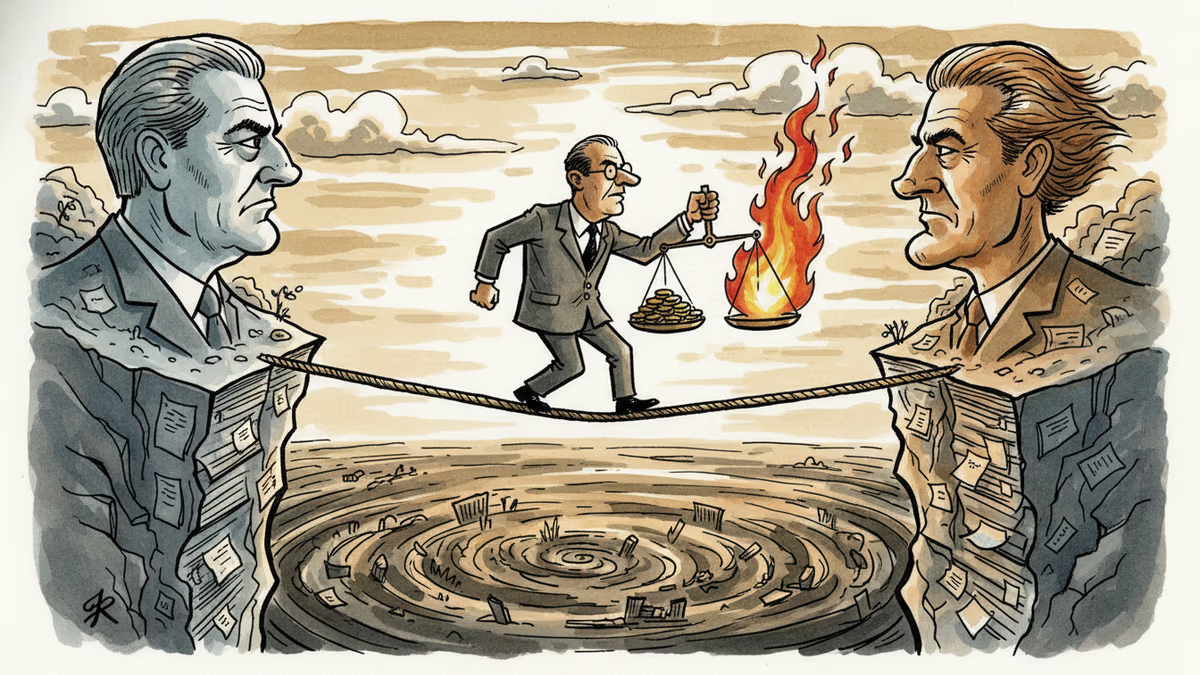
The Most Contested Central Bank Appointment in Decades Is Over
A bruising confirmation vote has finally installed a new central bank chief. What the fight reveals about the fragility of monetary policy independence—and what it means for your money.
The vote is done. But the damage to the institution may have already been done too.
After one of the most protracted and politically charged confirmation battles for a central bank chief in living memory, the vote has finally passed. The new governor has a mandate—on paper. What they may not have, at least not fully, is the one thing that makes a central banker effective: the market's unquestioned belief that their decisions are free from political interference.
What Happened, and Why It Got So Ugly
The process was fraught from the start. The nomination triggered immediate political pushback, confirmation hearings became a proxy war over interest rate preferences, and the timeline stretched well beyond what markets consider comfortable. The vote eventually confirmed the appointment, but not before exposing just how vulnerable the position of central bank chief has become in an era of polarized politics.
This isn't a story about one person. It's about what the fight signals. When legislators openly debate whether a central bank nominee will cut rates fast enough—or slow enough—to suit their political agenda, the independence of the institution is already being tested in public. The nominee's actual qualifications often become secondary to the question of whose economic preferences they represent.
The stakes are high because the job is genuinely powerful. A central bank governor's decisions on benchmark interest rates ripple through mortgage payments, corporate borrowing costs, currency valuations, and employment figures. That's exactly why political actors want a say—and exactly why economists argue they shouldn't have one.
The Historical Cost of Getting This Wrong
The case for central bank independence isn't ideological—it's empirical. In the 1970s, political pressure on the U.S. Federal Reserve helped produce double-digit inflation. Fixing it required Paul Volcker to raise rates to nearly 20%, triggering a brutal recession. Turkey's repeated currency crises over the past decade trace directly to presidential interference in the Central Bank of the Republic of Turkey. Argentina's chronic monetary instability has the same fingerprints.

Conversely, the credibility built by institutions like the Federal Reserve, the European Central Bank, and the Bank of England over decades of perceived independence is precisely what allows them to anchor inflation expectations—and why markets listen when they speak.
The concern now is subtler but real: even the appearance of a politicized appointment process can erode that credibility at the margin. Markets don't need proof of interference. Suspicion is enough to start pricing in a risk premium.
What This Means for Investors and Borrowers
For anyone with a variable-rate mortgage, a business loan, or a bond portfolio, the quality of central bank leadership is not an abstraction. Uncertainty about the policy direction—or doubts about whether the governor will act on data rather than political pressure—translates into wider spreads, higher volatility, and less predictable rate paths.
During the confirmation standoff, fixed-income markets showed exactly this dynamic: elevated uncertainty about the rate trajectory made duration bets riskier. Investors who positioned defensively in short-term instruments or dollar-denominated assets navigated the period better than those holding longer-dated local currency bonds.
For businesses planning capital expenditure or hiring, a murky rate outlook encourages caution. The indirect economic cost of a prolonged, contested confirmation is hard to quantify—but it is not zero.
Not Everyone Thinks Independence Is Sacred
It's worth noting the counterargument, because it has gained traction. Some economists and policymakers argue that too much central bank independence creates its own accountability problem. When unelected technocrats make decisions that affect millions of households, democratic oversight is not inherently illegitimate. The question is where the line falls between appropriate accountability and corrosive political interference.
There's also a structural critique: central bank mandates were largely written for a different era. Dual mandates of price stability and full employment were designed for economies that look quite different from today's—where supply-chain shocks, energy transitions, and geopolitical fragmentation create inflationary pressures that interest rates alone can't fully address. If the tool is limited, the argument goes, why should the person wielding it be insulated from democratic input?
These are legitimate questions. But they are different from demanding a governor who will deliver a specific rate cut on a specific timeline for political reasons.
This content is AI-generated based on source articles. While we strive for accuracy, errors may occur. We recommend verifying with the original source.
Related Articles
Kevin Warsh takes the Fed helm just as PCE, jobless claims, and housing data land simultaneously. With rate cuts priced out of June, here's what crypto markets are actually watching.
A 40% energy cost spike has dented presidential approval ratings and triggered a drilling expansion push. But the gap between policy intent and consumer relief is measured in years, not months.
Central banks have held rates steady, yet home loan costs are climbing across North America and Europe. Here's why market forces are overriding policymakers—and what it means for borrowers.
Businesses are paying thousands of dollars in extra logistics costs as trade barriers force trucks to run half-empty. Here's who pays, who profits, and what it means for prices.
Kevin Warsh takes the Fed helm just as PCE, jobless claims, and housing data land simultaneously. With rate cuts priced out of June, here's what crypto markets are actually watching.
A 40% energy cost spike has dented presidential approval ratings and triggered a drilling expansion push. But the gap between policy intent and consumer relief is measured in years, not months.
Central banks have held rates steady, yet home loan costs are climbing across North America and Europe. Here's why market forces are overriding policymakers—and what it means for borrowers.
Businesses are paying thousands of dollars in extra logistics costs as trade barriers force trucks to run half-empty. Here's who pays, who profits, and what it means for prices.
Thoughts
Share your thoughts on this article
Sign in to join the conversation