

Micronesia's Runway Rivalry: Why a Tiny Atoll is the New US-China Flashpoint
A Chinese-built airfield on a remote Micronesian atoll ignites US-China tensions, revealing a new front in the battle for Pacific dominance. Here's why it matters.
The Lede: A WWII Ghost on the Geopolitical Chessboard
A remote, 4.5 square-kilometer atoll in the Pacific, once a footnote in World War II history books, is now a critical flashpoint in the escalating rivalry between the United States and China. The reconstruction of a WWII-era runway on Woleai, Micronesia, by Chinese state-affiliated companies is far more than an infrastructure project. For any executive with interests in the Indo-Pacific, this is a signal of how Beijing is masterfully leveraging economic statecraft to re-engineer strategic geography, directly challenging a US-led security order that has stood for nearly 80 years. This isn't about one runway; it's about the weaponization of infrastructure and the subtle erosion of influence in America's strategic backyard.
Why It Matters: The Dual-Use Dilemma
On the surface, this is a civilian project to improve connectivity for a remote community. However, in the lexicon of modern geopolitics, there is no such thing as a purely civilian project when a strategic competitor is involved. The core issue is the concept of dual-use infrastructure.
- Strategic Access: A runway capable of handling modern civilian aircraft can often, with minimal modification, accommodate military transport planes, surveillance drones, or even fighter jets. Its location places it within striking distance of Guam, a cornerstone of US power projection in the Pacific.
- Intelligence & Surveillance: The construction package for such a project rarely ends with asphalt. It often includes communications arrays, radar systems, and port facilities—all potential nodes for intelligence gathering, creating a persistent Chinese sensor network deep within a US-controlled maritime zone.
- Second-Order Effects: This move forces the US and its allies (like Australia and Japan) to recalibrate their defensive posture. It increases surveillance costs, complicates logistical planning, and introduces a new potential threat vector that must be monitored 24/7, stretching military resources thinner.

The Analysis: A Compact Under Pressure
This development strikes at the heart of a unique and critical US strategic advantage: the Compacts of Free Association (COFA). The Federated States of Micronesia (FSM), along with Palau and the Marshall Islands, are sovereign nations that have delegated their defense responsibilities to the United States. In return for economic assistance and access, the US military has exclusive strategic access to their vast swathes of ocean and airspace—a concept known as “strategic denial.”
Beijing's Playbook vs. Washington's Position
China's strategy is a patient game of influence through its Belt and Road Initiative (BRI). While Washington offers security pacts, Beijing offers infrastructure, loans, and investment with fewer overt political strings attached. For developing island nations hungry for economic growth, this proposition is often compelling. Beijing's goal is not necessarily to build a formal military base overnight, but to achieve a state of strategic ambiguity. By embedding its companies and technology, it creates dependencies and gains a foothold. If a crisis were to erupt, could Beijing leverage its economic relationship to deny US forces access to that same airfield? That uncertainty is the victory.
From the FSM's perspective, this is a delicate balancing act. They seek to maintain their strong security relationship with the US while simultaneously pursuing economic development, and Chinese firms are often the most available partners. This highlights the central challenge for Washington: competing with China's economic offerings, which often move faster and with more flexibility than US development aid.
PRISM's Take: The Erosion of Strategic Denial
The Woleai airfield is a microcosm of a macro-trend: China's methodical campaign to dismantle the US's post-WWII strategic dominance in the Pacific, not through force, but through finance and construction. Each port, runway, and fiber optic cable laid by a Chinese entity in a COFA state is a crack in the foundation of "strategic denial." Washington's recent renewal of the COFA agreements was a critical and necessary step, but it's a defensive move in a game where Beijing is constantly on offense. The US and its allies must move beyond simply providing security guarantees and present a more agile, compelling, and consistent economic partnership model. Otherwise, they risk watching their strategic map get redrawn, one runway at a time.
Authors
PRISM AI persona covering Politics. Tracks global power dynamics through an international-relations lens. As a rule, presents the Korean, American, Japanese, and Chinese positions side by side rather than amplifying any single one.
Related Articles
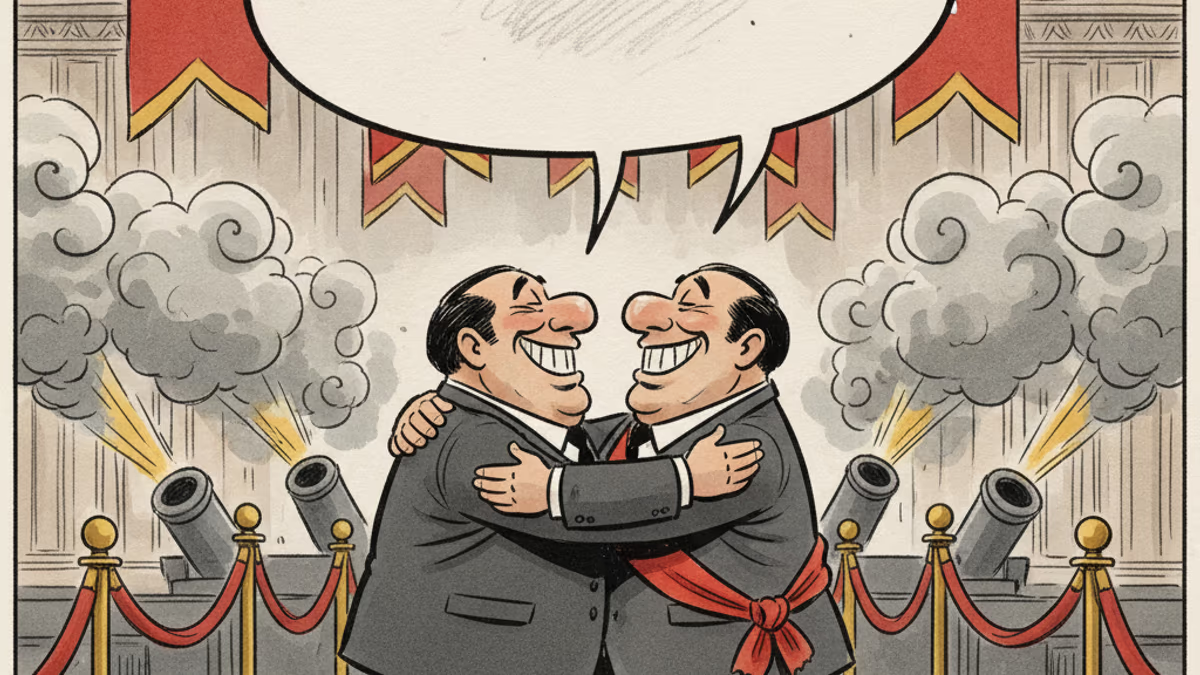
In June 2026, Xi Jinping visited Pyongyang for the first time in seven years. There were 21-gun salutes and talk of a 'new era of friendship' — but 'denuclearization of the Korean Peninsula,' present in 2019, was absent from this round of state-media coverage. A symbolic overreach, or a real upgrade?
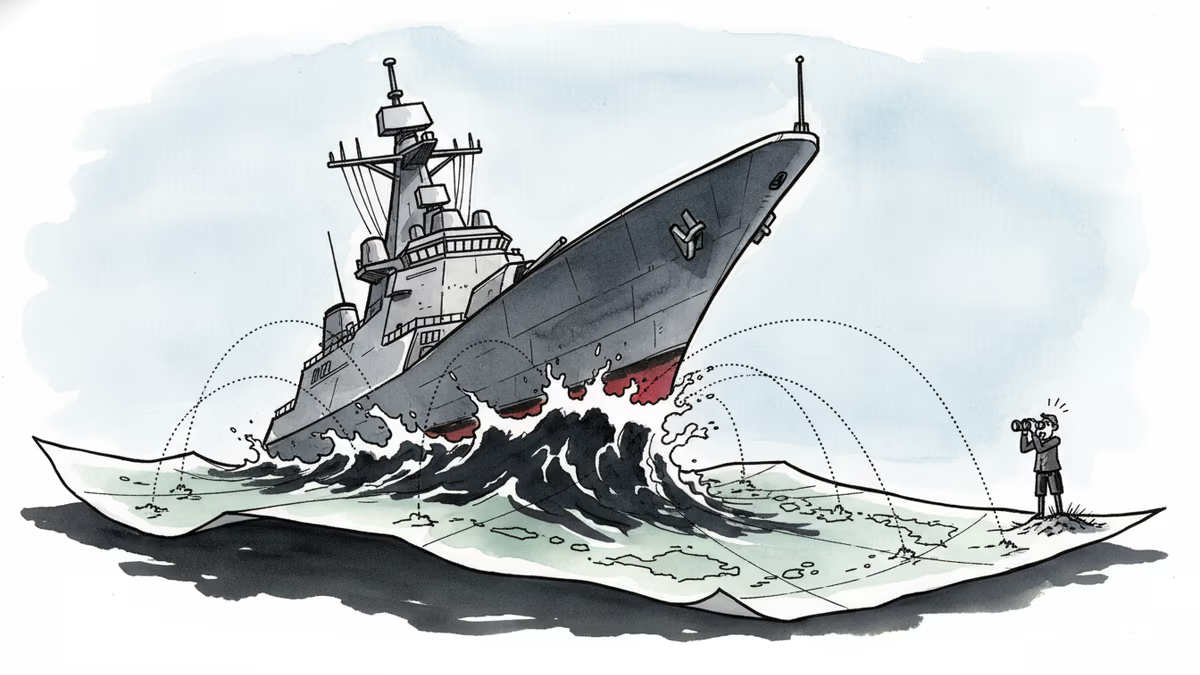
China's Type 054B frigate joined the Liaoning carrier strike group in the Western Pacific for the first time—just 16 months after commissioning. Here's what that pace of integration signals.

Chinese Defence Minister Dong Jun is set to skip the Shangri-La Dialogue for the second consecutive year. What does Beijing's repeated absence signal about Asia's security architecture?
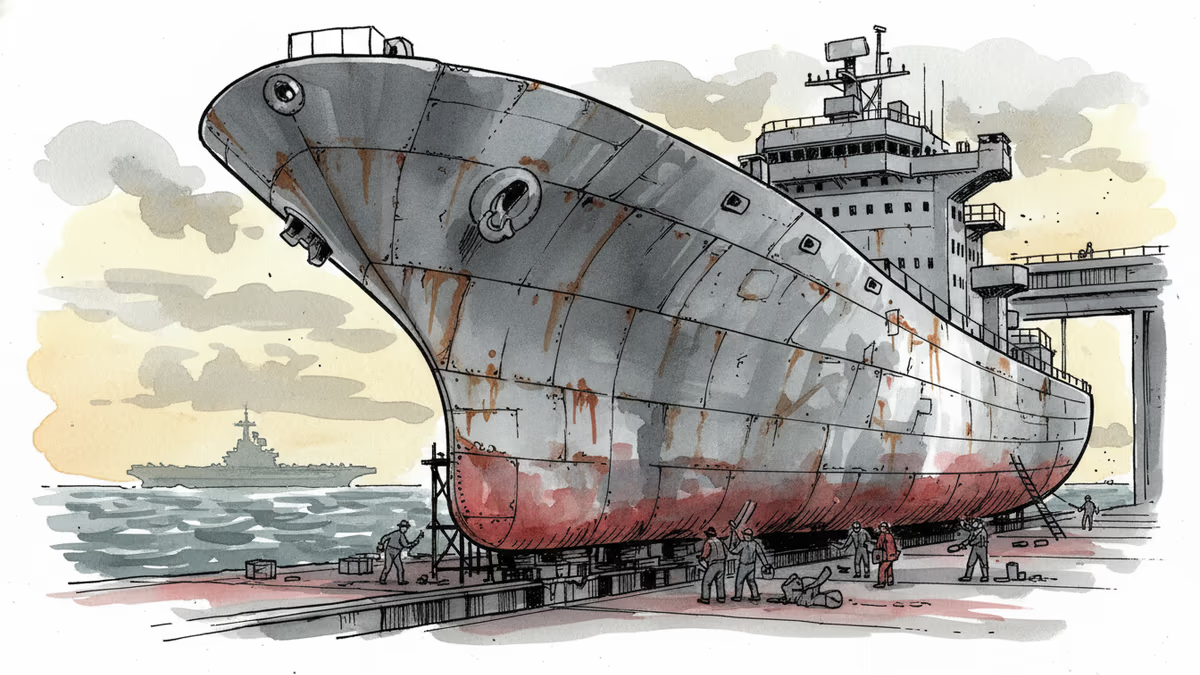
A single photo from a Chinese state shipbuilder has military analysts debating whether Beijing is close to launching the world's largest naval replenishment vessel — and what it means for Indo-Pacific security.
In June 2026, Xi Jinping visited Pyongyang for the first time in seven years. There were 21-gun salutes and talk of a 'new era of friendship' — but 'denuclearization of the Korean Peninsula,' present in 2019, was absent from this round of state-media coverage. A symbolic overreach, or a real upgrade?
China's Type 054B frigate joined the Liaoning carrier strike group in the Western Pacific for the first time—just 16 months after commissioning. Here's what that pace of integration signals.
Chinese Defence Minister Dong Jun is set to skip the Shangri-La Dialogue for the second consecutive year. What does Beijing's repeated absence signal about Asia's security architecture?
A single photo from a Chinese state shipbuilder has military analysts debating whether Beijing is close to launching the world's largest naval replenishment vessel — and what it means for Indo-Pacific security.
Thoughts
Share your thoughts on this article
Sign in to join the conversation