
China's Shadow Fleet: The Ship That Could Redraw the Pacific
A single photo from a Chinese state shipbuilder has military analysts debating whether Beijing is close to launching the world's largest naval replenishment vessel — and what it means for Indo-Pacific security.
The most consequential warship China may be building doesn't carry missiles or fighter jets. It carries fuel.
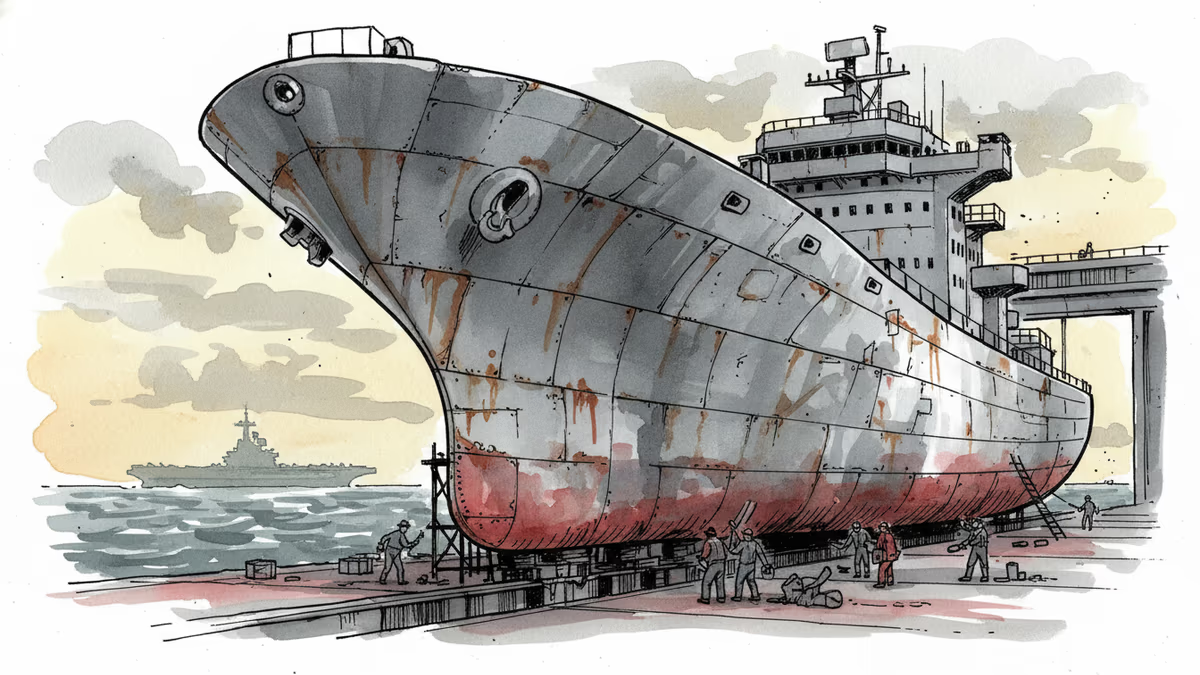
On May 22, China State Shipbuilding Corporation (CSSC) posted what appeared to be a routine social media update marking a traditional Chinese solar term. Tucked into the background of the image: an enormous hull sitting in a dry dock, its upper deck and island superstructures visibly near-complete. Military observers didn't need long to react. The vessel, they argued, could be the world's largest naval replenishment ship — a floating gas station and grocery store capable of keeping People's Liberation Army Navy (PLAN) carrier groups at sea almost indefinitely.
Why a Supply Ship Is the Real Story
Replenishment vessels rarely make headlines. They lack the visual drama of aircraft carriers or destroyers. But ask any naval strategist and they'll tell you: the supply ship is where real power projection lives.
The logic is straightforward. China has almost no overseas military bases — just one acknowledged facility in Djibouti, compared to the United States' roughly 800 installations worldwide. Every time a PLAN carrier group ventures deep into the Pacific or Indian Ocean, it operates at the end of a very long supply line. The further it goes, the more it depends on at-sea replenishment. Bigger, faster support ships don't just extend range — they transform what kind of operations become possible.
Currently, PLAN carrier groups rely on two 45,000-tonneType 901 Fuyu-class fast combat support ships and the considerably smaller, slower Type 903 Fuchi-class vessels. If the hull spotted in CSSC's photo exceeds that tonnage — and early speculation suggests it does — China's blue-water logistics capability would take a meaningful step forward.
Two Readings of the Same Hull

How you interpret this development depends significantly on where you're standing.
Beijing's framing is defensive. China argues it has legitimate security interests across the South China Sea, Taiwan Strait, and Indian Ocean shipping lanes — and that without a network of foreign bases, large replenishment ships are simply the practical alternative. State media has consistently positioned naval expansion as proportionate self-defense, not regional dominance.
Washington and Tokyo's reading is less generous. A vessel capable of sustaining carrier groups far from Chinese shores isn't a defensive asset in any conventional sense. It's a power projection tool — the same category of capability that allowed the U.S. Navy to maintain global reach throughout the Cold War and beyond. From this perspective, China isn't filling a gap; it's building toward parity.
| Dimension | Beijing's View | Washington/Tokyo's View |
|---|---|---|
| Purpose | Compensate for lack of bases | Extend offensive reach |
| Benchmark | U.S. has 800+ bases; China has 1 | Carrier group range multiplied |
| Regional effect | Deterrence, status quo | Destabilizing, status quo challenge |
| Strategic signal | Defensive sufficiency | Power projection ambition |
The Bigger Pattern
This isn't happening in isolation. Over the past decade, the PLAN has undergone the fastest naval expansion of any country in modern history. By total vessel count, it already surpasses the U.S. Navy. The gap that remains is in combat experience, interoperability, and — crucially — sustained logistical capacity. That last gap is precisely what a mega-replenishment ship addresses.
The timing matters too. China has been accelerating military modernization across the board, with 2027 — the centenary of the PLA's founding — widely cited as an internal benchmark for operational readiness. A vessel that appears close to launch in mid-2026 fits that timeline with uncomfortable precision.
For Indo-Pacific allies, the calculus is shifting. Australia, Japan, and South Korea have all increased defense spending in recent years, partly in response to PLAN expansion. The question isn't whether China is building a more capable navy — that's no longer in dispute. The question is what operational scenarios that navy is being built to execute.
This content is AI-generated based on source articles. While we strive for accuracy, errors may occur. We recommend verifying with the original source.
Related Articles

Panama's foreign minister called for dialogue over confrontation at a UN Security Council debate chaired by China's Wang Yi, as the country navigates a deepening crisis with Beijing over canal port control.
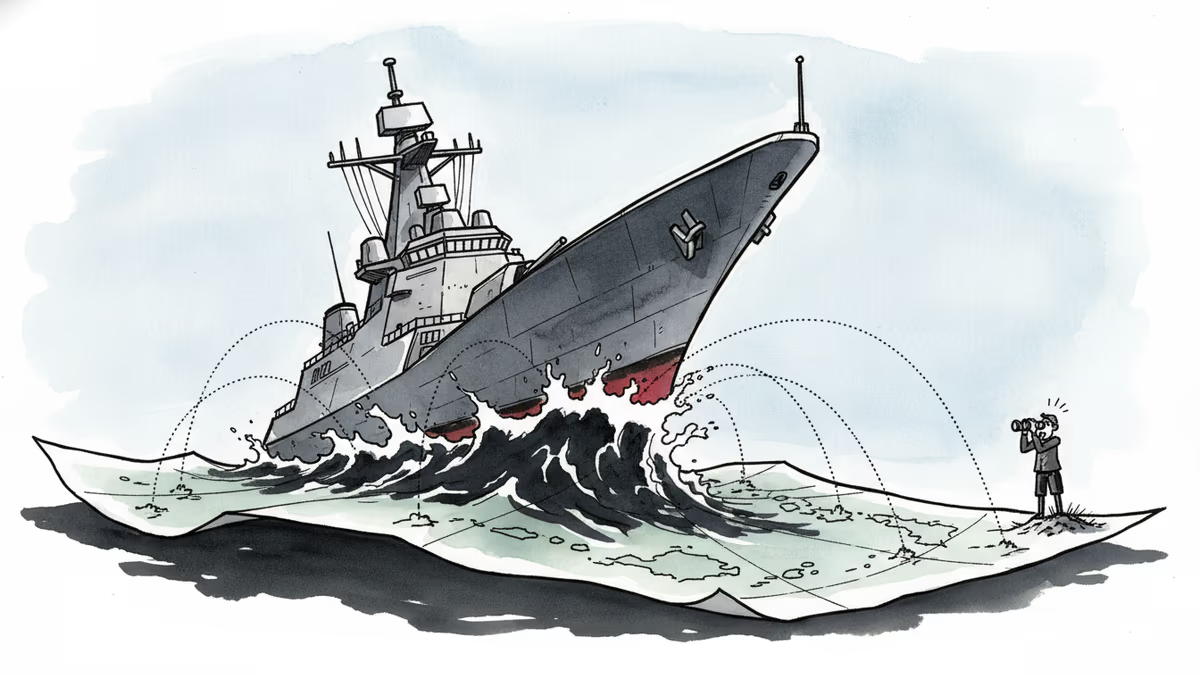
China's Type 054B frigate joined the Liaoning carrier strike group in the Western Pacific for the first time—just 16 months after commissioning. Here's what that pace of integration signals.

Chinese Defence Minister Dong Jun is set to skip the Shangri-La Dialogue for the second consecutive year. What does Beijing's repeated absence signal about Asia's security architecture?

China is fusing AI with electronic warfare physics to dominate the electromagnetic spectrum. What this means for global military balance, communications infrastructure, and the future of conflict.
Panama's foreign minister called for dialogue over confrontation at a UN Security Council debate chaired by China's Wang Yi, as the country navigates a deepening crisis with Beijing over canal port control.
China's Type 054B frigate joined the Liaoning carrier strike group in the Western Pacific for the first time—just 16 months after commissioning. Here's what that pace of integration signals.
Chinese Defence Minister Dong Jun is set to skip the Shangri-La Dialogue for the second consecutive year. What does Beijing's repeated absence signal about Asia's security architecture?
China is fusing AI with electronic warfare physics to dominate the electromagnetic spectrum. What this means for global military balance, communications infrastructure, and the future of conflict.
Thoughts
Share your thoughts on this article
Sign in to join the conversation