
Seven Years, One Missing Word: What the Kim–Xi Pyongyang Summit Left Unsaid
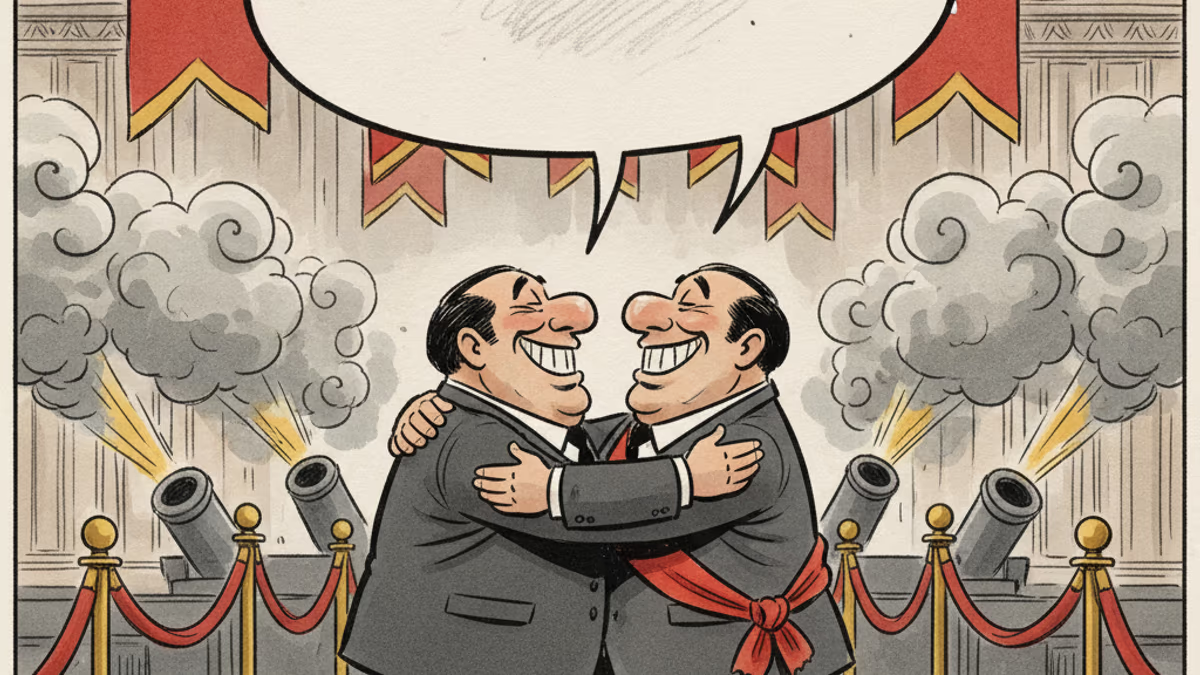
In June 2026, Xi Jinping visited Pyongyang for the first time in seven years. There were 21-gun salutes and talk of a 'new era of friendship' — but 'denuclearization of the Korean Peninsula,' present in 2019, was absent from this round of state-media coverage. A symbolic overreach, or a real upgrade?
In 2019, standing in Pyongyang, Xi Jinping spoke of “denuclearization of the Korean Peninsula.” In 2026, back in the same city, he didn't.
Around noon on June 8, the aircraft carrying Chinese President Xi Jinping touched down at Pyongyang's Sunan International Airport. His wife, Peng Liyuan, traveled with him; North Korean leader Kim Jong Un and his wife, Ri Sol Ju, met them on the tarmac. A 21-gun salute from the Korean People's Army followed, with a welcome ceremony at Kim Il Sung Square and talks at the Kumsusan State Guest House. The visit — cross-confirmed by Western, South Korean, and Japanese outlets — was Xi's first to North Korea since 2019, seven years ago. It also happened to fall in the 65th anniversary year of the China–North Korea Treaty of Friendship, Cooperation, and Mutual Assistance.
The pageantry was lavish and the rhetoric ran hot. Yet what Western analysts fixed on wasn't the language that made it onto the stage — it was the language left off it.
What's Confirmed, and What's Only Claimed
A line worth drawing first: the information around this summit comes in two layers. There are the facts cross-checked by Western, South Korean, and Japanese media, and there are the announcements put out by Chinese and North Korean state outlets.
The facts are relatively solid. The timing (June 8–9, an overnight visit), the participants, the state-level protocol, and the seven-year gap were corroborated across RFA, Nikkei, and Bloomberg. The characterization of the coverage itself — formulaic, opaque, and heavy on symbolism — is one that Al Jazeera and the Washington-based think tank CSIS both make.
The announcements are another matter. Reports that Kim called developing ties with China “the state's most important, first-order strategic task,” or that Xi pledged to expand military exchanges, all trace back to state-media releases from outlets such as Xinhua and the Korean Central News Agency (KCNA). Whether any of it will be acted on — or is even accurate — can't be independently verified. The line that “friendship between China and North Korea in the new era is the people's choice” is state rhetoric, not established fact. That's why this article attaches “according to North Korean/Chinese announcements” every time it cites official statements.
Coverage said the two sides would broaden exchanges across the economy, trade, agriculture, science and technology, health, and the military — but the existence of any documented joint statement, let alone its full text, has not been independently confirmed. So it's hard to assert that anything was “agreed.” While symbolism and protocol filled the screen, whether anything was actually signed remains in the fog.
PRISM Insight — How to Read a Missing Word
>
The thing to watch in this summit isn't what was said but what wasn't. When Xi made his first Pyongyang visit in 2019, he referenced “denuclearization of the Korean Peninsula.” That phrase does not appear in this round of Chinese and North Korean state coverage (per comparative analysis by RFA and Taiwan's UDN). But whether that silence signals Beijing's tacit acceptance of a nuclear North Korea, or is merely an editorial omission in the reporting, cannot be established. It's why Western analysts are reading the summit less for its substance than for what it declined to say.
View A — The Alignment Is Being Institutionalized
On one side is the reading that the relationship has been meaningfully upgraded.
The logic runs like this: a state visit that broke a seven-year gap is itself a signal. Those who see deepening alignment read the disappearance of the denuclearization language as China's de facto tolerance of a nuclear North Korea, and treat the invocation of sweeping party-government-military exchanges as a move toward institutionalizing that closeness. Paired with the symbolic timing — 65 years since the treaty — the framing becomes one of a revisionist bloc consolidating: what some call CRINK (China, Russia, Iran, North Korea) reaching a high point. Editorials in parts of the South Korean press and outlets such as Taiwan's UDN (United Daily News) lean toward this reading.
For readers following it from the region, the core worry in this frame is a Pyongyang–Beijing–Moscow triangle — a security lens in which North Korea, with China and Russia at its back, restarts a “nuclear-and-economy in parallel” line. But even inside the South Korean government, the temperature varies. Unification Minister Chung Dong-young suggested amid this trend that “North Korea–US dialogue is likely to come up” (per South Korean reporting). Some domestic outlets have floated hopes that Xi might broker inter-Korean talks — though neither scenario has been confirmed to be materializing.

View B — Heavy on Symbolism, Light on Substance
On the other side is a skepticism about whether there was any deliverable at all.
CSIS's Sydney Seiler allowed that Xi wants to project “dynamic leadership on the international stage,” but judged it “unlikely” that Xi would spend much political capital on the question of North Korean denuclearization. Because the coverage centers on symbolism, he argues, the basis for any substantive agreement is thin — and China did nothing to claw back Russia's expanded influence over North Korea. From this vantage, the visit looks less like an achievement than an attempt by Beijing to reaffirm its own leverage in Pyongyang.
There's even an analysis that the one who came out ahead was Kim. He's content to see his status as a de facto nuclear state effectively accepted without having to negotiate with Washington or Seoul, and he's widening his own room to maneuver between China and Russia (per CSIS and Al Jazeera). In other words, the beneficiary of the closeness may not be China at all.
This is the crux of how to read the summit. Looking at the same scene, one side sees a bloc at its consolidating peak; the other sees an empty vessel with only symbolism inside. What's confirmed is the scale of the protocol — not the weight of the substance it supposedly held.
One Axis of US–China Competition, With Taiwan as a Footnote
For readers across the Chinese-speaking world, the grain runs a little differently. Zhao Tong, a scholar at the Carnegie Endowment for International Peace, told Taiwan's CNA (Central News Agency) that the visit's purpose was “deepening party-government-military exchanges and expanding people-to-people and economic-trade ties,” adding that the focus was “deepening exchanges, not Taiwan or denuclearization.” UDN read Xi's intent as “pulling North Korea back into Beijing's orbit.”
Taiwan wasn't entirely absent. There's a report that, in a meeting with Chinese Foreign Minister Wang Yi, the North Korean side expressed “firm support for China's position of defending its sovereignty and territorial integrity on issues including Taiwan.” But this, too, is a citation of a North Korean announcement, and Taiwan did not surface as a central item on the summit's agenda. For readers in the Chinese-speaking world, this summit is not a direct variable in cross-strait affairs so much as one axis of US–China strategic competition.
Japan reads yet another grain into it. Nikkei foregrounded Xi's remark about “strengthening China–North Korea military exchanges,” framing it as “a show of leadership in East Asia,” while Bloomberg's Japan edition led with the fact that, for all the talk of stronger ties, “the nuclear issue went unmentioned.” A message of pushback toward Japan said to be shared by China and North Korea is one that Tokyo receives as a diplomatic front aimed at itself.
Where the Real Trigger Lies
Here it's worth adding a piece of background that early coverage in the region tended to under-play. In Western analysis, the real trigger for the visit is identified as the rapid North Korea–Russia convergence. As Pyongyang tilted quickly toward Moscow, the reading goes, Beijing moved to reassert its influence over North Korea. If that's right, Pyongyang's 21-gun salute reads less as a celebratory volley of closeness than as a signal of pushback — a bid not to be crowded out.
Of course, this too is an analyst's interpretation, not a principal's confirmation. That's true of most of the “why” around this summit. The motives are conjecture, the announcements are rhetoric, and what's confirmed is form.
Return, then, to the one firm fact. In 2019, the word “denuclearization” was there in Pyongyang; in 2026, it wasn't. Whether that empty space means a shift in policy or an edit in the reporting, no one can yet declare. The next observation point is clear enough: if North Korea moves toward another nuclear test or a long-range missile launch before year's end, China's response will offer the first real measure of what this silence weighs.
This content is AI-generated based on source articles. While we strive for accuracy, errors may occur. We recommend verifying with the original source.
Related Articles
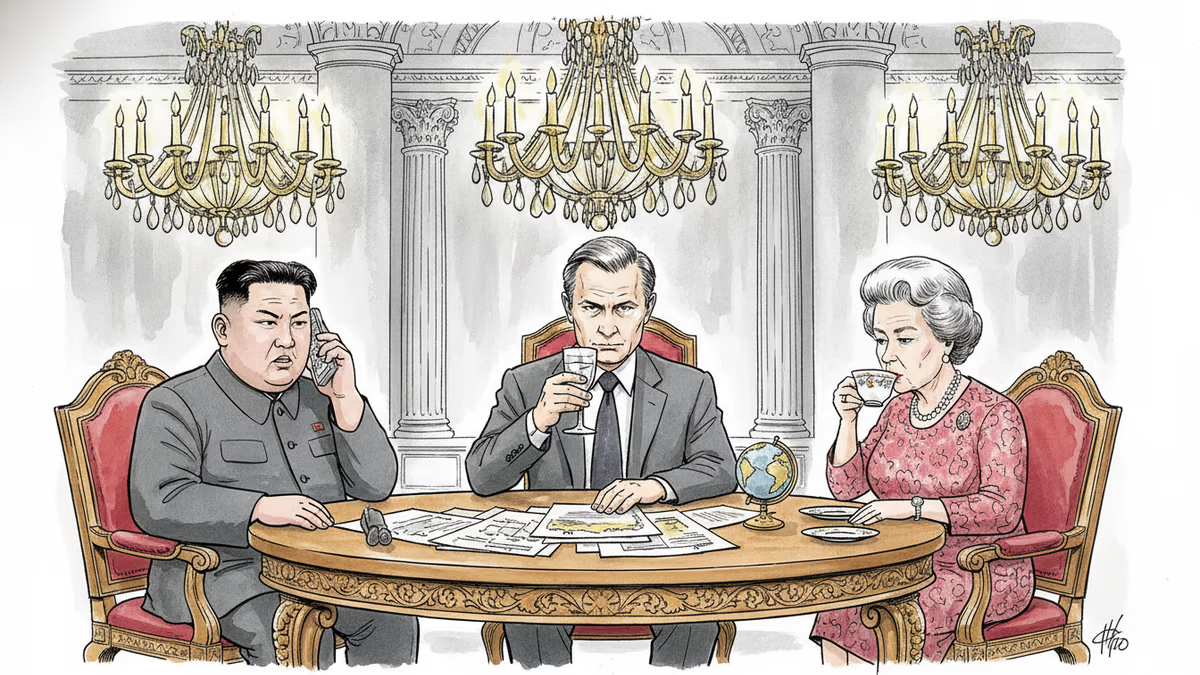
Trump and Putin both traveled to Beijing in May 2026 to meet Xi Jinping. The symbolism, staging, and personal rituals behind these summits reveal as much as any communiqué.
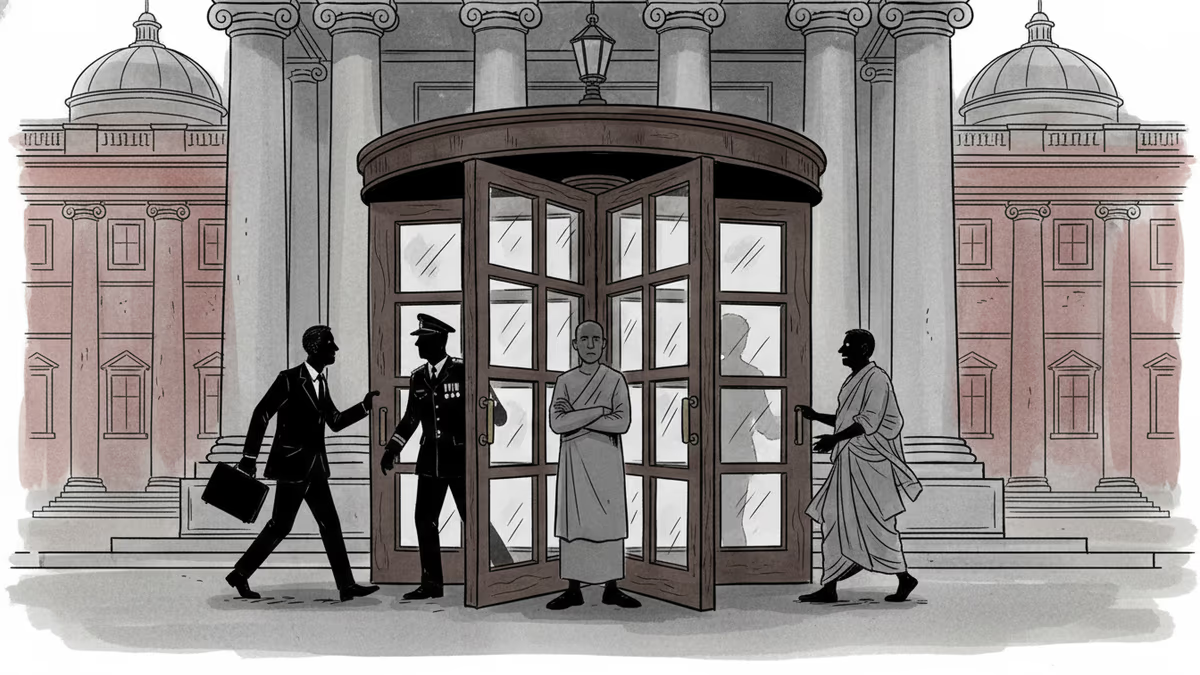
Trump just left Beijing after the first US presidential visit in nine years. Putin arrives Wednesday. Pakistan's PM follows. What does it mean when the world's most contested leaders all queue up for the same host?
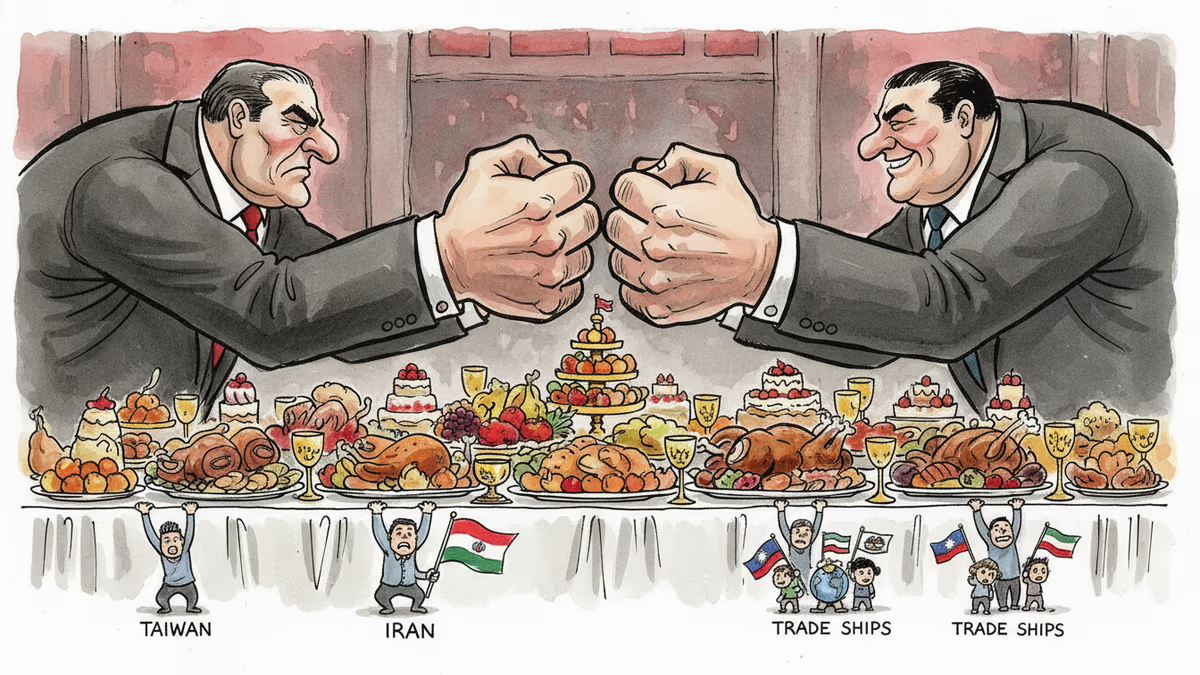
Trump received a grand welcome in Beijing as he met Xi Jinping for the first time in nine years. Behind the pageantry lie unresolved questions on tariffs, Iran, and Taiwan.
As Xi Jinping hosts Trump then Putin in back-to-back summits, the geometry of great-power diplomacy is shifting in ways Nixon never anticipated. Here's what the numbers reveal.
Trump and Putin both traveled to Beijing in May 2026 to meet Xi Jinping. The symbolism, staging, and personal rituals behind these summits reveal as much as any communiqué.
Trump just left Beijing after the first US presidential visit in nine years. Putin arrives Wednesday. Pakistan's PM follows. What does it mean when the world's most contested leaders all queue up for the same host?
Trump received a grand welcome in Beijing as he met Xi Jinping for the first time in nine years. Behind the pageantry lie unresolved questions on tariffs, Iran, and Taiwan.
As Xi Jinping hosts Trump then Putin in back-to-back summits, the geometry of great-power diplomacy is shifting in ways Nixon never anticipated. Here's what the numbers reveal.
Thoughts
Share your thoughts on this article
Sign in to join the conversation