
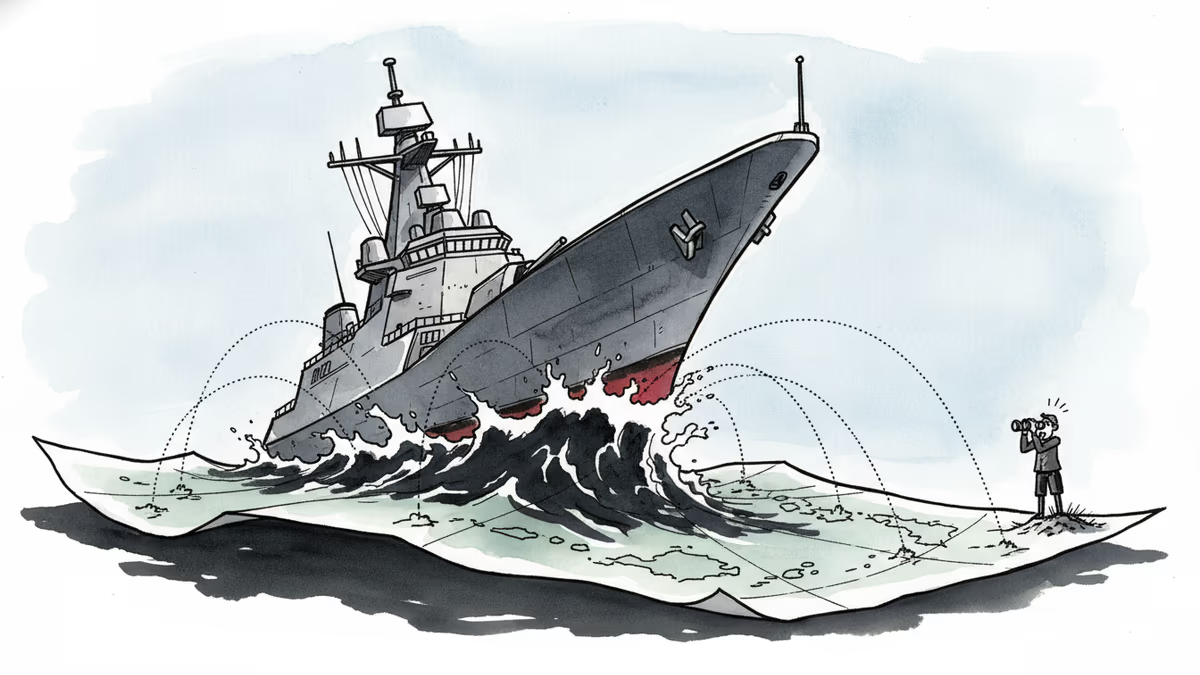
China's Newest Frigate Just Crossed the Line
China's Type 054B frigate joined the Liaoning carrier strike group in the Western Pacific for the first time—just 16 months after commissioning. Here's what that pace of integration signals.
Sixteen months from commissioning to carrier strike group deployment in the open Pacific. That's the timeline that's drawing attention in Tokyo, Washington, and every naval intelligence office tracking the People's Liberation Army Navy.
On May 26, Japan's Ministry of Defense announced that Maritime Self-Defense Force assets had monitored the Chinese aircraft carrier Liaoning and four escort vessels operating approximately 880 kilometers southwest of Okinotorishima—Japan's southernmost island—on May 25. The following day, Japanese forces confirmed repeated carrier-based aircraft and helicopter operations from the Liaoning's flight deck. Routine enough, by recent standards. What wasn't routine was the identity of one of the escorts: the Luohe (hull number 545), the PLAN's first operational Type 054B frigate, making its confirmed debut in a Chinese carrier strike group deployment.
What the Type 054B Actually Represents
The Type 054B—NATO designation Jiangkai III—is the designated successor to the Type 054A, which has served as China's primary multirole escort frigate for over a decade. The Luohe entered service in January 2025, and this deployment marks the first confirmed instance of the class operating as part of a carrier strike group beyond the First Island Chain.
Exact specifications remain classified, but analysts assess the 054B as a significant generational upgrade across sensors, anti-submarine warfare (ASW) capabilities, and blue-water endurance. Chinese military media has described the ship as featuring improved phased-array radar, upgraded sonar, enhanced stealth geometry, and—notably—AI-assisted battle management systems claimed to reduce air defense blind spots and compress reaction times during complex multi-vessel operations. The frigate is also assessed as capable of operating the Z-20F ASW helicopter, a meaningful upgrade over earlier PLAN frigates in the submarine-hunting role that is arguably the most critical mission for carrier escort vessels.
Also present in the formation: the Type 901 fast combat support ship Hulunhu. The inclusion of a large replenishment vessel is a deliberate signal. It means the PLAN wasn't running a short-range coastal exercise—it was practicing sustained far-seas operations far from mainland logistics infrastructure.
On May 19, Japan had also confirmed for the first time that the Luohe transited the Miyako Strait—the strategic chokepoint between Okinawa and Miyako Island—into the Western Pacific. That transit alone represented the first known deployment of a Type 054B beyond the First Island Chain.
The Architecture Taking Shape

The PLAN currently operates three aircraft carriers. The Liaoning and Shandong have been operational for several years. The Fujian, which commissioned in November 2025, is still building full operational capability but carries a meaningful distinction: electromagnetic catapults comparable to those on the U.S. Navy's Gerald R. Ford-class carriers, potentially enabling the launch of heavier, more capable aircraft.
What's emerging around these carriers is a layered strike group architecture that analysts are increasingly comparing to the U.S. Navy's carrier battle group model. The Type 055 Renhai-class destroyer—large, heavily armed, and equipped for long-range air defense—appears to function as the primary air defense and command platform. The Type 054B is being positioned as the ASW and close-escort specialist. Together, they form a tiered defensive envelope around the carrier.
This structural convergence matters more than any individual platform. Naval power isn't just about what ships a navy possesses—it's about how coherently those ships operate together. The speed at which China is integrating next-generation platforms into coordinated strike group operations is the metric that defense planners in Washington and Tokyo are watching most closely.
The timing of this particular deployment adds another layer. It coincided with a period of intensified U.S.-Japan and U.S.-Philippines military exercises around the First Island Chain and Taiwan's surrounding waters. Taiwanese analysts have suggested the Liaoning deployment may partly reflect Beijing's effort to project counter-pressure against growing allied military coordination in the region—a demonstration that China's naval reach extends well into the spaces those exercises are designed to secure.
How Different Capitals Read This
For Tokyo, the Miyako Strait has become one of the PLAN's primary Pacific gateways, and Chinese naval transits through it have increased steadily over the past decade. The first transit of China's newest frontline surface combatant through that chokepoint is not an abstraction—it's a data point in an accelerating trend line that directly shapes Japan's defense posture and acquisition priorities.
For Washington, the picture is more strategic. The PLAN's shift from fleet expansion to integrated carrier strike group proficiency represents a qualitative change in the challenge. A larger navy is one problem. A navy that can sustain coordinated multi-vessel operations thousands of kilometers from home ports—with replenishment, ASW coverage, and layered air defense—is a different order of problem.
Beijing's own framing, predictably, differs. Chinese officials and state media consistently characterize such deployments as the normal exercise of sovereign rights and as a legitimate counterbalance to U.S. military presence in East Asia. Whether the PLAN's expanding blue-water footprint is best understood as offensive posturing or as the predictable behavior of a rising power seeking strategic depth is a question that doesn't resolve cleanly along any single analytical axis.
For regional partners—South Korea, Australia, the Philippines—the calculus is more granular. Expanded PLAN carrier strike group operations in the Western Pacific affect the geometry of any contingency scenario involving the Korean Peninsula, the South China Sea, or the Taiwan Strait. It changes transit times, complicates deconfliction, and raises the operational cost of power projection for any party.
This content is AI-generated based on source articles. While we strive for accuracy, errors may occur. We recommend verifying with the original source.
Related Articles

Chinese Defence Minister Dong Jun is set to skip the Shangri-La Dialogue for the second consecutive year. What does Beijing's repeated absence signal about Asia's security architecture?
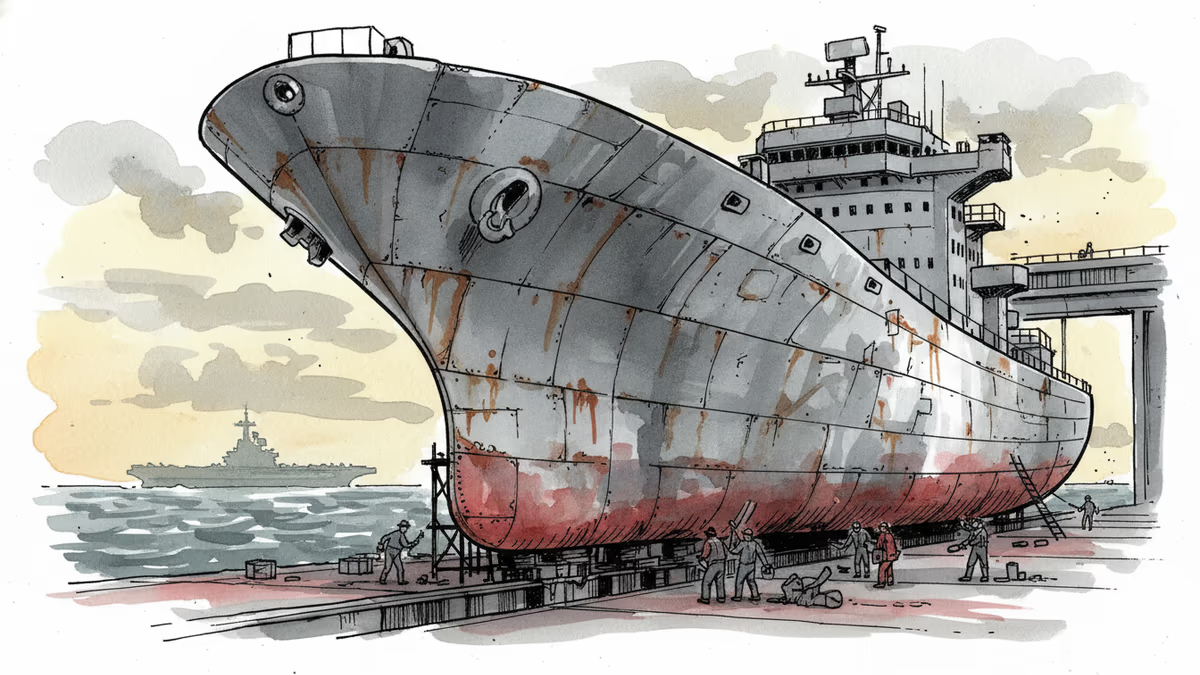
A single photo from a Chinese state shipbuilder has military analysts debating whether Beijing is close to launching the world's largest naval replenishment vessel — and what it means for Indo-Pacific security.
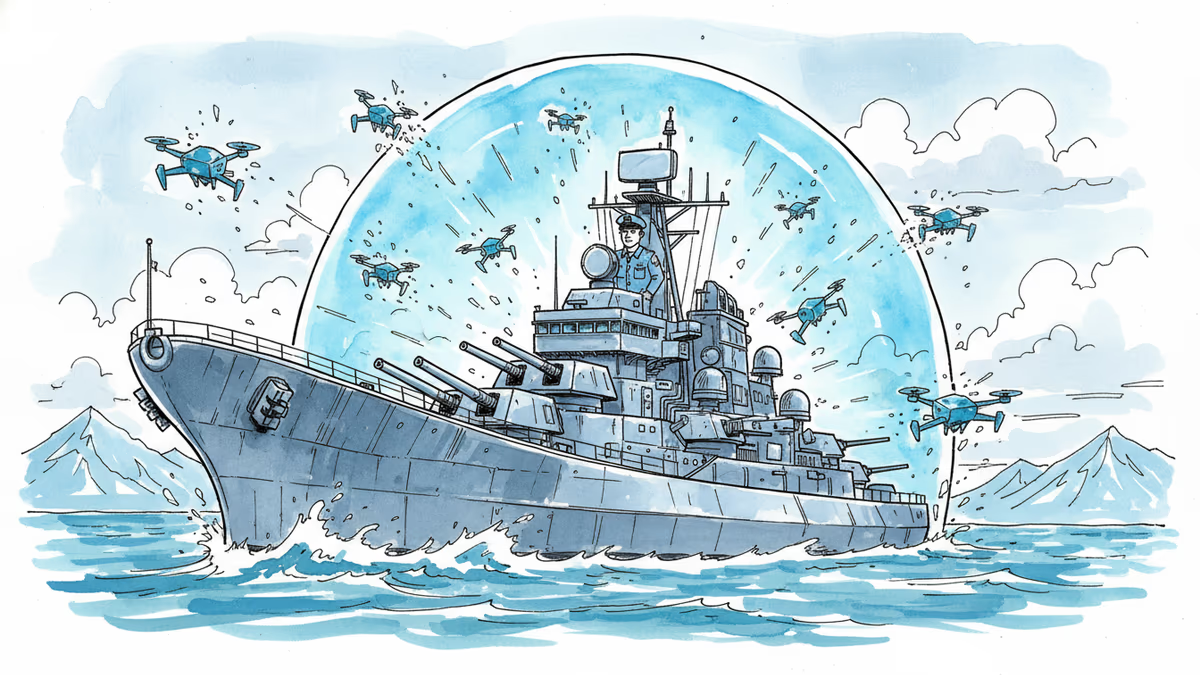
China's navy has successfully tested a new anti-drone air defense system in the Bohai Sea. The announcement reflects a broader arms race reshaping how every major naval power thinks about ship survivability.
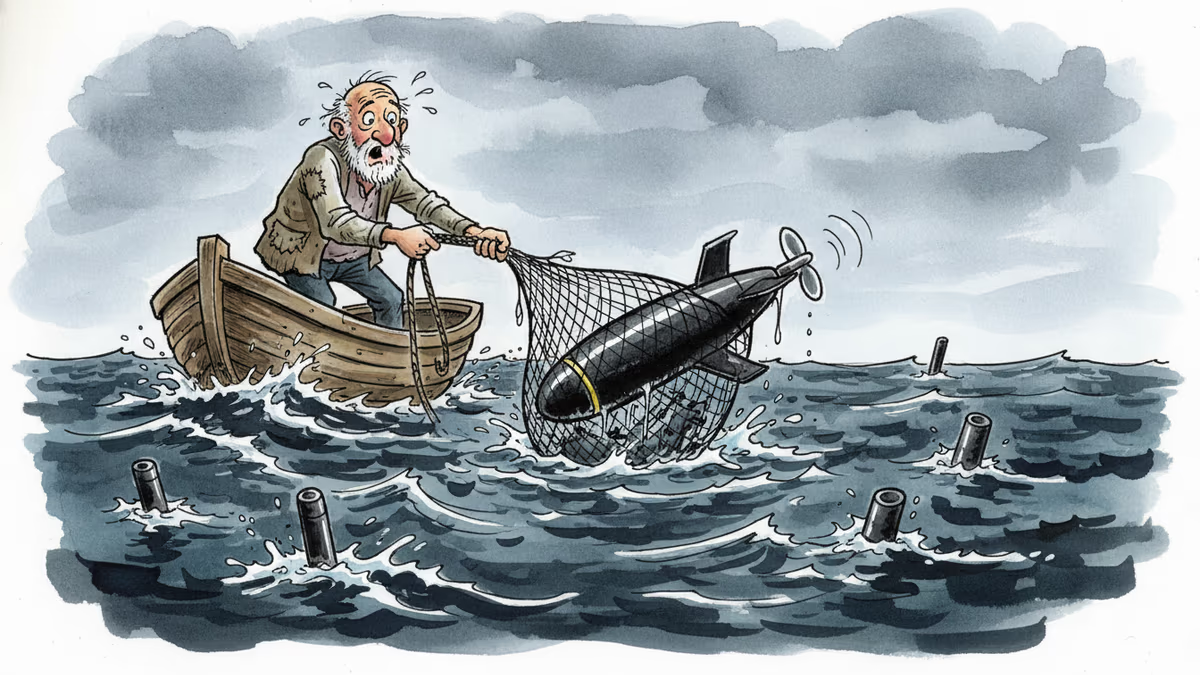
An Indonesian fisherman pulled a Chinese underwater drone from waters near the Lombok Strait—a critical deep-water passage to Australia. The find reveals a quiet but expanding pattern of Chinese subsurface surveillance across the Indo-Pacific.
Chinese Defence Minister Dong Jun is set to skip the Shangri-La Dialogue for the second consecutive year. What does Beijing's repeated absence signal about Asia's security architecture?
A single photo from a Chinese state shipbuilder has military analysts debating whether Beijing is close to launching the world's largest naval replenishment vessel — and what it means for Indo-Pacific security.
China's navy has successfully tested a new anti-drone air defense system in the Bohai Sea. The announcement reflects a broader arms race reshaping how every major naval power thinks about ship survivability.
An Indonesian fisherman pulled a Chinese underwater drone from waters near the Lombok Strait—a critical deep-water passage to Australia. The find reveals a quiet but expanding pattern of Chinese subsurface surveillance across the Indo-Pacific.
Thoughts
Share your thoughts on this article
Sign in to join the conversation