
China's New Shield: What It Signals About the Future of Naval Warfare
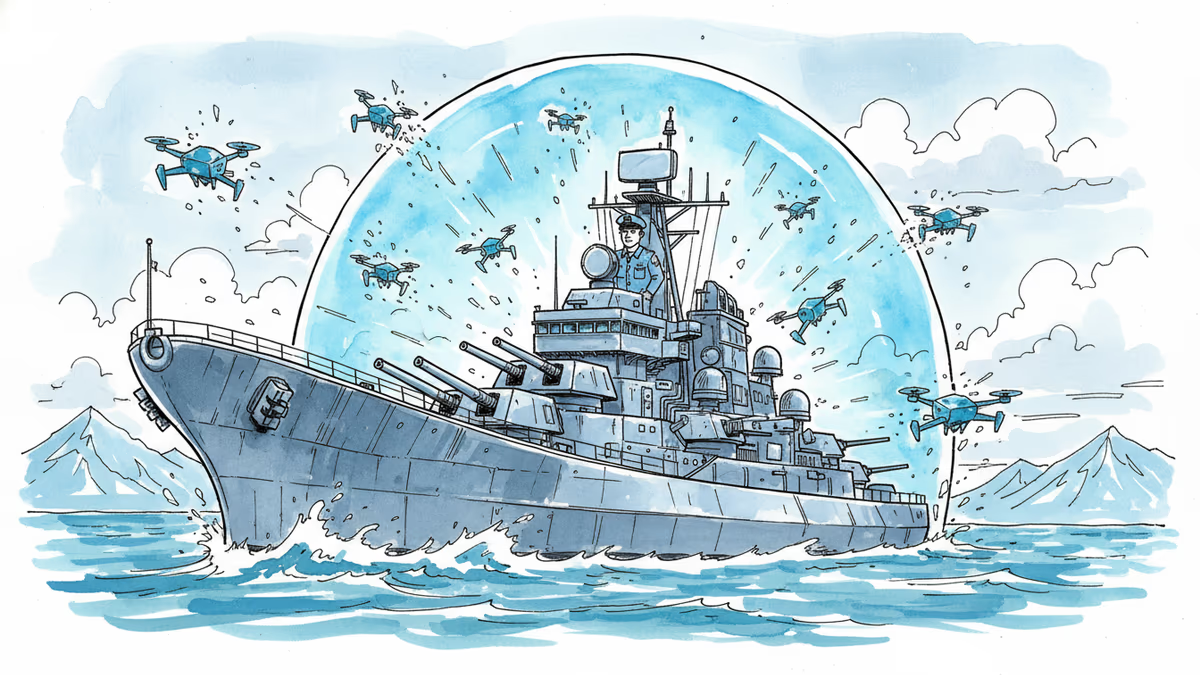
China's navy has successfully tested a new anti-drone air defense system in the Bohai Sea. The announcement reflects a broader arms race reshaping how every major naval power thinks about ship survivability.
A Ukrainian drone the size of a surfboard sank a Russian warship. That single fact rewrote the threat calculus for every admiral on earth.
Now China has announced its answer.
What Happened in the Bohai Sea
On Monday, China Central Television (CCTV) reported that the People's Liberation Army Navy had successfully completed a "finalisation test" of a new shipborne anti-drone air defense system. The test took place in the Bohai Sea—China's enclosed inner sea near Beijing, carefully shielded from foreign observation.
A finalisation test is not a prototype demonstration. It is the formal certification that a weapon system's design meets all operational requirements—the last bureaucratic gate before serial production and fleet deployment. In plain terms: this system is ready to go to sea.
CCTV disclosed no technical specifications—no engagement range, no intercept mechanism, no details on whether it handles drone swarms or individual targets. That silence is itself informative. State media announcements in China serve a dual function: signaling capability while withholding enough to preserve strategic ambiguity.
The Threat That Forced This Moment
The timing of this announcement is not incidental. It is a direct response to a pattern that has played out across three active conflict zones in the past four years.
In Ukraine, cheap maritime drones have systematically harassed and damaged Russia's Black Sea Fleet, forcing it to retreat from Crimean waters it once dominated. In the Red Sea, Houthi drone and missile attacks have disrupted global commercial shipping lanes and compelled the US and allied navies to burn through expensive interceptor missiles defending against far cheaper threats. In the Middle East more broadly, drone warfare has demonstrated that asymmetric aerial threats can hold sophisticated military assets at persistent risk.

The common thread: a low-cost drone can threaten a multi-billion-dollar warship. That asymmetry has forced every serious naval power to reckon with a question they once considered secondary—how do you protect a ship from the sky when the sky is filled with cheap, autonomous threats?
Where China Fits in the Broader Competition
China is not alone in racing toward an answer, but its strategic context gives this announcement particular weight.
The US Navy has been integrating laser-based systems like HELIOS and high-powered microwave weapons onto surface vessels. Britain's DragonFire laser system recently completed successful trials. Israel, with decades of layered air defense experience, has been adapting its expertise to maritime platforms. South Korea's LIG Nex1, whose Cheongung-II system has already been exported to the UAE, has been expanding its naval air defense portfolio as well.
But China's calculus is shaped by one specific geography: the Taiwan Strait. In any conflict scenario involving Taiwan, drone threats run in both directions. China would likely deploy drones offensively, but Taiwan—backed by US capabilities—could use drones to target Chinese surface vessels. An effective anti-drone system doesn't just protect Chinese ships in general; it changes the survivability math in the scenario that Chinese military planners think about most.
That makes this announcement as much a geopolitical signal as a technical one.
What We Don't Know—and Why It Matters
The gaps in CCTV's report are significant. The most demanding challenge in modern naval drone defense isn't intercepting a single drone—it's handling a coordinated swarm attack, where dozens or hundreds of small drones approach simultaneously from multiple vectors. Whether this system addresses that problem remains unknown.
There is also the fundamental economics of the intercept equation. If a $500 drone requires a $100,000 missile to shoot down, the defender bleeds resources faster than the attacker. Effective anti-drone systems need to be cheap per kill—lasers and directed energy weapons are attractive precisely because their cost-per-shot is low. Whether China's new system uses kinetic interceptors, directed energy, electronic jamming, or some combination is not stated.
And then there is the pace of the offense-defense cycle itself. Drone technology has consistently evolved faster than the defensive systems designed to counter it. Smaller airframes, lower radar cross-sections, AI-enabled swarm coordination—each iteration raises the bar for defenders. A system that passes its finalisation test in 2026 may face a meaningfully different threat environment by 2028.
This content is AI-generated based on source articles. While we strive for accuracy, errors may occur. We recommend verifying with the original source.
Related Articles
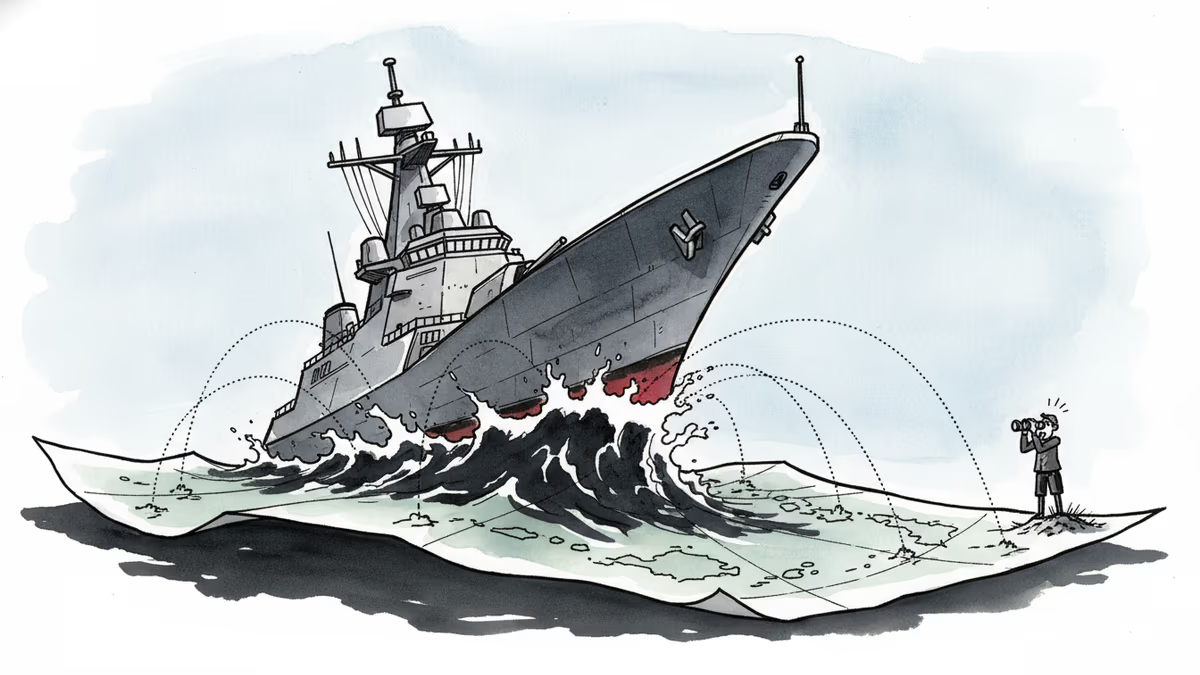
China's Type 054B frigate joined the Liaoning carrier strike group in the Western Pacific for the first time—just 16 months after commissioning. Here's what that pace of integration signals.

Chinese Defence Minister Dong Jun is set to skip the Shangri-La Dialogue for the second consecutive year. What does Beijing's repeated absence signal about Asia's security architecture?
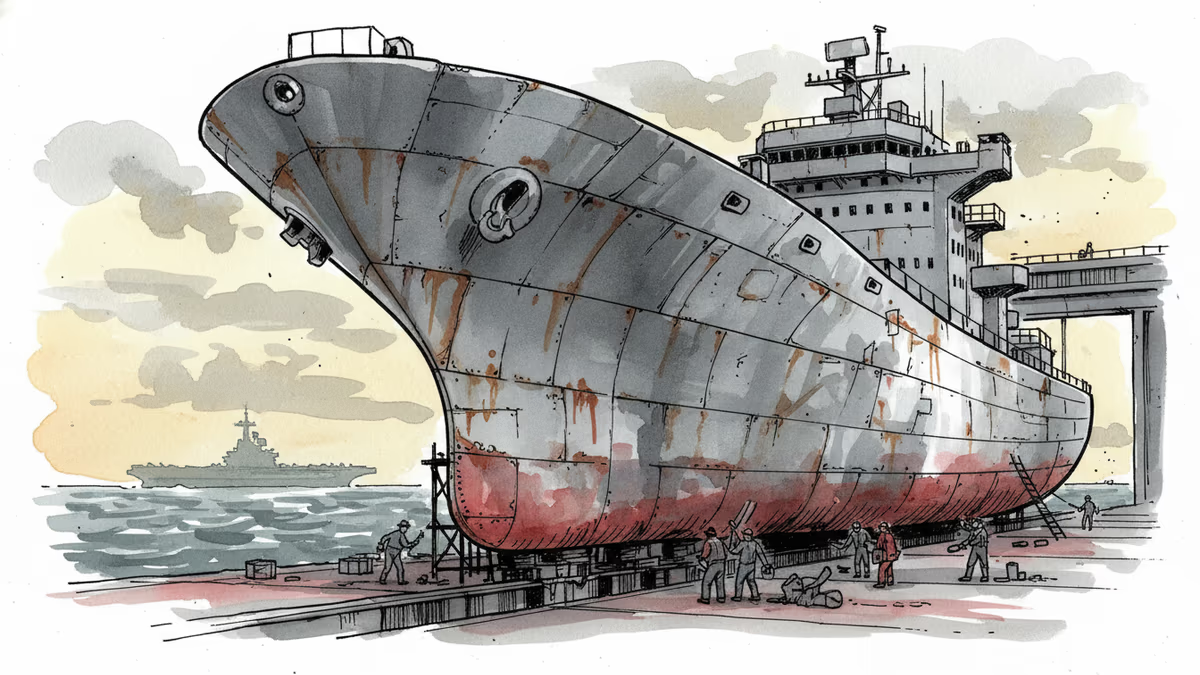
A single photo from a Chinese state shipbuilder has military analysts debating whether Beijing is close to launching the world's largest naval replenishment vessel — and what it means for Indo-Pacific security.
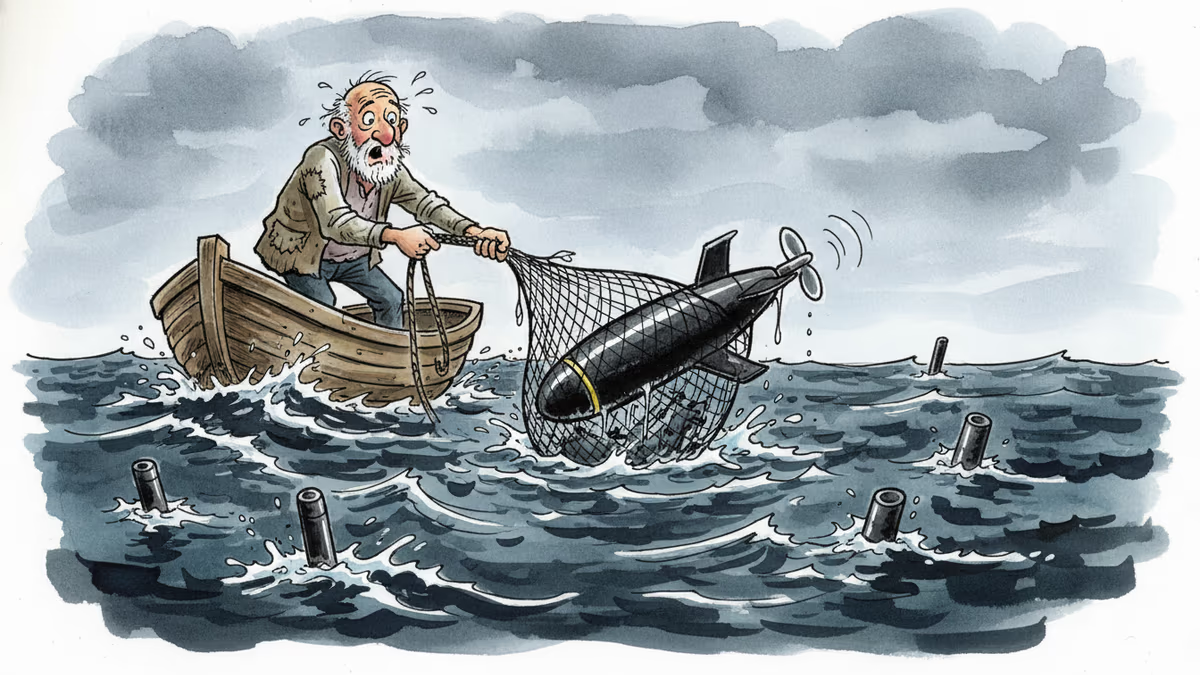
An Indonesian fisherman pulled a Chinese underwater drone from waters near the Lombok Strait—a critical deep-water passage to Australia. The find reveals a quiet but expanding pattern of Chinese subsurface surveillance across the Indo-Pacific.
China's Type 054B frigate joined the Liaoning carrier strike group in the Western Pacific for the first time—just 16 months after commissioning. Here's what that pace of integration signals.
Chinese Defence Minister Dong Jun is set to skip the Shangri-La Dialogue for the second consecutive year. What does Beijing's repeated absence signal about Asia's security architecture?
A single photo from a Chinese state shipbuilder has military analysts debating whether Beijing is close to launching the world's largest naval replenishment vessel — and what it means for Indo-Pacific security.
An Indonesian fisherman pulled a Chinese underwater drone from waters near the Lombok Strait—a critical deep-water passage to Australia. The find reveals a quiet but expanding pattern of Chinese subsurface surveillance across the Indo-Pacific.
Thoughts
Share your thoughts on this article
Sign in to join the conversation