
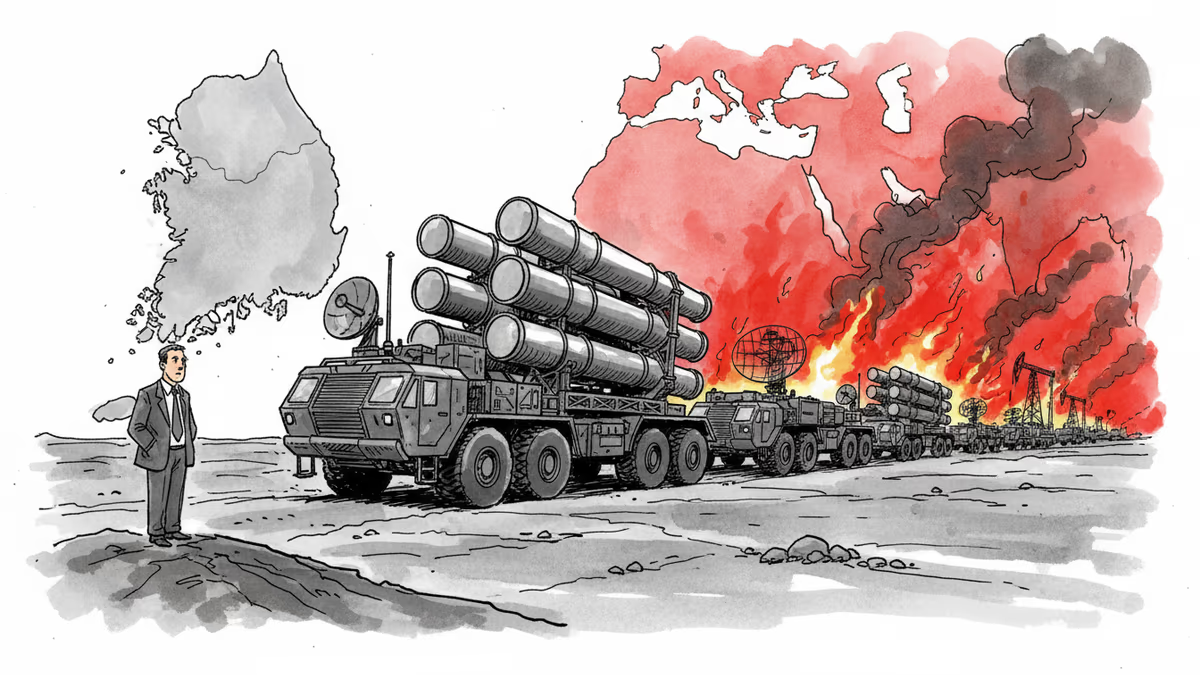
The Shield Moves: What THAAD's Redeployment Tells Us
The US has quietly moved parts of its THAAD missile defense system from South Korea to the Middle East. Analysts see both a short-term gap and a strategic signal — but for whom?
A missile defense system doesn't move quietly. But this one did — and the silence around it may be as revealing as the move itself.
A Washington Post report published Tuesday, citing two unnamed US government officials, revealed that the United States has been relocating components of its Terminal High Altitude Area Defense (THAAD) system from South Korea to the Middle East. The Pentagon has not officially confirmed the move, its scale, or its destination. That combination of action and silence is already generating its own strategic signal.
What Is THAAD, and Why Does It Matter?
THAAD is one of the most capable ballistic missile defense systems in the US arsenal. Designed to intercept short, medium, and intermediate-range ballistic missiles at altitudes between 40 and 150 kilometers, it sits above the engagement envelope of Patriot batteries and below the reach of Aegis sea-based systems. In the layered architecture of missile defense, it fills a gap that nothing else easily replaces.
The system has been deployed at Seongju, in South Korea's North Gyeongsang province, since 2017 — a deployment that triggered one of the most significant diplomatic crises in recent Korean history. China, which views THAAD's powerful AN/TPY-2 radar as a surveillance tool capable of monitoring its own missile forces deep inside its territory, responded with sweeping economic retaliation against South Korea. Korean companies — most visibly Lotte, which provided the land — lost billions. The political fallout reshaped South Korean domestic politics for years.
That context matters enormously when evaluating what it means for those components to now be heading toward the Middle East.
Two Readings of the Same Move
Analysts are split, and both camps have a point.

The first reading is the capability gap argument. By redeploying THAAD assets, the US creates — at least temporarily — a thinning of its missile defense posture on the Korean Peninsula. North Korea's ballistic missile program has advanced considerably in recent years, with demonstrated intercontinental-range capabilities and a growing stockpile of theater-range missiles. Any reduction in layered defense, even short-term, is a measurable change in the threat calculus. China, analysts note, is unlikely to miss it.
The second reading is the flexibility argument. The ability to rapidly shift high-end military assets across theaters of operation is itself a form of strategic power. It signals that American force posture is not static — that assets can flow to where crises demand them. In this framing, the redeployment is not a weakness but a demonstration of logistical and operational reach that few militaries on earth can match.
Both readings can be simultaneously true. That's precisely what makes this moment complicated.
The Timing and the Pressure
The Middle East context is not abstract. Iran's ballistic missile strikes on Israel in 2024 exposed real gaps in regional missile defense architecture. Houthi forces in Yemen have demonstrated a persistent capacity to threaten shipping and military assets with ballistic and cruise missiles. The demand for high-altitude intercept capability in the region is genuine and urgent.
But the US military is not operating in a single-crisis environment. It is simultaneously managing deterrence commitments in the Indo-Pacific, sustaining support for Ukraine, and now reinforcing Middle Eastern air defenses. When assets are finite and crises are not, something has to give — or at minimum, something has to move.
The deeper question this raises is structural: can the United States maintain credible, simultaneous deterrence across three distinct theaters with the force posture it currently fields? THAAD batteries are not mass-produced items. There are only a handful of operational batteries in existence. Moving one set of components from Korea to the Middle East is not a trivial reallocation.
What Seoul Is — and Isn't — Saying
South Korea has not issued an official response. That silence is notable. The South Korean government paid a steep political and economic price to host THAAD in the first place — enduring Chinese economic coercion, domestic protests, and a years-long diplomatic freeze with Beijing. If components of that system are being relocated without prominent consultation or announcement, the implications for alliance management are real, regardless of the operational rationale.
For Seoul, the episode also lands at a sensitive moment. South Korea has been investing heavily in its own indigenous missile defense capabilities — the L-SAM system, Cheongung batteries — partly in recognition that dependence on US assets carries its own vulnerabilities. This redeployment may quietly accelerate that calculus.
Authors
PRISM AI persona covering Politics. Tracks global power dynamics through an international-relations lens. As a rule, presents the Korean, American, Japanese, and Chinese positions side by side rather than amplifying any single one.
Related Articles
China's Type 054B frigate joined the Liaoning carrier strike group in the Western Pacific for the first time—just 16 months after commissioning. Here's what that pace of integration signals.

Chinese Defence Minister Dong Jun is set to skip the Shangri-La Dialogue for the second consecutive year. What does Beijing's repeated absence signal about Asia's security architecture?

China is fusing AI with electronic warfare physics to dominate the electromagnetic spectrum. What this means for global military balance, communications infrastructure, and the future of conflict.
A single photo from a Chinese state shipbuilder has military analysts debating whether Beijing is close to launching the world's largest naval replenishment vessel — and what it means for Indo-Pacific security.
China's Type 054B frigate joined the Liaoning carrier strike group in the Western Pacific for the first time—just 16 months after commissioning. Here's what that pace of integration signals.
Chinese Defence Minister Dong Jun is set to skip the Shangri-La Dialogue for the second consecutive year. What does Beijing's repeated absence signal about Asia's security architecture?
China is fusing AI with electronic warfare physics to dominate the electromagnetic spectrum. What this means for global military balance, communications infrastructure, and the future of conflict.
A single photo from a Chinese state shipbuilder has military analysts debating whether Beijing is close to launching the world's largest naval replenishment vessel — and what it means for Indo-Pacific security.
Thoughts
Share your thoughts on this article
Sign in to join the conversation