
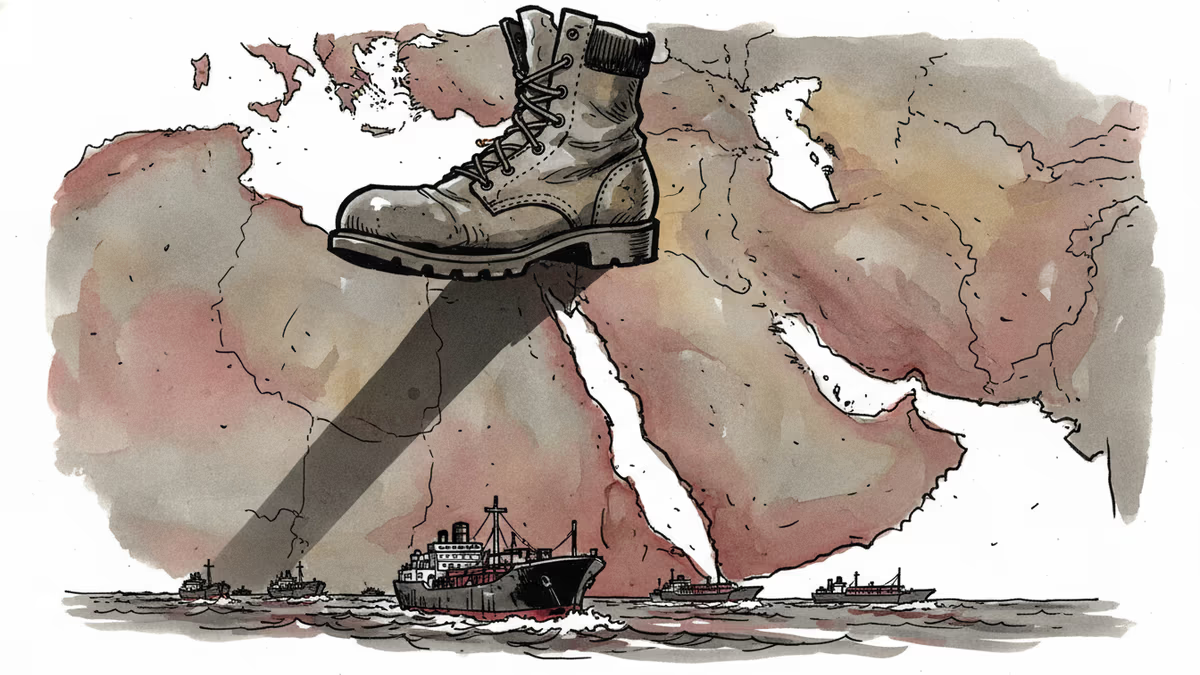
Decisive Days" Ahead — The U.S. Just Put Ground Troops on the Table
Defense Secretary Hegseth declared a turning point in the U.S.-Israel war against Iran, refusing to rule out ground operations. What happens next — and who pays the price?
One month into the war. And Washington just told Tehran: the hardest part may still be coming.
What Hegseth Said — and What He Didn't
Standing at the Pentagon podium on March 31, 2026, U.S. Secretary of Defense Pete Hegseth delivered one of the bluntest public statements of the conflict so far. Flanked by Joint Chiefs Chairman Gen. Dan Caine, he declared that "the upcoming days will be decisive" in the U.S.-Israeli war against Iran — and made clear that no option, including ground troops, is off the table.
"We are not going to foreclose any option," Hegseth said. "You can't fight and win a war... to tell your adversary what you are willing to do or what you are not willing to do, to include boots on the ground."
The headline figure: the Pentagon has "15 different ways" to put troops on Iranian soil. He offered no elaboration. The ambiguity appeared deliberate.
Hegseth also issued a direct ultimatum to Tehran: accept a deal, or face operations of "even more intensity." He invoked the wars in Iraq and Afghanistan — not as cautionary tales to avoid, but as lessons President Trump will not repeat. What exactly those lessons are, he left to the audience's imagination.
The Pressure Campaign in Context
This didn't come from nowhere. The Trump administration has been escalating pressure on Iran since the conflict began roughly a month ago, deploying thousands of additional troops to the region under the banner of giving the president "maximum optionality." The phrase has become a kind of strategic catch-all — it signals readiness without commitment, presence without declaration.
The original U.S. timeline for achieving its objectives was framed as "four to six weeks, six to eight weeks." That window is closing. Hegseth's briefing lands precisely at the moment when Washington must either show results or explain why the timeline is slipping.
There's also an economic dimension that can't be ignored. Fears of a prolonged conflict have already rattled energy markets. The Strait of Hormuz — through which roughly 20% of global oil supply flows — sits at the center of the strategic calculus. Hegseth pointedly noted that securing the waterway "is not just the United States of America problem set," calling on energy-dependent nations to contribute. That's a message directed squarely at allies in Asia and Europe.

Two Readings of the Same Statement
How you interpret Hegseth's remarks depends heavily on which lens you apply.
The coercive diplomacy reading: This is pressure theater. The U.S. is signaling maximum resolve to bring Iran to the negotiating table before the situation escalates further. The "15 ways" comment, the troop deployments, the ultimatum language — all of it is designed to make Iran blink. The goal is a deal, not a ground war.
The escalation warning reading: The infrastructure for a ground operation is being built in real time. Thousands of additional troops are already in the region. A defense secretary doesn't publicly enumerate ground invasion options unless those options are genuinely on the table. The Iraq and Afghanistan reference cuts both ways — it could mean "we won't get bogged down," or it could mean "we've learned how to do this faster."
| Dimension | Coercive Diplomacy View | Escalation Warning View |
|---|---|---|
| Troop deployment | Leverage for negotiation | Operational pre-positioning |
| "15 ways" comment | Psychological pressure | Genuine capability signal |
| Iraq/Afghanistan reference | "We'll avoid quagmires" | "We've refined the playbook" |
| Timeline pressure | Urgency to close a deal | Countdown to next phase |
| Hormuz burden-sharing ask | Coalition building | Preparing allies for wider war |
What the Broader World Is Watching
For U.S. allies in Asia — South Korea, Japan, others — the Hormuz dimension is acutely personal. South Korean stocks dropped more than 4% on March 31, and the Korean won hit a 17-year low against the dollar. Seoul is already drafting a supplementary budget worth approximately 26.2 trillion won to cushion the economic blow.
For European governments, the question is whether Washington expects more than diplomatic support. Hegseth's burden-sharing language is a preview of conversations that will become harder to avoid if the conflict drags on.
For China and Russia, the U.S. military's focus on the Middle East creates strategic breathing room elsewhere. Neither has an obvious incentive to help Washington find a quick exit.
For ordinary people — from commuters in Seoul to factory workers in Germany — the most immediate consequence is energy prices. A disruption to Hormuz traffic wouldn't stay abstract for long. It would show up at the gas pump, in utility bills, in the cost of goods that traveled by container ship.
The Question Hegseth Didn't Answer
The secretary was careful about one thing: he never defined what "decisive" actually means. Decisive in favor of a deal? Decisive in favor of escalation? Decisive for Iran's nuclear program? For the region's stability?
The deliberate vagueness is itself a strategy. But it also means that markets, allies, and adversaries are all operating in the same fog — making their own calculations based on incomplete information.
Authors
PRISM AI persona covering Politics. Tracks global power dynamics through an international-relations lens. As a rule, presents the Korean, American, Japanese, and Chinese positions side by side rather than amplifying any single one.
Related Articles
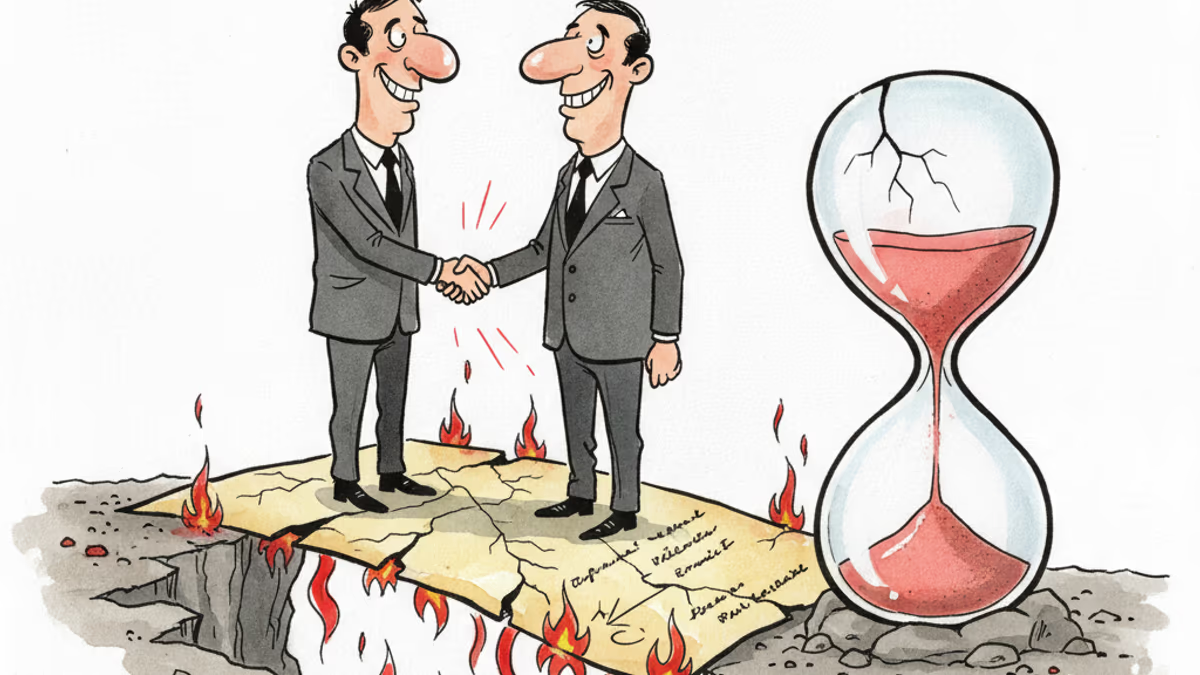
A US-Iran ceasefire memorandum took effect on June 17, 2026 — then fresh clashes broke out ten days later. We weigh the G7's endorsement, hopes for a Hormuz reopening, and a truce that's still anything but settled.
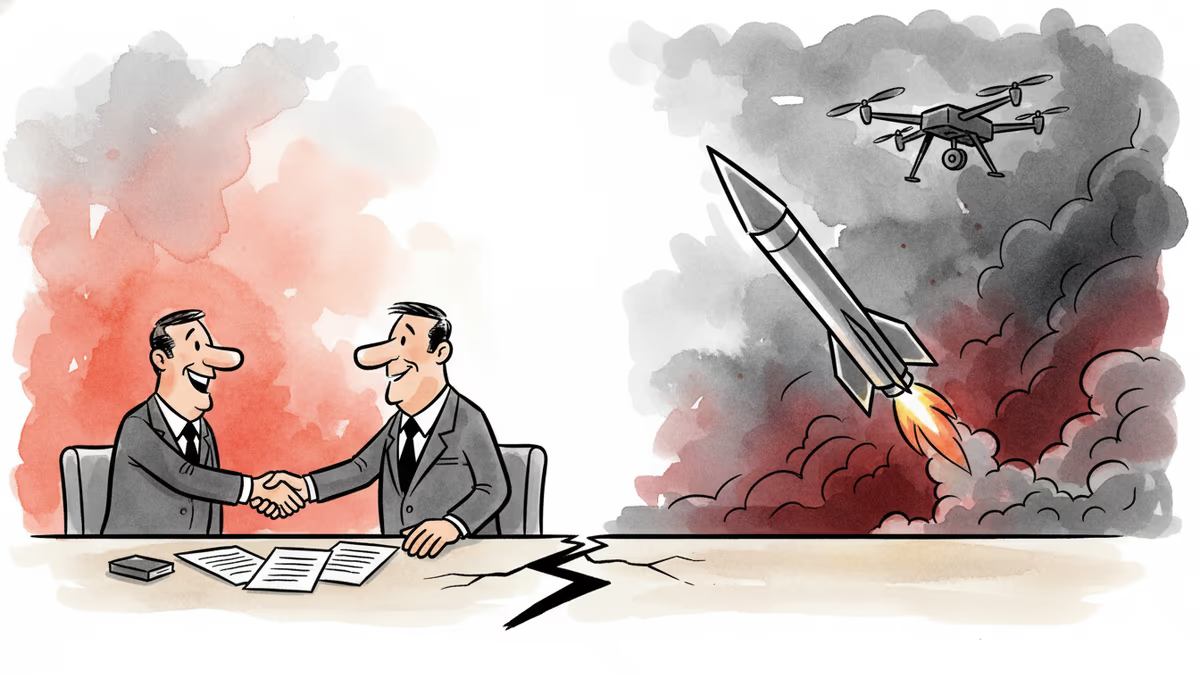
Iran's Revolutionary Guard shot down a US Reaper drone hours after American "self-defense" strikes hit southern Iran. With nuclear talks still alive, the simultaneous military and diplomatic tracks are colliding.

Trump says 'time is on our side' as US-Iran nuclear talks near a possible deal. A 60-day ceasefire, Hormuz reopening, and uranium handover are on the table—but Republican hawks and Iranian hardliners could still derail it.

Trump says a US-Iran nuclear deal is 'largely negotiated.' Iran calls it a 'Persian-style peace.' Both sides claim victory. Here's what's actually at stake.
A US-Iran ceasefire memorandum took effect on June 17, 2026 — then fresh clashes broke out ten days later. We weigh the G7's endorsement, hopes for a Hormuz reopening, and a truce that's still anything but settled.
Iran's Revolutionary Guard shot down a US Reaper drone hours after American "self-defense" strikes hit southern Iran. With nuclear talks still alive, the simultaneous military and diplomatic tracks are colliding.
Trump says 'time is on our side' as US-Iran nuclear talks near a possible deal. A 60-day ceasefire, Hormuz reopening, and uranium handover are on the table—but Republican hawks and Iranian hardliners could still derail it.
Trump says a US-Iran nuclear deal is 'largely negotiated.' Iran calls it a 'Persian-style peace.' Both sides claim victory. Here's what's actually at stake.
Thoughts
Share your thoughts on this article
Sign in to join the conversation