
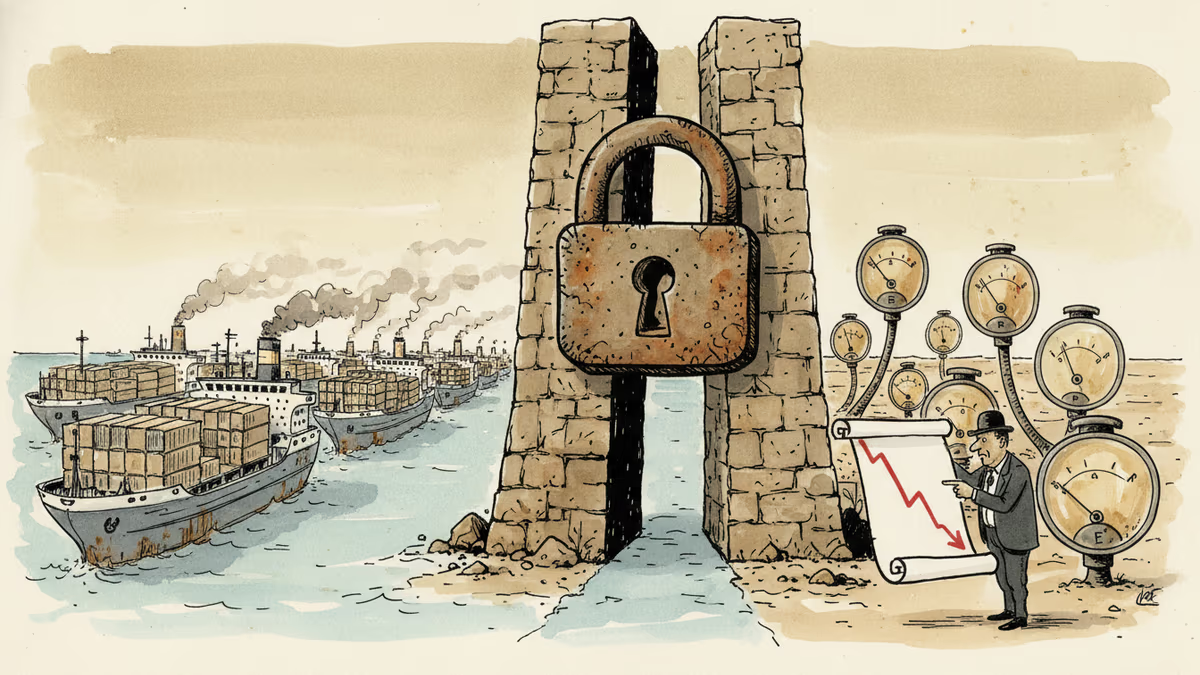
The Strait Stays Quiet—And the World Pays
The UN has cut its 2026 global growth forecast to 2.5%, citing the Iran war's disruption of Hormuz shipping. Even after a ceasefire, only 10 ships a day pass where 130 once did.
A ceasefire was declared on April 8. The ships still aren't moving.
Before the US and Israel launched their war on Iran on February 28, roughly 130 commercial vessels transited the Strait of Hormuz every day. As of Monday, that number stood at 10, according to maritime intelligence firm Windward. The guns have largely fallen silent. The tankers have not returned. And the global economy is now being handed the bill.
What the UN Is Actually Saying
The UN Department of Economic and Social Affairs released its mid-year economic outlook on Tuesday, cutting its 2026 global GDP growth forecast from 2.7% to 2.5%, and trimming 2027's projection from 2.9% to 2.8%. The International Monetary Fund had already moved in the same direction in April, downgrading its own forecast from 3.3% to 3.1%.
The numbers themselves are notable. But the language around them is what commands attention.
Shantanu Mukherjee, director of economic analysis at the UN's economic division, described what began as a "blow to energy markets" as having evolved into a "broader supply shock of uncertain scope, magnitude and duration that is rippling across the world." He was careful to emphasize that the baseline forecast assumes oil prices begin easing in the second half of the year, and that governments can partially offset the shock by drawing on fuel reserves. Remove those assumptions, and the picture darkens considerably.
In an adverse scenario, Mukherjee said, global growth could slow to just 2.1% — a level that, outside the COVID-19 pandemic and the 2007–2009 financial crisis, would rank among the worst performances of the 21st century.
"Our numbers right now are coming with a significant amount of uncertainty," he told reporters. "And uncertainty… in and of itself is a significant drag on the economy."
Who Gets Hit Hardest

The geographic distribution of pain is uneven, and the pattern is familiar.
Western Asia faces the sharpest regional slowdown, with its 2026 growth forecast slashed from 4.1% to 1.4% — a 2.7 percentage point drop. The Caribbean, West Africa, Central Africa, South-Eastern Europe, and the United Kingdom each saw their forecasts cut by 0.4 to 0.5 percentage points.
The world's two largest economies were left untouched. The US holds at 2.0% growth; China at 4.6%. Both have greater insulation — the US through domestic energy production, China through diversified supply relationships and strategic reserves.
Developing nations, by contrast, are expected to grow 1.3 percentage points below their pre-pandemic average this year. For the global economy as a whole, the shortfall is 0.7 percentage points. The gap between those two figures captures a recurring feature of global crises: the countries least responsible for the disruption tend to absorb the most damage.
That asymmetry has consequences beyond growth statistics. Slower growth in lower-income economies means slower poverty reduction, higher food prices driven by energy costs, and the potential for social instability — the kinds of second-order effects that rarely appear in GDP forecasts but eventually show up in refugee flows, political upheaval, and humanitarian appeals.
Why the Ceasefire Isn't Enough
The puzzle at the center of this story is why a ceasefire hasn't restored shipping. The answer lies in the nature of risk pricing.
Insurance underwriters and shipping operators don't respond to political announcements — they respond to verified, stable conditions. As long as Iran has not formally and credibly withdrawn its threat of attacks on commercial vessels, the actuarial math doesn't change. A ship owner weighing a Hormuz transit still faces the possibility of losing a vessel worth hundreds of millions of dollars. The ceasefire reduces the probability of that outcome; it does not eliminate it.
This is the mechanism Mukherjee was pointing to when he called uncertainty "a significant drag." It's not just that oil is expensive. It's that no one knows for how long, or what triggers the next escalation. Businesses delay investment. Consumers pull back. Financial markets price in volatility. Each of these rational individual responses compounds into a collective slowdown that the original military action alone could not have produced.
Optimists have a case to make. Saudi Arabia and other Gulf producers have been increasing output to compensate for Hormuz disruptions. Strategic petroleum reserves across the US, Europe, and Asia have been activated. Diplomatic back-channels between Washington and Tehran remain open, and a more durable agreement could shift the situation quickly. The UN's own baseline scenario banks on exactly this kind of gradual normalization.
But the baseline has been wrong before. In January, the UN forecast 2.7% growth for 2026. Four months and one war later, that number is 2.5% — with a credible path to 2.1% if conditions deteriorate.
This content is AI-generated based on source articles. While we strive for accuracy, errors may occur. We recommend verifying with the original source.
Related Articles

Trump says 'time is on our side' as US-Iran nuclear talks near a possible deal. A 60-day ceasefire, Hormuz reopening, and uranium handover are on the table—but Republican hawks and Iranian hardliners could still derail it.
Trump arrives in Beijing as the Iran war strains global energy markets. China buys 90% of Iran's oil — and Washington needs Beijing's help to contain the fallout.
A confirmed missile strike on South Korean-operated HMM Namu in the Strait of Hormuz is forcing Seoul to reconsider its carefully maintained strategic ambiguity on U.S.-led maritime security operations.
A federal court struck down Trump's sweeping 10% global tariff, ruling he overstepped his legal authority. His administration appealed within 24 hours. Here's what's really at stake.
Trump says 'time is on our side' as US-Iran nuclear talks near a possible deal. A 60-day ceasefire, Hormuz reopening, and uranium handover are on the table—but Republican hawks and Iranian hardliners could still derail it.
Trump arrives in Beijing as the Iran war strains global energy markets. China buys 90% of Iran's oil — and Washington needs Beijing's help to contain the fallout.
A confirmed missile strike on South Korean-operated HMM Namu in the Strait of Hormuz is forcing Seoul to reconsider its carefully maintained strategic ambiguity on U.S.-led maritime security operations.
A federal court struck down Trump's sweeping 10% global tariff, ruling he overstepped his legal authority. His administration appealed within 24 hours. Here's what's really at stake.
Thoughts
Share your thoughts on this article
Sign in to join the conversation