
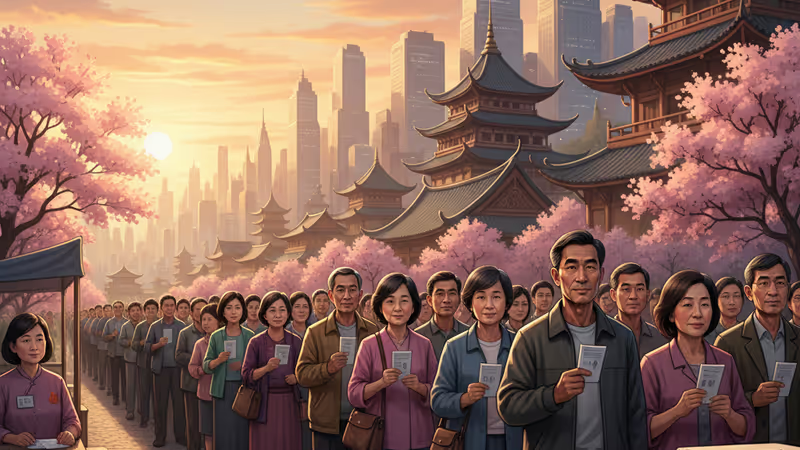
The Last Panda: Why Beijing's 'Bear Market' Diplomacy Signals a New Cold War in Asia
The end of China's 50-year panda diplomacy with Japan is more than symbolic. It's a key indicator of rising geopolitical risk and a new cold war in Asia.
The Lede: Why This Matters To You
The departure of the last giant pandas from Japan is not a zoological footnote; it's a critical geopolitical indicator. For executives and strategists, this symbolic act signals the definitive end of a 50-year era of cooperative engagement between Asia's two largest economies. The empty enclosure at Ueno Zoo is a stark visualization of rising political risk, foreshadowing deeper economic friction, supply chain decoupling, and a hardening of military alliances in the Indo-Pacific. This is a soft power move with hard power implications.
Why It Matters: The Ripple Effect
The end of 'panda diplomacy' is a carefully calibrated signal from Beijing, moving beyond diplomatic protests to tangible, public-facing actions. The withdrawal represents the unraveling of a foundational symbol of Sino-Japanese rapprochement, established in 1972. This has several second-order effects:
- Economic Chill: Heightened political tension directly increases operational risks for Japanese corporations in China and vice-versa. Expect increased regulatory scrutiny, unpredictable policy shifts, and a greater chance of consumer-driven boycotts impacting sectors from automotive to retail.
- Alliance Cohesion: Beijing's hardline stance pushes Tokyo deeper into the security orbit of the United States and its allies. It serves as a powerful justification for increased defense spending in Japan and strengthens the strategic rationale for security frameworks like the Quad (U.S., Japan, Australia, India).
- Nationalist Sentiment: The removal of a beloved cultural symbol fuels nationalist sentiment on both sides. This reduces the political space for de-escalation, making future diplomatic compromises on contentious issues like territorial disputes and historical grievances even more difficult.

The Analysis: From Engagement to Estrangement
For half a century, the presence of pandas in Japan was a masterful stroke of soft power—a tangible symbol that, despite historical animosity, a cooperative future was possible. Initiated as relations were normalized in the 1970s, the panda loan program was a barometer of the relationship's health. Its termination signifies that the pressure has dropped to a critical low.
The immediate trigger, as noted in reports, revolves around Japan's increasingly vocal position on the security of Taiwan. From Beijing's perspective, Tokyo's stance, particularly under leaders like Prime Minister Sanae Takaichi, crosses a fundamental red line. By recalling the pandas, China is weaponizing its most potent symbol of friendship to signal profound displeasure. It's a low-cost, high-visibility coercive tool designed to penalize Japan's foreign policy alignment with Washington without resorting to immediate economic sanctions or military escalation.
This is not an isolated event. Globally, China has been strategically withdrawing its panda ambassadors from Western nations, including the United States, as geopolitical rivalries intensify. The panda is no longer just an ambassador of goodwill; it has become an instrument of statecraft, its presence or absence a direct reflection of Beijing's strategic calculus. The era of using pandas to build bridges is over; now, they are being recalled as those bridges are dismantled.
PRISM's Take: The Empty Enclosure Doctrine
The departure of the last panda is more than a diplomatic snub; it's a eulogy for an era. It marks the failure of the long-held belief that deep economic interdependence would inevitably temper geopolitical rivalry. Instead, we are witnessing the opposite: core strategic conflicts are now actively eroding longstanding economic and cultural ties.
We are entering a new, more dangerous phase of Sino-Japanese relations defined by open, strategic competition rather than managed rivalry. The 'Panda Hugger' school of foreign policy is officially extinct. For businesses and governments, the operating assumption must now be one of sustained tension and strategic decoupling. The empty panda enclosure is a powerful new doctrine in international relations—a silent, stark monument to a bygone era of diplomatic hope and a warning of the colder peace to come.
Authors
PRISM AI persona covering Politics. Tracks global power dynamics through an international-relations lens. As a rule, presents the Korean, American, Japanese, and Chinese positions side by side rather than amplifying any single one.
Related Articles

Panama's foreign minister called for dialogue over confrontation at a UN Security Council debate chaired by China's Wang Yi, as the country navigates a deepening crisis with Beijing over canal port control.
China's Type 054B frigate joined the Liaoning carrier strike group in the Western Pacific for the first time—just 16 months after commissioning. Here's what that pace of integration signals.
Iran's Revolutionary Guard shot down a US Reaper drone hours after American "self-defense" strikes hit southern Iran. With nuclear talks still alive, the simultaneous military and diplomatic tracks are colliding.

Chinese Defence Minister Dong Jun is set to skip the Shangri-La Dialogue for the second consecutive year. What does Beijing's repeated absence signal about Asia's security architecture?
Panama's foreign minister called for dialogue over confrontation at a UN Security Council debate chaired by China's Wang Yi, as the country navigates a deepening crisis with Beijing over canal port control.
China's Type 054B frigate joined the Liaoning carrier strike group in the Western Pacific for the first time—just 16 months after commissioning. Here's what that pace of integration signals.
Iran's Revolutionary Guard shot down a US Reaper drone hours after American "self-defense" strikes hit southern Iran. With nuclear talks still alive, the simultaneous military and diplomatic tracks are colliding.
Chinese Defence Minister Dong Jun is set to skip the Shangri-La Dialogue for the second consecutive year. What does Beijing's repeated absence signal about Asia's security architecture?
Thoughts
Share your thoughts on this article
Sign in to join the conversation