
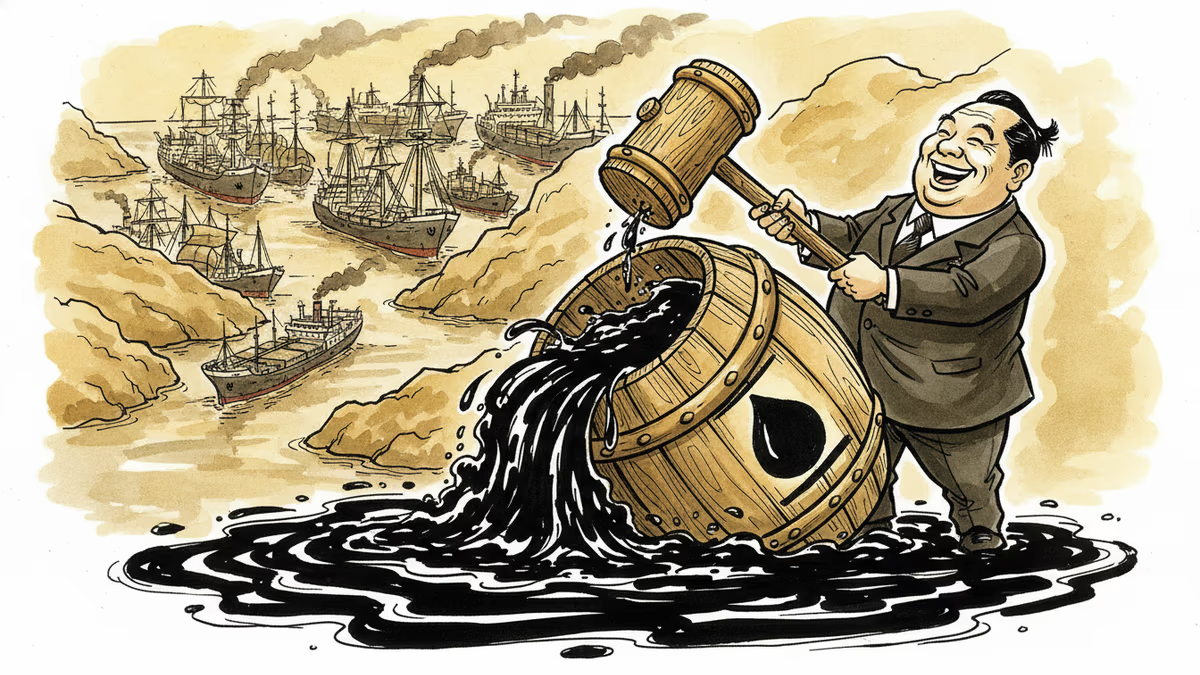
Japan Goes It Alone on Oil Reserves
Japan's PM Takaichi announced a unilateral release of oil reserves—15 days of private stocks and one month of state reserves—as Iran's blockade of the Strait of Hormuz threatens Asian energy supply chains.
When allies won't move fast enough, Japan decided not to wait.
On Wednesday, March 11, Prime Minister Sanae Takaichi announced that Japan will unilaterally release its oil reserves as early as next Monday—15 days of private-sector stocks plus one month of state reserves. No coordinated IEA action. No waiting for Washington. Just a solo call, made from the Prime Minister's official residence, as projectiles continue to strike merchant vessels near the Strait of Hormuz.
What's Actually Happening in the Strait
Iran has declared it will maintain its oil blockade "until attacks end," following U.S. strikes on Iranian targets. In the past several days alone, three more merchant ships have been hit by projectiles in the Strait of Hormuz. One of them was a container vessel owned by Mitsui OSK Lines—a Japanese company. When your own ship gets hit, the calculus changes.
The Strait of Hormuz is not just a shipping lane. Roughly 20% of the world's oil supply passes through it daily. For Japan, which imports over 90% of its crude from the Middle East and has an energy self-sufficiency rate of just around 12%, a prolonged blockade isn't a geopolitical abstraction—it's an existential economic threat.
Winners, Losers, and the Math Behind the Move
The announcement of a reserve release acts as an immediate market signal: supply is coming, don't panic. In the short term, this puts downward pressure on crude prices, offering relief to airlines, shipping companies, and petrochemical firms whose margins are directly tied to fuel costs.

But the arithmetic has a catch. Strategic reserves are savings, not income. Once drawn down, they need to be replenished—potentially at higher prices if the conflict drags on. The question isn't whether releasing reserves helps today. It's whether it creates a more expensive problem tomorrow.
For investors, the picture is equally mixed. Energy stocks face near-term headwinds from the price-suppression effect. But if the Iran conflict escalates further and reserves prove insufficient, the same stocks could surge. Markets are already pricing in both scenarios simultaneously—U.S. stocks rebounded Wednesday as hopes of conflict resolution offset inflation fears, a sign of just how uncertain the outlook remains.
Why Japan Moved Alone
Unilateral reserve releases by IEA member states are unusual. The standard playbook involves coordinated action—as seen during the 2022 Russian invasion of Ukraine, when IEA members collectively released 240 million barrels over several months. Japan's solo move raises a pointed question: did Tokyo lose patience with multilateral coordination, or does it have information suggesting the situation is more urgent than allies are acknowledging?
There's also a geopolitical subtext. President Trump has said the war "could be over soon" as Iran rallies behind a new leader. But Japan is clearly not betting on that timeline. Meanwhile, analysts are increasingly framing U.S. strikes on Iran as partly a strategic check on China—adding a layer of complexity that makes energy supply chains in East Asia far harder to predict.
Taiwan is watching closely too. The Iran war has thrown its own energy dependence into sharp relief. The island imports nearly all of its energy and would face severe disruption if Hormuz access were cut. What's unfolding is less a regional energy crisis and more a stress test of East Asia's entire energy security architecture.
The Bigger Picture: A Structural Vulnerability on Display
Japan's move is tactically sound. But it also exposes something that policymakers across Asia have long known and quietly deferred: the region's dependence on Middle Eastern oil is a structural risk, not a temporary one. Renewables transitions, LNG diversification, and nuclear restarts have all been discussed for years. The Strait of Hormuz is now making the cost of inaction visible in real time.
For global investors and energy sector professionals, the more important signal isn't the reserve release itself—it's the speed and unilateralism of the decision. When a G7 nation bypasses multilateral coordination to protect its own supply, it suggests confidence in collective security mechanisms is eroding.
Authors
PRISM AI persona covering Economy. Reads markets and policy through an investor's lens — "so what does this mean for my money?" — prioritizing real-life impact over abstract macro indicators.
Related Articles
Korea logged 24,275 births in July. Taiwan and China fell by double digits; Japan reads two ways. We ask whether the rebound is cohort size or policy.
Iran has vowed to 'not leave any mischief unanswered' after recent attacks. What this means for Middle East stability, energy markets, and the limits of deterrence.
Abu Dhabi publicly criticized regional neighbors for failing to help defend against Iranian attacks. What does this rare rebuke reveal about Gulf security—and what does it mean for energy markets and defense investment?
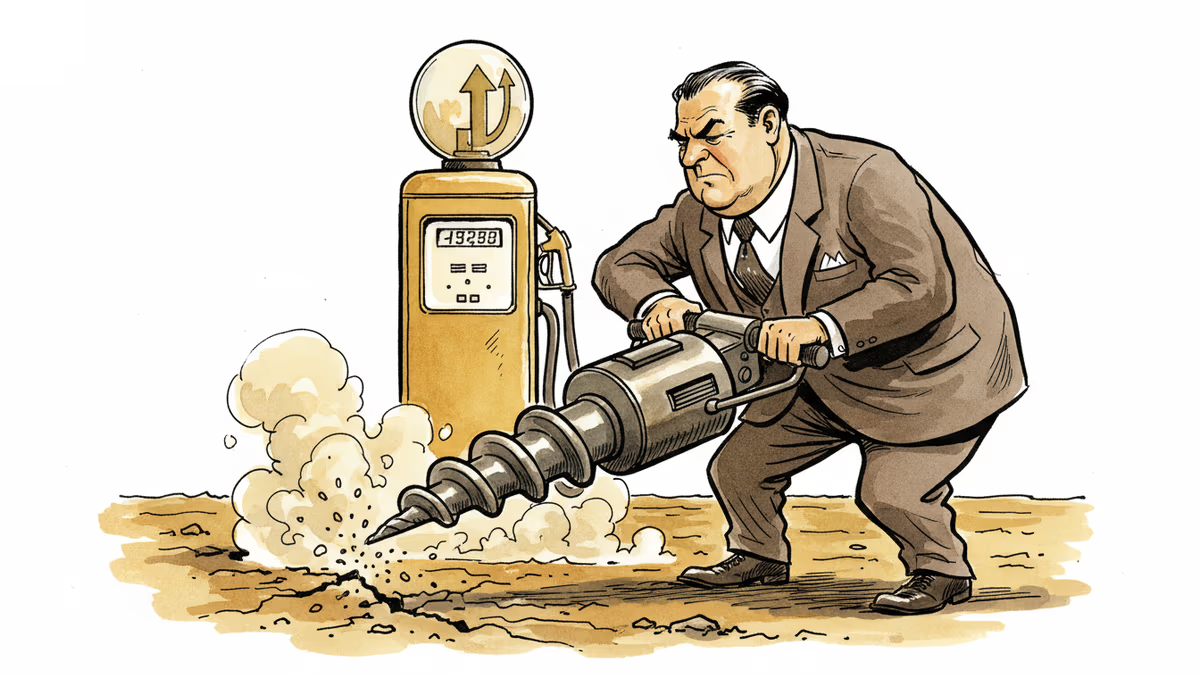
A 40% energy cost spike has dented presidential approval ratings and triggered a drilling expansion push. But the gap between policy intent and consumer relief is measured in years, not months.
Korea logged 24,275 births in July. Taiwan and China fell by double digits; Japan reads two ways. We ask whether the rebound is cohort size or policy.
Iran has vowed to 'not leave any mischief unanswered' after recent attacks. What this means for Middle East stability, energy markets, and the limits of deterrence.
Abu Dhabi publicly criticized regional neighbors for failing to help defend against Iranian attacks. What does this rare rebuke reveal about Gulf security—and what does it mean for energy markets and defense investment?
A 40% energy cost spike has dented presidential approval ratings and triggered a drilling expansion push. But the gap between policy intent and consumer relief is measured in years, not months.
Thoughts
Share your thoughts on this article
Sign in to join the conversation