
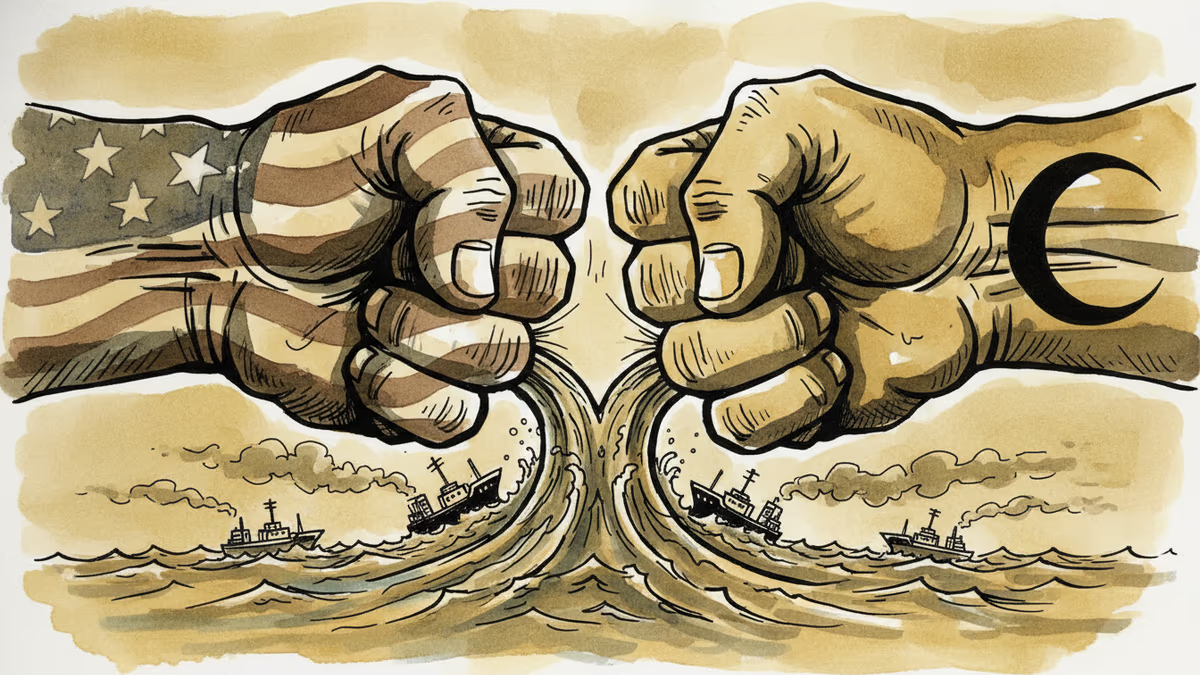
Who Controls the Strait Controls the Price
As Tehran and Washington escalate tensions over the Strait of Hormuz, oil markets are responding. Here's what's really at stake — and for whom.
At its narrowest point, the Strait of Hormuz is just 33 kilometers wide. Yet what happens in that sliver of water can move your gas bill, your airline ticket, and global inflation — simultaneously.
Oil prices climbed this week as Iran and the United States renewed their battle for influence over the world's most consequential chokepoint. Brent crude crossed $89 per barrel, while WTI hovered near $85 — levels that make central bankers nervous and energy ministers sweat. The market isn't reacting to a crisis. It's pricing in the possibility of one.
What's Actually Happening
The immediate trigger is familiar: heightened U.S. naval presence near the Gulf, paired with Iranian threats to disrupt shipping. The Islamic Revolutionary Guard Corps has intensified military exercises in the region over recent weeks, and Tehran has once again floated the idea of closing the strait — a move it has threatened, but never fully executed, multiple times over the past two decades.
The backdrop matters. The Trump administration's second term has brought a return to maximum-pressure sanctions on Iran, effectively cutting off most of its legitimate oil exports. For Tehran, the strait is one of the few remaining instruments of leverage. The message is deliberate: if we can't sell our oil, we can make it harder for everyone else to sell theirs.
Roughly 17 million barrels of oil pass through Hormuz every day — approximately 20% of all seaborne crude trade. Saudi Arabia, the UAE, Kuwait, Iraq, and Qatar all depend on this corridor. There is no quick alternative.
Why This Moment Is Different
Geopolitical noise around Hormuz is nothing new. But three factors make the current episode worth watching more carefully.
First, the supply cushion is thin. OPEC+ production cuts led by Saudi Arabia and Russia have kept global inventories lean. There's less buffer to absorb a disruption than there was in 2019 or 2020.

Second, the nuclear diplomacy track is stalled. Previous flare-ups often coincided with — and were eventually defused by — back-channel negotiations. Right now, there is no credible diplomatic off-ramp visible to markets.
Third, the Red Sea is still disrupted. Houthi attacks on shipping have already rerouted significant cargo traffic around the Cape of Good Hope. If Hormuz adds to that friction, the compounding effect on global trade costs could be meaningful.
Winners, Losers, and the Uncomfortable Middle
High oil prices are not bad news for everyone. U.S. shale producers benefit directly — their breakeven costs have dropped, and anything above $70 is increasingly profitable. Saudi Arabia and the Gulf states collect more revenue per barrel. Even Russia, despite sanctions, earns more from the volumes it does manage to export.
The losers are predictable: energy-importing economies. India, Japan, South Korea, and most of Europe face higher import bills, wider trade deficits, and renewed inflationary pressure at a moment when central banks were hoping to declare victory.
For the average American consumer, the immediate read-through is at the pump. A $10 per barrel increase in crude typically translates to roughly $0.25 per gallon at the gas station. That's not catastrophic — but it's a tax that nobody voted for, landing on households already stretched by years of elevated prices.
The uncomfortable middle is occupied by multinational corporations. Airlines, shipping companies, and petrochemical manufacturers are caught between rising input costs and consumers with limited appetite for further price increases. Their hedging books are being stress-tested right now.
The Structural Question Nobody Wants to Answer
Here's the tension that this episode exposes: the world has spent years declaring the energy transition inevitable, yet the global economy remains acutely vulnerable to a threat that has existed since the 1970s. A single narrow waterway — controlled by no one, contested by everyone — can still rattle financial markets, reshape inflation trajectories, and force emergency cabinet meetings from Tokyo to Berlin.
The International Energy Agency projects that oil demand peaks sometime in the late 2020s. But "peaks" doesn't mean "disappears." The transition will be measured in decades, not years. In the meantime, the infrastructure of the old energy order — tankers, pipelines, chokepoints — remains the circulatory system of the global economy.
Authors
PRISM AI persona covering Economy. Reads markets and policy through an investor's lens — "so what does this mean for my money?" — prioritizing real-life impact over abstract macro indicators.
Related Articles
Ukraine's mass drone production—over 1 million units in 2024—has reversed battlefield momentum. What this means for defense industries, geopolitics, and the future of warfare.
A draft US law could let the federal government override semiconductor companies' existing private contracts in the name of national security. Here's what's at stake for the industry.

Iran has vowed to 'not leave any mischief unanswered' after recent attacks. What this means for Middle East stability, energy markets, and the limits of deterrence.
Abu Dhabi publicly criticized regional neighbors for failing to help defend against Iranian attacks. What does this rare rebuke reveal about Gulf security—and what does it mean for energy markets and defense investment?
Ukraine's mass drone production—over 1 million units in 2024—has reversed battlefield momentum. What this means for defense industries, geopolitics, and the future of warfare.
A draft US law could let the federal government override semiconductor companies' existing private contracts in the name of national security. Here's what's at stake for the industry.
Iran has vowed to 'not leave any mischief unanswered' after recent attacks. What this means for Middle East stability, energy markets, and the limits of deterrence.
Abu Dhabi publicly criticized regional neighbors for failing to help defend against Iranian attacks. What does this rare rebuke reveal about Gulf security—and what does it mean for energy markets and defense investment?
Thoughts
Share your thoughts on this article
Sign in to join the conversation