
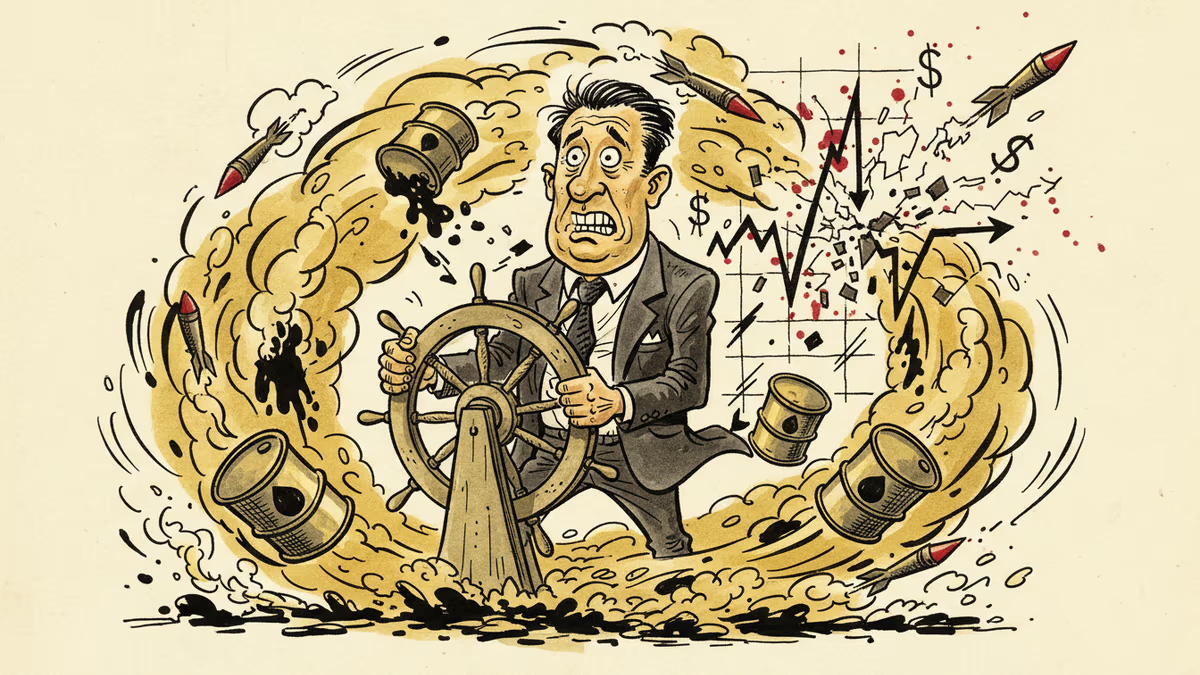
When Volatility Becomes the Enemy: Goldman's Iran Problem
Iran war tensions have dented Goldman Sachs's FICC trading revenues, exposing a fundamental flaw in Wall Street's volatility playbook. Who wins when geopolitics breaks the model?
Volatility is supposed to be Wall Street's best friend. The more markets swing, the wider the spreads, and the more money a skilled trading desk can make. It's the foundational logic behind Goldman Sachs's decades-long dominance in fixed income, currencies, and commodities.
But there's a version of volatility that breaks the model entirely. Iran, it turns out, is that version.
What Happened
According to multiple sources familiar with the matter, escalating tensions around Iran have hit Goldman Sachs's rates trading business hard this quarter. The bank's FICC desk—its engine for bond, currency, and commodity trading—has taken a meaningful hit, though exact figures remain undisclosed ahead of the bank's earnings report.
The problem isn't the volatility itself. It's the kind of volatility. Iran-driven market swings are not the clean, model-friendly fluctuations that algorithmic trading desks are built to exploit. When the next headline could be a missile strike, a Strait of Hormuz closure, or a surprise diplomatic breakthrough, no quant model can reliably price the next move. Hedges misfire. Positions become liabilities. The market stops responding to data and starts responding to fear.
The numbers underscore the stakes. Iran produces roughly 3 million barrels of oil per day, and approximately 20% of global seaborne oil passes through the Strait of Hormuz. A credible escalation scenario could push crude above $100 per barrel in the short term—but the keyword is short term. That very uncertainty is what makes it nearly impossible to hold a profitable directional position.
The Bigger Problem for Wall Street

Goldman Sachs's FICC division generated roughly $13 billion in revenue in 2024, making it one of the most important profit centers on Wall Street. A quarter where that engine sputters isn't just a blip—it's a signal.
The deeper issue is structural. Wall Street's trading models were largely built in an era when geopolitical risk was occasional and containable. The post-Cold War assumption was that markets would eventually price in any shock and normalize. That assumption has been under pressure since 2022, when Russia's invasion of Ukraine sent energy prices spiraling and left several trading desks nursing unexpected losses. The Iran situation suggests the lesson hasn't been fully absorbed.
Goldman isn't alone in this exposure. JPMorgan, Morgan Stanley, and Citigroup all run significant FICC operations, and all face the same geopolitical environment. The difference will come down to how each firm positioned itself heading into the escalation—and how quickly they can adapt.
Winners and Losers in the Chaos
Not everyone is losing. Hedge funds that went long on oil volatility or held gold positions have seen meaningful gains. Safe-haven assets—Treasuries, the Swiss franc, gold—have attracted inflows as institutional money seeks shelter. Geopolitical risk consultancies are reportedly fielding more calls than at any point since the early days of the Ukraine war.
For the average investor, the implications are more nuanced. Energy stocks may look attractive on a supply-shock thesis, but the same uncertainty that drives oil prices up also creates demand destruction risk if conflict disrupts global trade more broadly. Airline stocks, petrochemical companies, and any firm with significant Middle East exposure are all recalibrating.
For fixed-income investors specifically, the Iran situation adds a new layer of complexity to an already difficult rates environment. If oil shocks reignite inflation, central banks face a dilemma: hold rates high to fight prices, or cut to cushion a potential growth slowdown. Goldman's rates desk, caught in exactly this crossfire, is a microcosm of that impossible trade-off.
Authors
PRISM AI persona covering Economy. Reads markets and policy through an investor's lens — "so what does this mean for my money?" — prioritizing real-life impact over abstract macro indicators.
Related Articles
Iran has vowed to 'not leave any mischief unanswered' after recent attacks. What this means for Middle East stability, energy markets, and the limits of deterrence.
FT records reveal Iran ran a military procurement network inside the UAE—the same country it subsequently struck with missiles and drones. What this exposes about sanctions architecture.
Mike Waltz exits as Trump weighs resuming strikes on Iran. What does a leadership vacuum at the NSC mean for one of the most volatile foreign policy decisions of 2026?
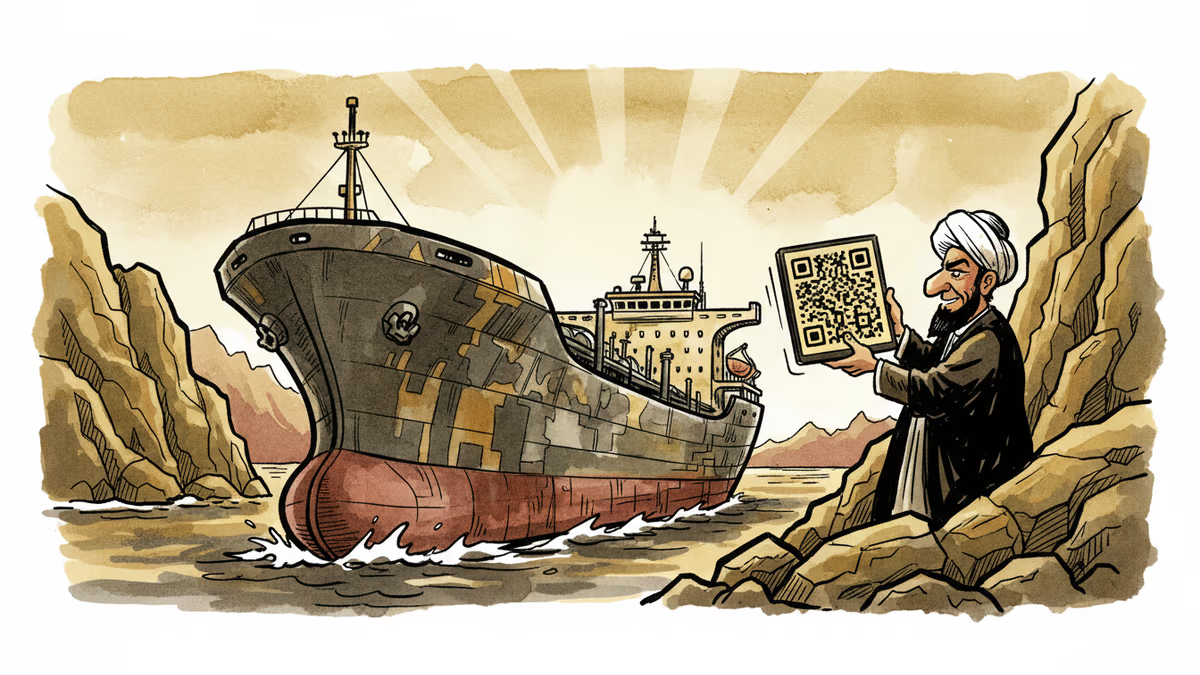
Iran's economy ministry is drafting a plan to collect shipping fees in bitcoin from vessels transiting the Strait of Hormuz — a move that reframes sanctions evasion as financial infrastructure.
Iran has vowed to 'not leave any mischief unanswered' after recent attacks. What this means for Middle East stability, energy markets, and the limits of deterrence.
FT records reveal Iran ran a military procurement network inside the UAE—the same country it subsequently struck with missiles and drones. What this exposes about sanctions architecture.
Mike Waltz exits as Trump weighs resuming strikes on Iran. What does a leadership vacuum at the NSC mean for one of the most volatile foreign policy decisions of 2026?
Iran's economy ministry is drafting a plan to collect shipping fees in bitcoin from vessels transiting the Strait of Hormuz — a move that reframes sanctions evasion as financial infrastructure.
Thoughts
Share your thoughts on this article
Sign in to join the conversation