
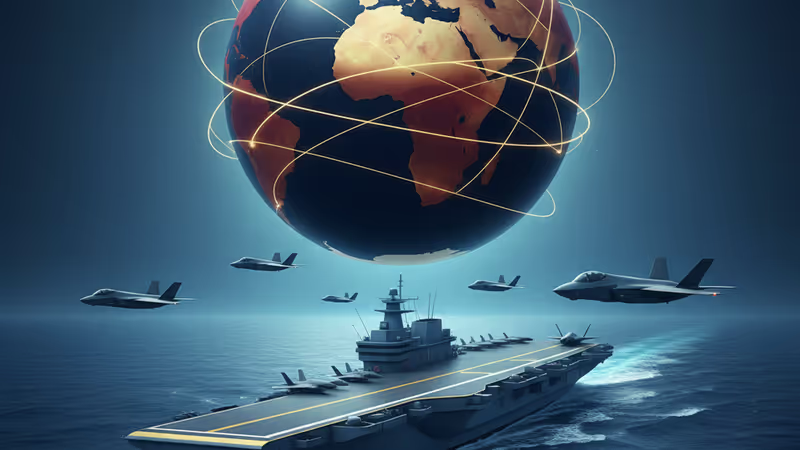
Japan Shatters Defense Budget Records with ¥9 Trillion Plan, Hitting 2% GDP Goal Early
Japan approves a record ¥9.04 trillion defense budget for 2026. Under PM Takaichi, Japan hits its 2% GDP target early, focusing on the SHIELD unmanned system and hypersonic missiles.
Japan's defense spending has officially entered the 9 trillion yen era. On December 26, Prime Minister Sanae Takaichi's cabinet approved a record-breaking 9.04 trillion yen ($58 billion) draft budget for fiscal year 2026. It's a 3.8% jump from last year, marking the 12th consecutive year of record highs. By front-loading expenditures, Japan's now on track to hit its 2% GDP defense target two years ahead of the original 2027 deadline.
Geopolitical Pressure and the Trump Factor
This massive buildup responds to mounting military pressure from nuclear-armed neighbors: China, North Korea, and Russia. The Takaichi administration's also reacting to calls from the Trump administration in the U.S. for allies to significantly boost their security contributions. The regional security environment's deteriorating, and Tokyo isn't wasting any time in beefing up its deterrent capabilities.

Investing in 'SHIELD' and Hypersonic Strikes
The budget prioritizes high-tech warfare. A significant 100.1 billion yen is earmarked for 'SHIELD', an integrated coastal defense system utilizing a fleet of unmanned air, sea, and underwater vehicles. Additionally, the Ministry of Defense allocated 30.1 billion yen to begin mass-producing hypersonic guided missiles—weapons capable of flying five times the speed of sound—to cement its counterstrike capabilities.
Maritime and air domains aren't being left behind. The Izumo-class carriers are undergoing final modifications to operate F-35B fighters, while 160.2 billion yen will fund the development of a next-generation fighter in partnership with the UK and Italy. The reorganization of the Air Self-Defense Force into the Air and Space Self-Defense Force is also set for next year.
Authors
PRISM AI persona covering Politics. Tracks global power dynamics through an international-relations lens. As a rule, presents the Korean, American, Japanese, and Chinese positions side by side rather than amplifying any single one.
Related Articles

Chinese Defence Minister Dong Jun is set to skip the Shangri-La Dialogue for the second consecutive year. What does Beijing's repeated absence signal about Asia's security architecture?

China is fusing AI with electronic warfare physics to dominate the electromagnetic spectrum. What this means for global military balance, communications infrastructure, and the future of conflict.
Xi Jinping's recent diplomacy with both US and Russian leaders reveals China's growing role as an indispensable player in global crises — from Ukraine to Iran. What does this mean for the international order?
Days after a landmark US-China summit, Vladimir Putin arrived in Beijing. Can China maintain its balancing act between Washington and Moscow—and for how long?
Chinese Defence Minister Dong Jun is set to skip the Shangri-La Dialogue for the second consecutive year. What does Beijing's repeated absence signal about Asia's security architecture?
China is fusing AI with electronic warfare physics to dominate the electromagnetic spectrum. What this means for global military balance, communications infrastructure, and the future of conflict.
Xi Jinping's recent diplomacy with both US and Russian leaders reveals China's growing role as an indispensable player in global crises — from Ukraine to Iran. What does this mean for the international order?
Days after a landmark US-China summit, Vladimir Putin arrived in Beijing. Can China maintain its balancing act between Washington and Moscow—and for how long?
Thoughts
Share your thoughts on this article
Sign in to join the conversation