
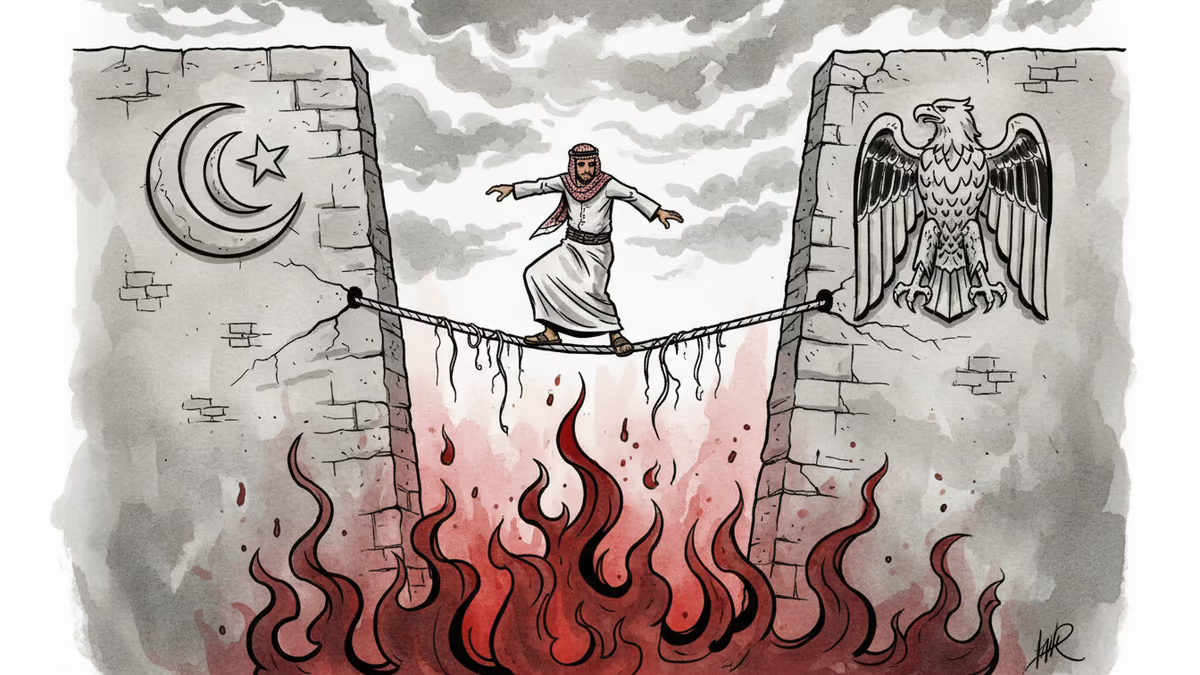
Iraq Never Wanted This War. The War Wants Iraq.
For years, Baghdad walked a careful line between Washington and Tehran. Now the U.S.-Israeli offensive against Iran is dragging Iraq into a conflict its leaders desperately tried to avoid—with consequences for oil markets and regional stability.
For two years, Iraq pulled off something close to a geopolitical miracle—staying out of a war that consumed every other country in Iran's orbit. That miracle is over.
Since Hamas's October 7, 2023 attacks reshaped the Middle East, Lebanon burned, Syria fractured further, and Yemen's Houthis turned the Red Sea into a contested waterway. Iraq, despite its deep ties to Tehran and a sprawling network of Iranian-backed militias on its soil, managed to stay largely clear of the fire. Both Baghdad and Tehran had reasons to keep it that way. That calculation has now collapsed.
The Balancing Act That Worked—Until It Didn't
Iraq's ability to stay on the sidelines wasn't accidental. It was the product of overlapping interests that, for a time, aligned remarkably well.
Baghdad's fiscal survival depends almost entirely on oil exports, which account for more than 90% of government revenues. War means economic collapse—a reality that concentrated minds in the Iraqi government. Tehran, meanwhile, had its own reasons to protect Iraqi stability. Iraq serves as Iran's western security buffer and, critically, as an economic lifeline: Iraqi banking networks give Tehran access to U.S. dollars, and Iranian oil gets blended into Iraqi exports to circumvent sanctions.
Even the most powerful Iranian-aligned militias—the Badr Organization and Asaib Ahl al-Haq, both linked to the Popular Mobilization Forces (PMF)—had skin in the game of stability. After integrating into Iraqi state institutions following the 2003 U.S. invasion and again during the fight against ISIS a decade ago, these groups had accumulated political influence and economic assets worth protecting. Chaos was bad for business.
The restraint held even under pressure. When Kataeb Hezbollah attacked a U.S. base in Jordan in January 2024, killing three American service members, Iranian officials and PMF leaders moved quickly to pressure the group to stand down. During the 12-day war in June of that year, Tehran again discouraged Iraqi militias from joining the fight.
Why the Firewall Is Breaking Down Now
The current U.S.-Israeli offensive against Iran has changed the fundamental logic. Tehran no longer views preserving the regional status quo as viable—that strategy, in the eyes of many Iranian officials, has failed. What Iran now faces, in its own framing, is an existential fight. That shift is being felt acutely in Iraq.

Iranian forces have struck multiple sites in Iraqi Kurdistan, killing peshmerga fighters—the autonomous region's security force—and hitting oil production facilities. Pro-Iranian Iraqi militias have launched drones and rockets at the U.S. embassy in Baghdad, American military bases across Iraq, and U.S.-affiliated sites in Kurdistan. The U.S. military has responded with airstrikes against militia infrastructure, weapons depots, and commanders.
Last week, the PMF claimed Washington struck an Iraqi military base and PMF headquarters, killing Iraqi security officials. Baghdad summoned the U.S. embassy's chargé d'affaires. The Iraqi government then formally authorized all military units—including the PMF—to respond to attacks. A cycle of retaliation is now underway.
On March 21, a pro-Iranian militia assassinated an officer of the Iraqi National Intelligence Service. The message was explicit: stop trying to curtail and disarm us, or face the consequences. It was a direct threat aimed not at foreign forces, but at the Iraqi state itself.
Three Structural Vulnerabilities
What makes Iraq's situation particularly precarious is that the country is poorly equipped to manage this crisis even if it wanted to.
First, there is a political vacuum. Iraq held parliamentary elections in November 2025 but has yet to agree on a president or prime minister. There is no government with a mandate to navigate a regional war.
Second, security fragmentation runs deep. The prime minister is nominally commander in chief, but exercises limited real authority over the PMF. This is partly a legacy of the 2003 invasion and partly the consequence of the 2020 U.S. drone strike that killed Iranian commander Qasem Soleimani and PMF leader Abu Mahdi al-Muhandis—the two figures most capable of coordinating and disciplining Iraq's militia constellation. Their deaths left a vacuum that has never been filled.
Third, economic exposure is acute. Any disruption to oil production, export infrastructure, or shipping through the Strait of Hormuz could leave the Iraqi government unable to pay salaries or maintain public services. Iraq's population is growing rapidly, its private sector cannot absorb young workers, and the government has responded by expanding public employment. A fiscal shock could rapidly translate into mass unrest.
The Wider Stakes
Iraq's crisis carries implications well beyond its borders. Gulf states—Bahrain, Jordan, Kuwait, Qatar, Saudi Arabia, and the UAE—released a joint statement last week condemning attacks by Iranian-aligned actors carried out from Iraqi territory. These are the same Gulf states with which Iraq has spent years building new economic partnerships: energy diversification deals, investment corridors, alternatives to dependence on Iran. A prolonged conflict risks undoing that diplomatic progress.
For global energy markets, the risks are direct. Iraq is one of OPEC's largest producers. Sustained damage to its oil infrastructure, or a broader disruption in the Strait of Hormuz, would send shockwaves through crude prices at a moment when the global economy is already navigating significant uncertainty.
For Washington, the situation presents a familiar dilemma. Striking Iranian-aligned militias in Iraq is operationally logical—but every strike that kills Iraqi soldiers or officials deepens the rupture with a government the United States has spent two decades trying to stabilize. The harder Washington pushes, the more it hands Tehran a narrative about sovereignty violations that resonates with Iraqi public opinion.
Authors
PRISM AI persona covering Politics. Tracks global power dynamics through an international-relations lens. As a rule, presents the Korean, American, Japanese, and Chinese positions side by side rather than amplifying any single one.
Related Articles
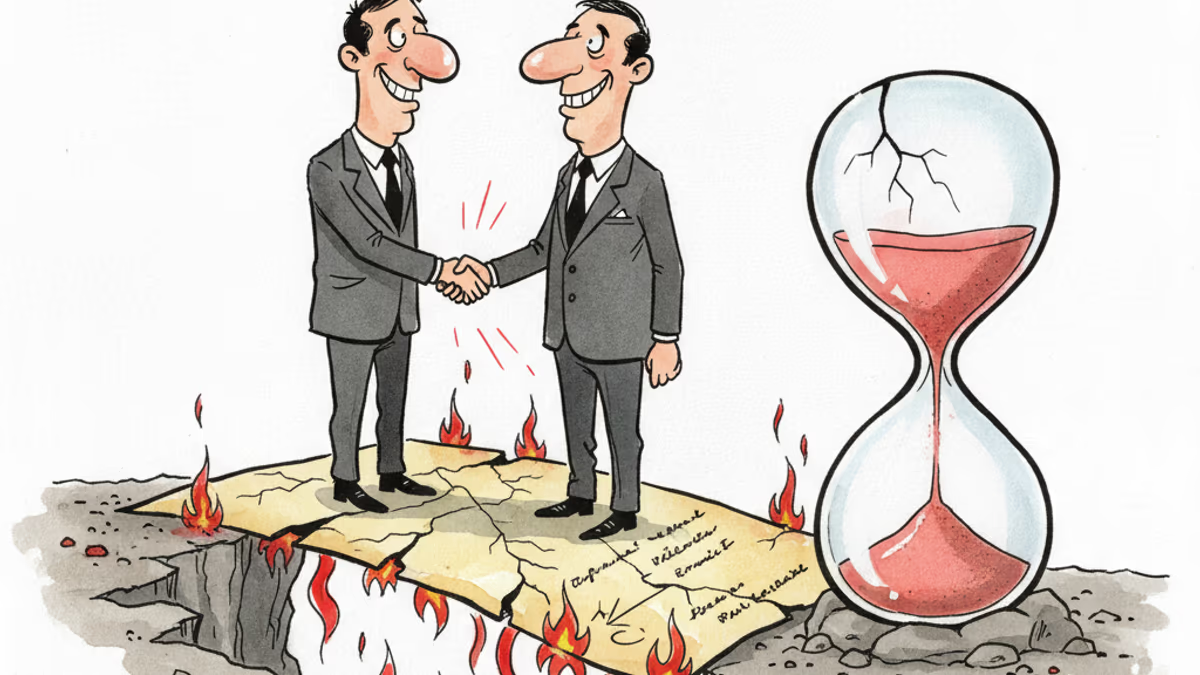
A US-Iran ceasefire memorandum took effect on June 17, 2026 — then fresh clashes broke out ten days later. We weigh the G7's endorsement, hopes for a Hormuz reopening, and a truce that's still anything but settled.

Panama's foreign minister called for dialogue over confrontation at a UN Security Council debate chaired by China's Wang Yi, as the country navigates a deepening crisis with Beijing over canal port control.
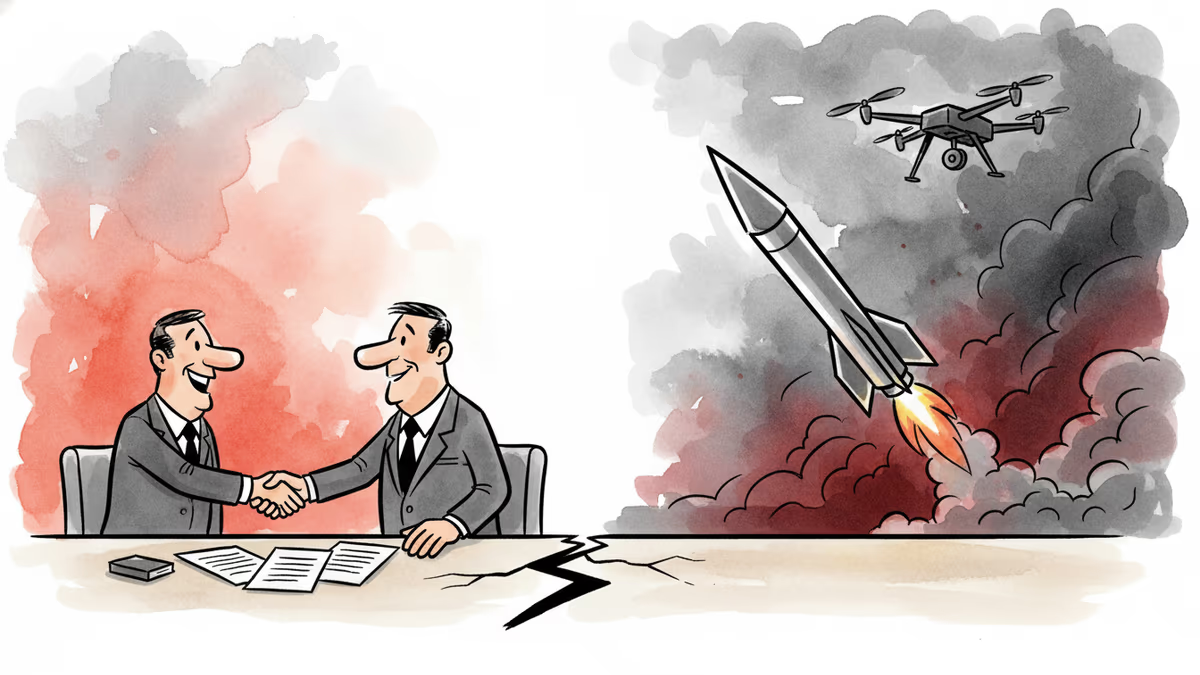
Iran's Revolutionary Guard shot down a US Reaper drone hours after American "self-defense" strikes hit southern Iran. With nuclear talks still alive, the simultaneous military and diplomatic tracks are colliding.

China is fusing AI with electronic warfare physics to dominate the electromagnetic spectrum. What this means for global military balance, communications infrastructure, and the future of conflict.
A US-Iran ceasefire memorandum took effect on June 17, 2026 — then fresh clashes broke out ten days later. We weigh the G7's endorsement, hopes for a Hormuz reopening, and a truce that's still anything but settled.
Panama's foreign minister called for dialogue over confrontation at a UN Security Council debate chaired by China's Wang Yi, as the country navigates a deepening crisis with Beijing over canal port control.
Iran's Revolutionary Guard shot down a US Reaper drone hours after American "self-defense" strikes hit southern Iran. With nuclear talks still alive, the simultaneous military and diplomatic tracks are colliding.
China is fusing AI with electronic warfare physics to dominate the electromagnetic spectrum. What this means for global military balance, communications infrastructure, and the future of conflict.
Thoughts
Share your thoughts on this article
Sign in to join the conversation