
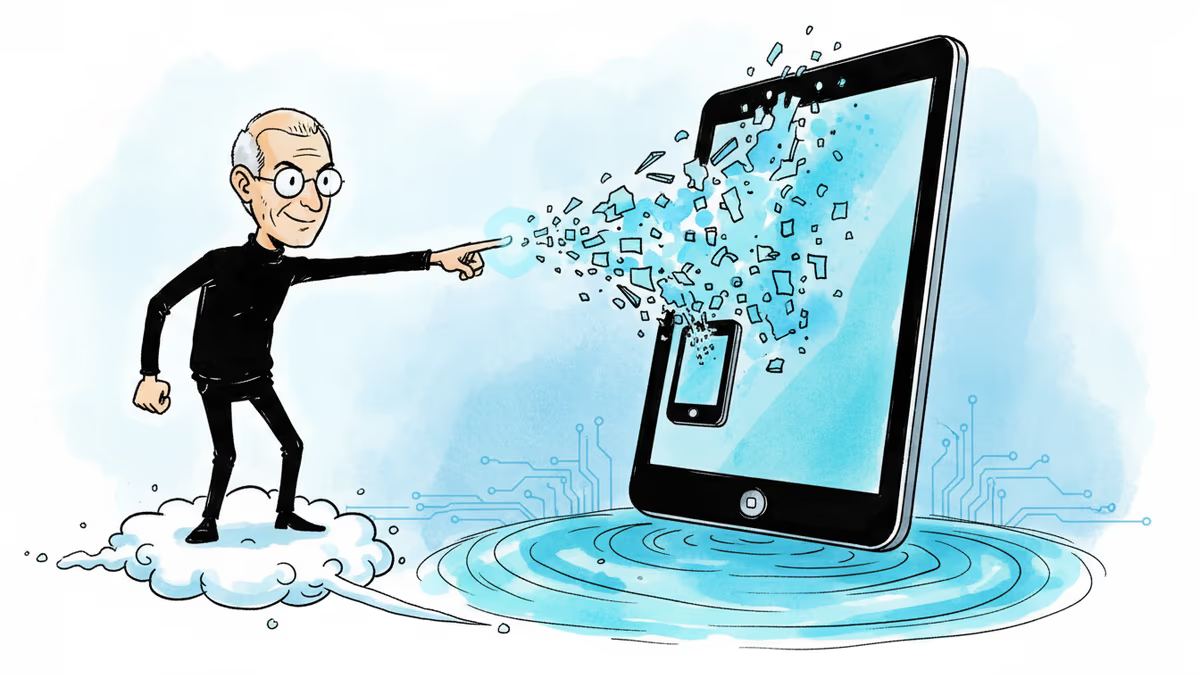
The iPhone Started as a Tablet (And Other Secrets)
The untold story behind the iPhone's creation reveals false starts, lucky breaks, and a surprising origin as a tablet project. Innovation isn't always what it seems.
January 9, 2007.Steve Jobs pulled the iPhone from his pocket and changed everything. It looked inevitable—beautifully conceived, self-assured, conceptually obvious.
But the device that seemed destined for greatness actually stumbled into existence through false starts, last-minute pivots, and sheer luck. Most surprising of all: Apple didn't set out to build a phone. They were building a tablet.
The real story reveals something uncomfortable about innovation—it's messier, more accidental, and more human than we'd like to believe.
The Projector That Started Everything
In 1999, British designer Duncan Kerr joined Jony Ive's industrial design studio. By early 2003, he was hosting Tuesday meetings with a radical question: What if we could ditch the 25-year-old "point mouse, click button" routine?
Kerr's team experimented with camera-driven systems, spatial audio, and haptics. But the breakthrough came from an unlikely source: a 6.25 x 5-inch black trackpad made by a Delaware company called FingerWorks. Its inventor, Wayne Westerman, was a piano player suffering from repetitive stress injuries.
In late 2003, Apple commissioned a bigger version: 12 x 9.5 inches. Kerr's team built a test rig that was wonderfully crude—an LCD projector on a tripod, shining down onto the trackpad with white paper taped over it. But when they started moving on-screen icons with their fingers, spreading two fingers to enlarge photos, using both hands to tap and stretch objects, it felt magical.
In November 2003, Ive showed the demo to Jobs. Everyone who saw it knew: this was the future. Of what, they weren't sure yet.
A Microsoft Engineer's Birthday Party
The catalyst came from an unexpected source. In late 2005, Jobs attended the 50th birthday party of a Microsoft engineer—the husband of his wife Laurene's friend. Over dinner, the guy lectured Jobs about how Microsoft had solved computing's future with a stylus-driven tablet.
"But he was doing the device all wrong," Jobs later told Walter Isaacson. "This dinner was like the 10th time he talked to me about it, and I was so sick of it that I came home and said, 'F*** this. Let's show him what a tablet can really be.'"
Jobs stormed into Monday's executive meeting with a declaration: "We need to show the world how to create a real tablet." No stylus. "God gave us 10 styluses," he said, wiggling his fingers.
Sudenly, that FingerWorks demo seemed incredibly relevant.
When Tablets Hit Reality
Using iBook laptop components, Ive's team built prototype multi-touch tablets running Mac OS X. They weren't compelling. In 2005, a page-sized touchscreen required a fast processor, which demanded a fat battery. The prototypes were disappointingly heavy and thick.
Worse, Mac OS wasn't designed for finger operation. The interface that worked brilliantly with a mouse cursor felt clunky under fingertips.
But Jobs already had another idea brewing. By 2005, cellphones could play music—crudely, but the writing was on the wall. Nobody wanted to carry two devices. The iPod's days were numbered.

The Motorola Disaster
Apple had zero phone experience—no engineers, designers, or cellular industry contacts. So Jobs partnered with veteran phone maker Motorola, whose thin, shiny RAZR flip phone was a massive hit.
The plan seemed logical: add iPod software to a phone Motorola had already designed. It would be the first phone capable of playing music from the iTunes Store.
When Jobs unveiled the Motorola ROKR E1 in September 2005, his disgust was palpable. "It's a pretty cool phone," he managed, to no applause. Despite available memory, it could hold only 100 songs. Transferring music took forever.
"The frustrating part was, people kept calling it the Apple phone or the iTunes phone," says current worldwide marketing head Greg Joswiak. "It was like, 'Trust me: We had nothing to do with this. We created iTunes; they created the phone.'"
All cellphones, Jobs realized, were awful. "We just hated them; they were so awful to use," he later told Fortune. But the market was huge—a billion phones per year, four times PC shipments.
The iPod Phone That Couldn't Text
The shortest route to a music phone seemed obvious: add phone features to the iPod. Jobs asked Tony Fadell, who ran the iPod business, to mock something up.
Fadell's team tried various approaches. One was a full-screen video iPod—"like a tiny little iPad before iPads," Fadell recalls. It could show a virtual click wheel for scrolling, then hide it for video playback.
Another prototype was a standard iPod with cellular guts.
Both failed at the same hurdle: text entry. The wheel was fantastic for scrolling through phone numbers but nightmarish for typing. You'd scroll to one letter at a time. "We tried for weeks and weeks and weeks to try to make that happen, but it never worked," Fadell says.
Then someone remembered the multi-touch experiment from the design studio. What if they shrunk that technology down for a phone interface? A device that was nothing but screen?
"Put the tablet project on hold," Jobs decided. "Let's build a phone."
The Physics of Scrolling
By this point, the multi-touch group—Kerr, Bas Ording, and Imran Chaudhri—had evolved beyond their projector setup. They'd developed standalone hardware: 12-inch multi-touch iBook screens. To simulate a phone, they limited the "live" screen area to a phone-sized rectangle.
Ording, an interface designer at Apple since 1998 who specialized in animations, created a demo contacts app with 200 names. You could flick your finger to scroll the list, tap a name to open their "card," then tap a phone number to open a dialing screen.
The breakthrough was inertial scrolling. Flick a webpage and it kept scrolling with its own momentum. Flick harder, scroll faster. Stop flicking, and it gradually slowed to a stop, obeying physics.
When you reached the page's end, instead of stopping abruptly, it would "bounce" like hitting a rubber band.
This wasn't just interface design—it was interface psychology. The screen felt alive, responsive, almost organic.
The Bigger Questions
The iPhone's origin story reveals an uncomfortable truth about innovation: it's rarely the result of brilliant foresight. Instead, it emerges from failed experiments, chance encounters, and the willingness to abandon successful products (like the iPod) before competitors do.
Apple didn't invent multi-touch technology—FingerWorks did. They didn't start with a phone vision—they started with a tablet that was too heavy. The breakthrough came from combining existing technologies in a new context, driven by frustration with existing solutions.
Authors
Related Articles
After 15 years of fragmented mobile messaging, Apple and Google are rolling out end-to-end encrypted RCS messaging between iPhones and Android devices. Here's what changed, why it took so long, and what it means for your privacy.
Apple agreed to pay $250 million to settle claims it misled iPhone 16 buyers about Apple Intelligence features. What this means for consumers, Big Tech marketing, and the AI industry.

Apple quietly removed the entry-level $599 Mac Mini, raising the starting price to $799 — just one day after Tim Cook warned of chip supply constraints on the earnings call.

Apple names John Ternus, its hardware engineering chief, as the next CEO. The shift from operator to product person signals where Apple thinks its next decade of growth will come from — and raises real questions about what comes next.
After 15 years of fragmented mobile messaging, Apple and Google are rolling out end-to-end encrypted RCS messaging between iPhones and Android devices. Here's what changed, why it took so long, and what it means for your privacy.
Apple agreed to pay $250 million to settle claims it misled iPhone 16 buyers about Apple Intelligence features. What this means for consumers, Big Tech marketing, and the AI industry.
Apple quietly removed the entry-level $599 Mac Mini, raising the starting price to $799 — just one day after Tim Cook warned of chip supply constraints on the earnings call.
Apple names John Ternus, its hardware engineering chief, as the next CEO. The shift from operator to product person signals where Apple thinks its next decade of growth will come from — and raises real questions about what comes next.
Thoughts
Share your thoughts on this article
Sign in to join the conversation