
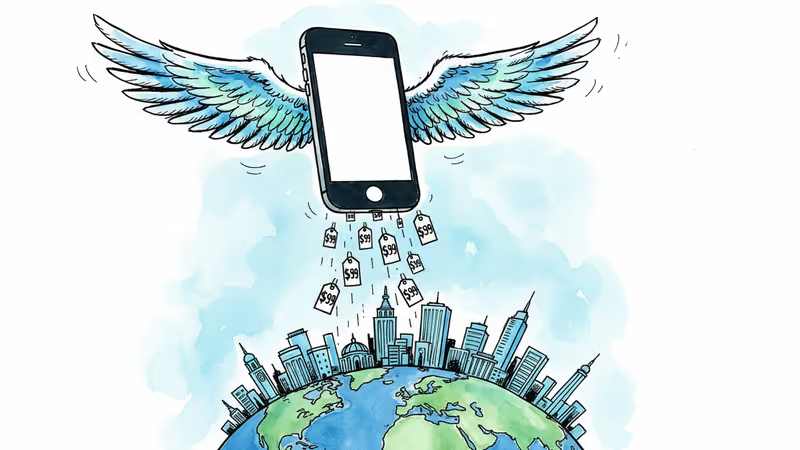
Apple's iPhone 17e Strategy: Premium Features at $599 to Capture Emerging Markets
Apple maintains $599 pricing for iPhone 17e despite rising component costs, targeting emerging markets and enterprise customers with A19 chip and in-house cellular technology.
$599. That's the same price Apple charged for the iPhone 16e, and it's what the company plans to charge for the upcoming iPhone 17e. In an era where RAM and storage prices are soaring, this pricing decision signals something bigger than cost management—it's a strategic play for market expansion.
According to Mark Gurman, Apple isn't just maintaining price parity; it's preparing for an aggressive push into emerging markets and enterprise segments with significantly upgraded hardware.
Upgraded Specs, Same Price Tag
The iPhone 17e will pack the A19 chip from the flagship iPhone 17 lineup, marking a substantial performance boost from its predecessor. The device will also feature MagSafe charging and, perhaps most significantly, Apple's in-house cellular chips—a move that reduces dependence on Qualcomm and gives Apple more control over its supply chain.
Industry analysts estimate that component costs have risen 10-15% across the board. Yet Apple is absorbing these increases rather than passing them to consumers. This suggests the company sees the $599 price point as strategically crucial for market penetration.
Exploiting Competitive Gaps
Apple's timing appears calculated. The Pixel 10a is expected to offer minimal upgrades, while Samsung continues focusing on premium segments. This leaves a gap in the mid-range market that Apple seems eager to fill.

Emerging markets represent Apple's biggest growth opportunity. In India, iPhone market share sits at just 5%, while Southeast Asia shows similar single-digit penetration. However, these markets are experiencing rapid economic growth, creating a expanding middle class with increasing purchasing power.
The enterprise angle is equally compelling. Post-pandemic remote work has made companies more conscious of device security and management efficiency—areas where Apple's ecosystem traditionally excels.
The Broader Market Implications
This strategy could reshape the global smartphone landscape. If successful, it might force competitors to reconsider their positioning. Samsung's Galaxy A series, which dominates the mid-range segment, could face unprecedented pressure from a premium brand willing to compete on price.
For consumers, this represents a rare opportunity to access flagship-level performance at mid-range prices. The A19 chip in particular should deliver computational photography and AI capabilities previously reserved for premium devices.
But there are risks. Apple has spent decades building a premium brand image. Aggressive pricing in emerging markets could dilute that perception, especially if the strategy expands to developed markets.
Enterprise Opportunities
The enterprise market presents unique dynamics. Many companies have been reluctant to adopt iPhones due to cost considerations, despite preferring iOS for security and management features. At $599, the total cost of ownership calculation changes significantly.
This could accelerate enterprise iOS adoption, particularly in sectors like healthcare, finance, and government where security is paramount. The integration with Apple's broader ecosystem—from MacBooks to enterprise software—becomes more compelling when the entry price drops.
Authors
Related Articles
After 15 years of fragmented mobile messaging, Apple and Google are rolling out end-to-end encrypted RCS messaging between iPhones and Android devices. Here's what changed, why it took so long, and what it means for your privacy.
Apple agreed to pay $250 million to settle claims it misled iPhone 16 buyers about Apple Intelligence features. What this means for consumers, Big Tech marketing, and the AI industry.
Apple quietly removed the entry-level $599 Mac Mini, raising the starting price to $799 — just one day after Tim Cook warned of chip supply constraints on the earnings call.

Apple names John Ternus, its hardware engineering chief, as the next CEO. The shift from operator to product person signals where Apple thinks its next decade of growth will come from — and raises real questions about what comes next.
After 15 years of fragmented mobile messaging, Apple and Google are rolling out end-to-end encrypted RCS messaging between iPhones and Android devices. Here's what changed, why it took so long, and what it means for your privacy.
Apple agreed to pay $250 million to settle claims it misled iPhone 16 buyers about Apple Intelligence features. What this means for consumers, Big Tech marketing, and the AI industry.
Apple quietly removed the entry-level $599 Mac Mini, raising the starting price to $799 — just one day after Tim Cook warned of chip supply constraints on the earnings call.
Apple names John Ternus, its hardware engineering chief, as the next CEO. The shift from operator to product person signals where Apple thinks its next decade of growth will come from — and raises real questions about what comes next.
Thoughts
Share your thoughts on this article
Sign in to join the conversation