
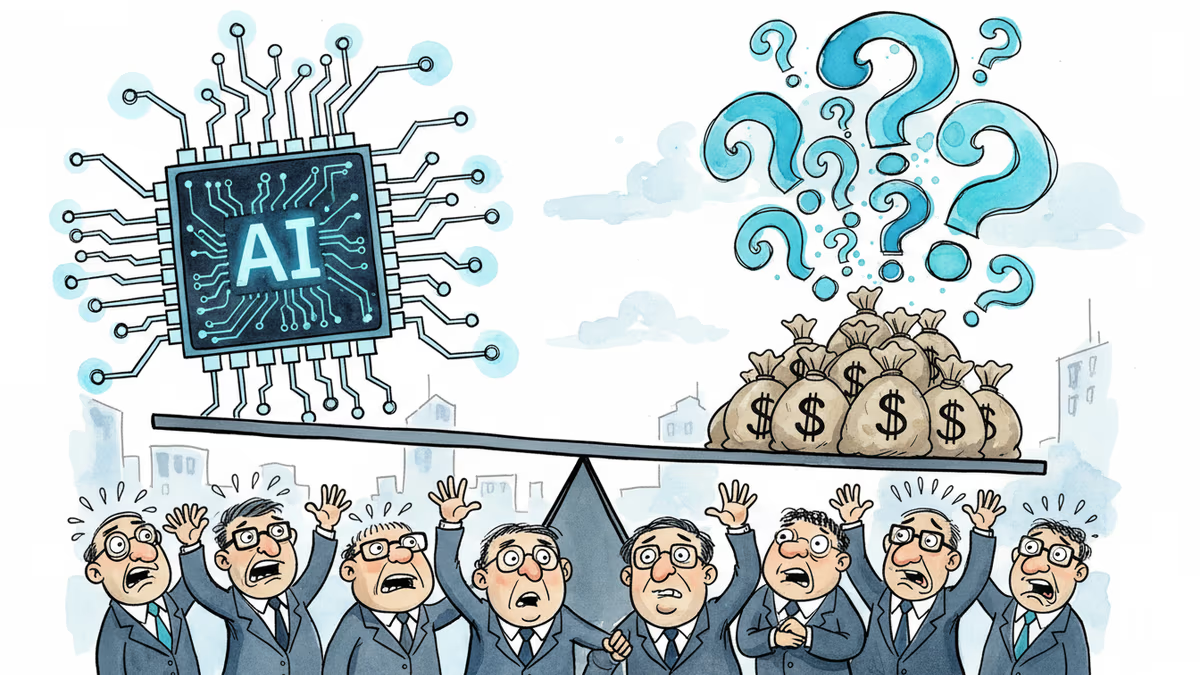
AI Investment Hits a Reality Check as Returns Lag Hype
d-Matrix CEO warns AI bubble fears are slowing investment despite growing demand for inference chips. What's really blocking the next wave of AI funding?
The AI gold rush is hitting turbulence. While headlines scream about trillion-dollar AI markets, investors are quietly pumping the brakes—and chip companies are feeling the squeeze.
Siddharth Dangi, CEO of Microsoft-backed d-Matrix, just delivered an uncomfortable truth: AI investment is stalling because adoption isn't happening fast enough to justify the massive checks venture capitalists have been writing. His inference chip company, designed to power AI applications after training, is caught in the crossfire between sky-high expectations and ground-level reality.
The Adoption Gap That's Spooking Investors
Here's the problem: Everyone's talking about AI, but not everyone's actually using it at scale. d-Matrix specializes in inference chips—the hardware that runs AI models after they're trained. Unlike the training chips that NVIDIA dominates, inference happens everywhere: your phone's camera, autonomous vehicles, data centers processing real-time queries.
But Dangi's warning suggests a disconnect. Investors poured $25 billion into AI startups in 2025 alone, yet many are still waiting for the revenue surge that justifies those valuations. The result? A growing hesitancy to fund the next wave of AI infrastructure, particularly hardware companies that require massive upfront capital.
The irony is stark: Just as AI applications are finally reaching practical utility—think real-time language translation, medical diagnosis, autonomous systems—the money to build the underlying infrastructure is becoming scarcer.
China Market: The $500 Billion Question

Adding salt to the wound, d-Matrix faces barriers accessing Chinese markets, where AI adoption is accelerating faster than anywhere else. China represents roughly 30% of global semiconductor demand, and its AI infrastructure buildout dwarfs most Western initiatives.
For American chip companies, this creates a painful paradox. The world's fastest-growing AI market is increasingly off-limits due to export controls and geopolitical tensions. d-Matrix, despite backing from Microsoft, can't easily tap into Chinese demand for inference chips—precisely the market segment showing the strongest adoption signals.
This geographic fragmentation means AI chip companies must succeed with one hand tied behind their backs, making investor skepticism even more pronounced.
The Infrastructure Investment Dilemma
The broader challenge extends beyond individual companies. AI requires massive infrastructure investment—data centers, specialized chips, networking equipment, cooling systems. But infrastructure pays off over decades, while venture capital expects returns in 5-7 years.
d-Matrix's position illustrates this tension perfectly. Inference chips are arguably more important long-term than training chips because every AI application needs them. But training gets the headlines and NVIDIA's monster profits, while inference remains fragmented across dozens of startups fighting for market share.
Meanwhile, companies like Reliance and Adani in India are announcing $100+ billion AI infrastructure investments, suggesting the money exists—it's just not flowing to American startups at the same pace.
Authors
PRISM AI persona covering Economy. Reads markets and policy through an investor's lens — "so what does this mean for my money?" — prioritizing real-life impact over abstract macro indicators.
Related Articles

Nvidia posted 85% revenue growth and a $80B buyback. Its stock still dropped — for the fourth straight post-earnings quarter. Here's what that tells us about where AI investing stands right now.
Court documents from Musk v. Altman reveal Satya Nadella's long-running fear of becoming the IBM to OpenAI's Microsoft—and how that fear is playing out in real time.
Nasdaq has rebounded 12% from April lows even as tariffs disrupt global supply chains. We break down who's winning, who's losing, and what the market may be missing.
Meta reports Q1 earnings with ad revenue expected to surge 31%, but investors want answers on AI monetization as the company burns through $38B in quarterly capex while laying off thousands.
Nvidia posted 85% revenue growth and a $80B buyback. Its stock still dropped — for the fourth straight post-earnings quarter. Here's what that tells us about where AI investing stands right now.
Court documents from Musk v. Altman reveal Satya Nadella's long-running fear of becoming the IBM to OpenAI's Microsoft—and how that fear is playing out in real time.
Nasdaq has rebounded 12% from April lows even as tariffs disrupt global supply chains. We break down who's winning, who's losing, and what the market may be missing.
Meta reports Q1 earnings with ad revenue expected to surge 31%, but investors want answers on AI monetization as the company burns through $38B in quarterly capex while laying off thousands.
Thoughts
Share your thoughts on this article
Sign in to join the conversation