

Blockchain Doesn't Make a Bet a Bond
Indonesia has blocked Polymarket, classifying it as illegal online gambling. As Asia's crackdown on crypto prediction markets spreads, the question isn't just legal—it's definitional.
Wrap a roulette wheel in blockchain code. Does it stop being a roulette wheel?
Indonesia's Ministry of Communication and Digital Affairs answered that question on May 25, 2026: no. The government blocked access to Polymarket, the crypto-based prediction platform, declaring it illegal online gambling under Indonesian law. Authorities said they were already tracing affiliated social media accounts and warned that similar platforms could face the same fate.
Alexander Sabar, the ministry's director general of digital space supervision, put it plainly: using blockchain technology or crypto assets does not change the fundamental nature of a platform that lets users wager money on uncertain outcomes.
What Polymarket Actually Does—And Why That's Contested
Polymarket lets users buy and sell contracts tied to real-world events: elections, sports results, crypto prices, geopolitical outcomes. The platform positions itself as a prediction market—a tool for aggregating information and crowd-sourcing probability estimates. Proponents argue it produces genuinely useful forecasts, pointing to its track record on U.S. elections and macro events.
Regulators in much of Asia see something simpler: people putting money on uncertain outcomes. The mechanism may be novel. The structure is not.
Indonesia joins a list that the ministry itself spelled out—Singapore, Brazil, and India have blocked Polymarket outright. Taiwan, Thailand, China, and Japan have imposed restrictions under local law. Ukraine has blocked it with no legal pathway for reinstatement. India recently classified such platforms as prohibited online money gaming, with Kalshi—a U.S.-regulated prediction market operator—also facing potential scrutiny there.
Polymarket is separately pursuing regulatory approval in Japan by 2030, though Japan's strict gambling laws make that a long road.

The Definitional War at the Heart of This
The real fight here isn't about Polymarket specifically. It's about who gets to define what a financial product is.
In the United States, Kalshi operates legally under CFTC oversight as a derivatives exchange. The same structural activity—trading contracts on uncertain outcomes—is a regulated financial instrument in one jurisdiction and a criminal offense in another. That gap isn't a bug in the system. It reflects genuinely different philosophical frameworks about risk, speculation, and the state's role in protecting citizens from themselves.
For crypto investors and fintech builders, the Indonesia ban is a data point in a pattern: decentralization does not equal deregulation. A blockchain-based platform with no central server can still be blocked at the network level. Users in restricted jurisdictions who access it via VPN are taking on legal risk, not just technical inconvenience.
The broader implication is structural. Prediction markets have attracted serious institutional interest—not just retail speculators, but hedge funds and political analysts who treat Polymarket data as a legitimate signal. If the platform continues to lose access across major Asian economies, that signal gets noisier. The market's information value depends partly on the diversity and size of its participant base.
Stakeholders Seeing This Very Differently
For regulators across Asia, this is consumer protection logic: unsophisticated users losing money on crypto-denominated bets on political outcomes is a social harm, and the fact that the platform calls itself a "market" doesn't change that calculus.
For prediction market advocates, the bans represent a category error with real costs. If Polymarket data had been widely accessible during, say, the 2024 U.S. election cycle, it arguably provided more accurate probability estimates than most polling aggregators. Restricting access to that information infrastructure has consequences beyond the platform itself.
For competing platforms—particularly Kalshi, which has pursued the regulatory compliance route in the U.S.—the Asian crackdown is a mixed signal. It validates the compliance-first strategy, but it also suggests that even compliant platforms may face geographic fragmentation that limits their scale.
This content is AI-generated based on source articles. While we strive for accuracy, errors may occur. We recommend verifying with the original source.
Related Articles
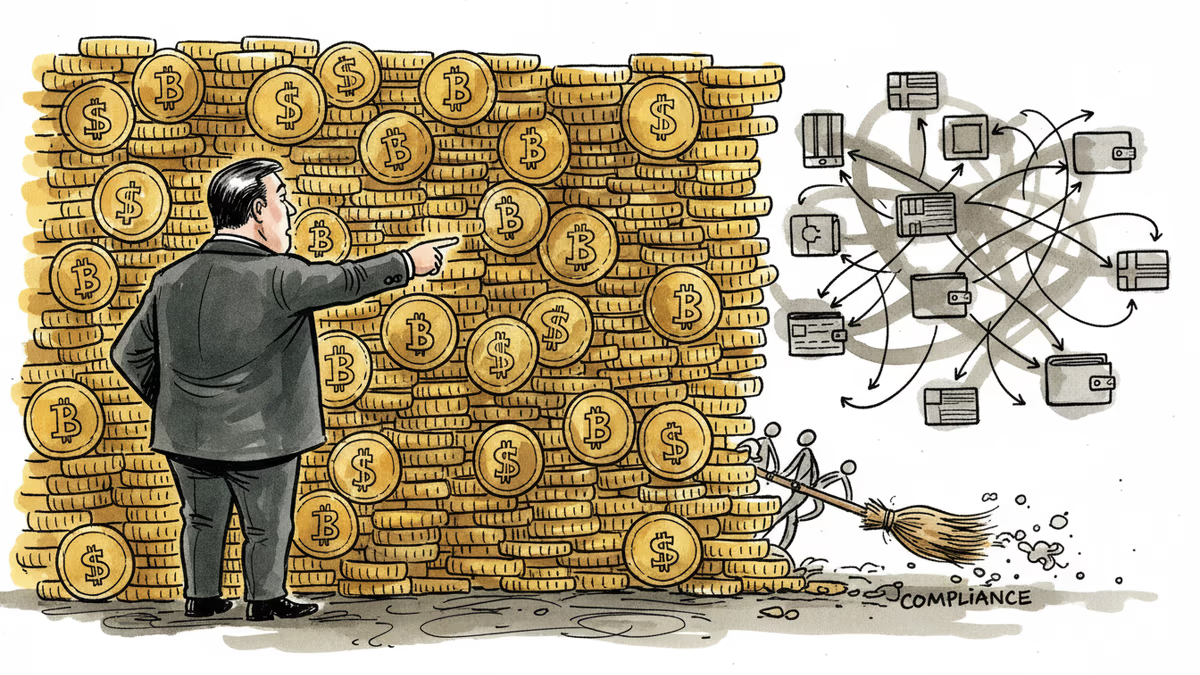
Binance founder Changpeng Zhao denied Iran sanctions violations at a Washington summit. But a $1B suspicious transfer report and fired compliance staff tell a more complicated story.

Indonesia's pesticide prices are set to jump 20-30% as Iran war disrupts raw material supply chains. Experts warn of cascading food inflation across Asia and beyond.

Indonesia's coal and nickel production cuts were meant to prop up prices. Now the Iran war has done that job instead—and miners are furious they can't cash in.
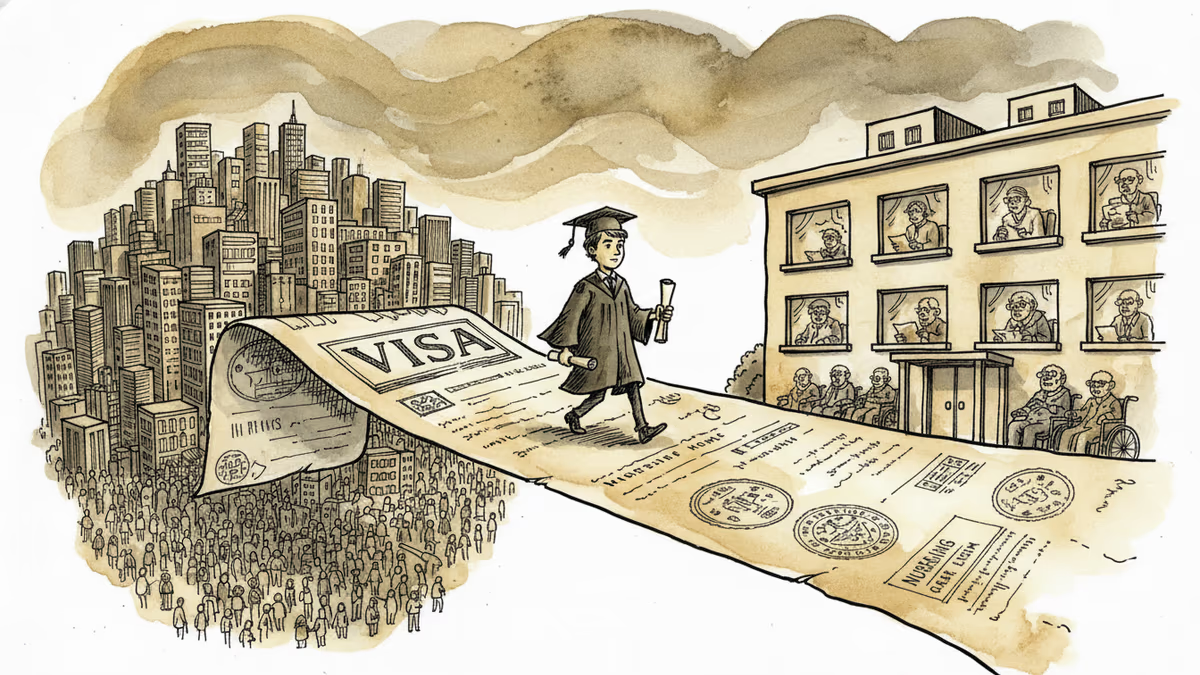
Indonesian university graduates are flocking to Japan's nursing homes, drawn by wages three to five times higher than at home. What does this cross-Pacific labor flow reveal about demographic pressure, policy design, and the future of care work?
Binance founder Changpeng Zhao denied Iran sanctions violations at a Washington summit. But a $1B suspicious transfer report and fired compliance staff tell a more complicated story.
Indonesia's pesticide prices are set to jump 20-30% as Iran war disrupts raw material supply chains. Experts warn of cascading food inflation across Asia and beyond.
Indonesia's coal and nickel production cuts were meant to prop up prices. Now the Iran war has done that job instead—and miners are furious they can't cash in.
Indonesian university graduates are flocking to Japan's nursing homes, drawn by wages three to five times higher than at home. What does this cross-Pacific labor flow reveal about demographic pressure, policy design, and the future of care work?
Thoughts
Share your thoughts on this article
Sign in to join the conversation