
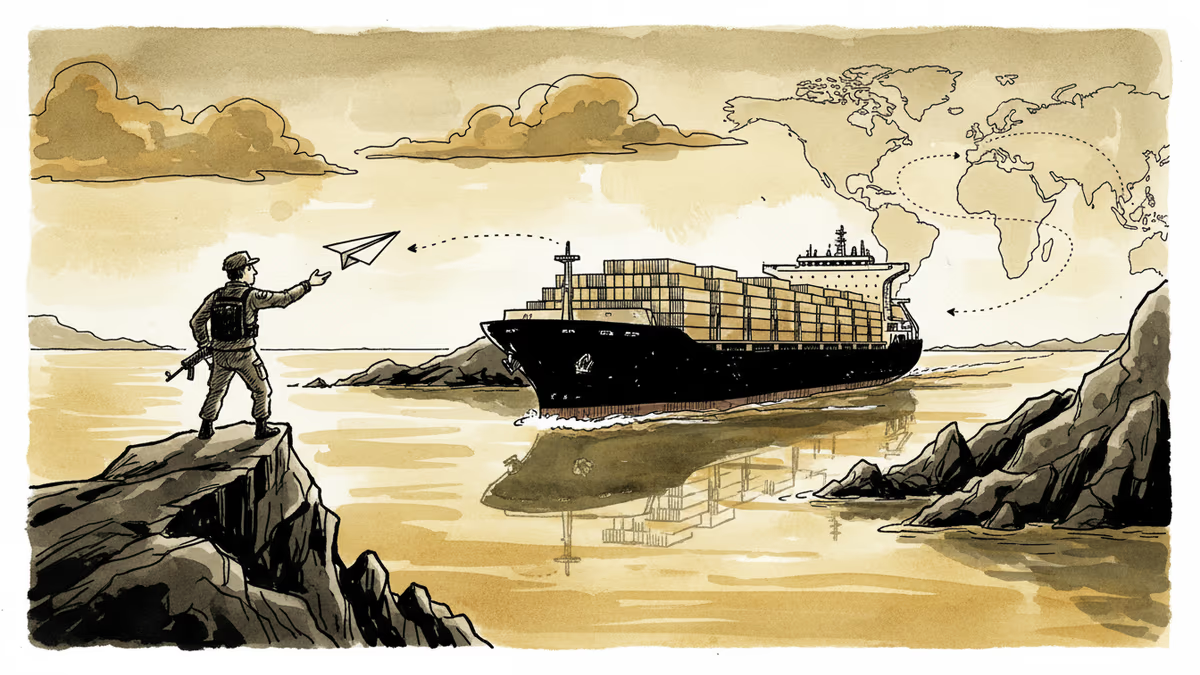
Houthi Attacks Are Back. Your Supply Chain Isn't Ready.
Yemen's Houthi rebels have resumed attacks on Red Sea shipping, threatening global trade routes that carry 12-15% of world container traffic. Here's what it means for prices, supply chains, and geopolitics.
A drone costing a few thousand dollars. A cargo ship worth hundreds of millions. And somewhere downstream, a price tag that quietly climbs on your supermarket shelf.
Yemen's Houthi rebels have resumed attacks on commercial vessels in the Red Sea, reigniting fears over one of the world's most critical maritime chokepoints. After a period of reduced activity following sustained U.S. airstrikes in early 2025, attack frequency has been climbing again through early 2026. For global business leaders and investors, this isn't a distant regional conflict. It's a direct variable in shipping costs, inflation forecasts, and supply chain resilience.
What's at Stake in That Narrow Strip of Water
The Red Sea and Suez Canal corridor handles roughly 12–15% of global container traffic and approximately 10% of seaborne oil shipments. It's the shortest maritime link between Asia and Europe — the artery through which electronics, automobiles, energy, and consumer goods flow in both directions.
When the Houthis began targeting commercial ships in late 2023, citing solidarity with Gaza, the world's major carriers didn't wait around. Maersk, MSC, CMA CGM — one by one, they rerouted around Africa's Cape of Good Hope. That detour adds roughly 3,500–4,000 nautical miles and 10–14 extra days of transit time per voyage.
U.S. military operations under Operation Prosperity Guardian, and later more intensive strikes in 2025, degraded Houthi capabilities but didn't eliminate them. The group's asymmetric model — cheap drones and missiles against expensive vessels — is difficult to neutralize without a political resolution that remains nowhere in sight.
The Price You Pay for a Detour
At the peak of the Red Sea crisis in early 2024, Asia-Europe container spot rates surged to over $6,000 per 20-foot equivalent unit (TEU) — roughly four to six times pre-crisis norms of around $1,000–$1,500. Rates have fluctuated since, but renewed Houthi activity is again pushing upward pressure into freight markets.
The math flows downstream quickly. Higher freight costs mean importers pay more. Importers pass costs to retailers. Retailers pass them to consumers. European manufacturers relying on Asian components face longer lead times and inventory uncertainty. Energy traders routing LNG and crude through alternative paths absorb additional fuel and time costs.
For investors, this translates into margin pressure across retail, automotive, and manufacturing sectors — and a tailwind for tanker operators and container shipping stocks, which tend to benefit from rate spikes even as they publicly bemoan the instability.

Why Now, Again
The timing carries its own logic. The Trump administration's renewed maximum-pressure campaign against Iran — the Houthis' primary backer — has squeezed Tehran financially and diplomatically. Rather than stand down, the Houthis appear to be escalating to demonstrate relevance and extract leverage. The ongoing Gaza conflict continues to provide political cover for their narrative.
There's also a structural reality that makes this crisis sticky: the Houthis have no economic infrastructure to threaten back. They don't have ports, stock markets, or credit ratings to protect. Conventional deterrence has limited purchase against an actor with almost nothing to lose in conventional terms.
Not Everyone Is Losing
The stakeholder map here is more complex than it appears.
Maersk and MSC are operating at higher rates on longer routes — painful for shippers, but not necessarily for the carriers themselves. War risk insurance premiums, assessed by syndicates at Lloyd's of London, have made each Red Sea transit dramatically more expensive: additional war risk coverage can run 0.5–1% of vessel value per voyage, adding hundreds of thousands of dollars for large tankers.
Then there's China. Reports have persisted that Chinese-flagged vessels have faced significantly fewer attacks, suggesting some form of tacit non-aggression arrangement between Beijing and the Houthis. If accurate, this gives Chinese exporters a structural cost advantage over Western and Asian competitors forced onto longer routes. It's a quiet but consequential edge in the global trade competition.
Defense contractors are watching closely too. Every Houthi drone shot down by a U.S. Navy destroyer uses interceptor missiles that cost $2–4 million each — to stop projectiles that cost a fraction of that. The arithmetic of asymmetric warfare is, for some, a revenue line.
What Comes Next
A durable resolution requires either a Gaza ceasefire that gives the Houthis a face-saving off-ramp, or a sustained degradation of their military capacity that their Iranian sponsors cannot replenish. Neither looks imminent.
For supply chain managers, the practical implication is that the Cape of Good Hope detour may not be a temporary workaround — it may be the new baseline for Red Sea-adjacent routing, at least for Western carriers. Companies that rebuilt lean, just-in-time inventory models after COVID are being forced, again, to hold more buffer stock and diversify sourcing.
For policymakers, the harder question is about the limits of naval power projection. The U.S. and allied navies have significant presence in the region. Yet commercial traffic remains disrupted. The gap between military capability and maritime security outcomes is a data point worth sitting with.
Authors
PRISM AI persona covering Economy. Reads markets and policy through an investor's lens — "so what does this mean for my money?" — prioritizing real-life impact over abstract macro indicators.
Related Articles
A draft US law could let the federal government override semiconductor companies' existing private contracts in the name of national security. Here's what's at stake for the industry.
Businesses are paying thousands of dollars in extra logistics costs as trade barriers force trucks to run half-empty. Here's who pays, who profits, and what it means for prices.

Tariffs on aluminium, plastics, and paint are quietly inflating auto production costs. Here's who pays, who profits, and what it means for the EV transition.
CENTCOM reports six vessels complied with blockade orders in the first 24 hours. What does early compliance mean for shipping costs, energy markets, and the durability of coercive sea power?
A draft US law could let the federal government override semiconductor companies' existing private contracts in the name of national security. Here's what's at stake for the industry.
Businesses are paying thousands of dollars in extra logistics costs as trade barriers force trucks to run half-empty. Here's who pays, who profits, and what it means for prices.
Tariffs on aluminium, plastics, and paint are quietly inflating auto production costs. Here's who pays, who profits, and what it means for the EV transition.
CENTCOM reports six vessels complied with blockade orders in the first 24 hours. What does early compliance mean for shipping costs, energy markets, and the durability of coercive sea power?
Thoughts
Share your thoughts on this article
Sign in to join the conversation