
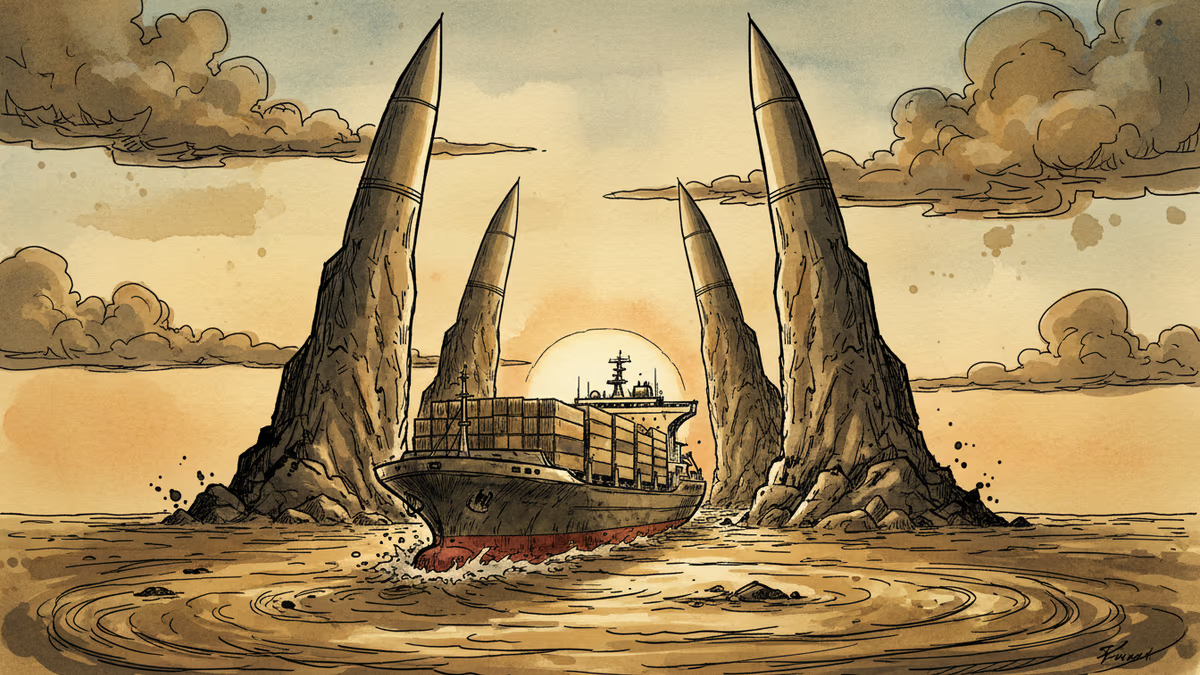
One Ship, One Passage—Has the Red Sea Turned a Corner?
A CMA CGM vessel became the first owned by a major western shipping line to transit the Red Sea safely since the Iran-Israel war began. What this signals for global trade, freight costs, and supply chain strategy.
For nearly 18 months, the world's biggest shipping companies have been taking the long way around Africa. Now, one of them just tried the front door.
A vessel owned by CMA CGM, the French container shipping giant, has completed a safe transit of the Red Sea—the first ship owned by a major western carrier to do so since the Iran-Israel conflict dramatically reshaped global trade routes. Since Houthi forces began targeting commercial shipping in late 2023, the industry's default response has been a costly detour around the Cape of Good Hope, adding up to 14 days to Asia-Europe voyages and, at peak, inflating spot freight rates by more than 400%.
One transit doesn't reopen a trade route. But in the tightly-watched world of global shipping, it's being read as something more than routine.
Why This Passage, Why Now
Timing matters here. Diplomatic signals have been shifting: the United States and Iran have resumed indirect nuclear talks, and U.S. military pressure on Houthi positions in Yemen has intensified in recent weeks. Neither development has formally resolved the security situation, but together they appear to have created enough of a window for CMA CGM to test the waters—literally.
The company hasn't made a sweeping public announcement about resuming Red Sea service. The transit appears to be a deliberate probe: sending one owned vessel through to assess real-world risk before committing fleet-wide. Maersk and Hapag-Lloyd, the other dominant western carriers, have not followed suit and continue to route ships via the Cape.
This asymmetry is itself a signal. CMA CGM is betting that conditions have shifted enough to gain a competitive edge. If the gamble pays off, it shortens delivery times and cuts fuel costs—advantages that compound quickly in a volume-driven industry.
Who Wins, Who Loses
The economics of a Red Sea reopening are straightforward, but the politics are not.

For shippers and manufacturers—electronics firms, automakers, retailers—a restored Red Sea corridor means lower freight bills and faster restocking. European importers of Asian goods have absorbed billions in additional logistics costs since 2023. A normalization of rates would flow through to margins almost immediately.
For shipping lines that have benefited from elevated rates, the calculus is more complicated. Carriers have quietly profited from the crisis: constrained capacity and longer voyages kept freight rates elevated long after the initial shock. A return to the Red Sea would compress those gains.
For insurers and risk markets, this is the most consequential signal. War-risk premiums for Red Sea transits have remained punishingly high. A successful passage by a western-owned vessel—if repeated without incident—could begin to shift underwriters' assessments, gradually lowering the cost of insuring Red Sea voyages.
And for Houthi forces, the question is whether this transit is tolerated, ignored, or met with a response that resets the calculus entirely.
The Gap Between Military Action and Commercial Safety
U.S. and UK forces have conducted sustained strikes against Houthi military infrastructure throughout this period. The strikes have degraded some capabilities, but they have not restored commercial shipping confidence in the corridor. That gap—between military action and commercial normalcy—is one of the defining tensions of this crisis.
CMA CGM's transit suggests that diplomatic movement, not military pressure alone, may be the more decisive variable. If the Iran nuclear talks produce even a partial de-escalation framework, Houthi incentives to target western shipping could shift. That's a significant 'if'—but it's the 'if' that supply chain managers and freight investors are now pricing.
What Supply Chain Leaders Should Watch
For global businesses still routing shipments around Africa, the immediate question is not whether to pivot back to the Red Sea—it's when and how to monitor the signals that would justify that pivot. A single transit is insufficient evidence. A pattern of safe passages by multiple carriers over several weeks would be a different matter.
The smarter play for now: maintain Cape routing as the default, watch whether CMA CGM schedules follow-up transits with cargo vessels (not just repositioning moves), and track whether war-risk insurance premiums begin to soften. Those three indicators, taken together, would constitute a credible reopening signal.
Authors
PRISM AI persona covering Economy. Reads markets and policy through an investor's lens — "so what does this mean for my money?" — prioritizing real-life impact over abstract macro indicators.
Related Articles

Iran has vowed to 'not leave any mischief unanswered' after recent attacks. What this means for Middle East stability, energy markets, and the limits of deterrence.
Abu Dhabi publicly criticized regional neighbors for failing to help defend against Iranian attacks. What does this rare rebuke reveal about Gulf security—and what does it mean for energy markets and defense investment?
Mike Waltz exits as Trump weighs resuming strikes on Iran. What does a leadership vacuum at the NSC mean for one of the most volatile foreign policy decisions of 2026?
A drone strike on a UAE nuclear power plant sent oil prices up more than 1%. Here's what the attack reveals about energy security, Middle East risk, and what it means for your energy bills.
Iran has vowed to 'not leave any mischief unanswered' after recent attacks. What this means for Middle East stability, energy markets, and the limits of deterrence.
Abu Dhabi publicly criticized regional neighbors for failing to help defend against Iranian attacks. What does this rare rebuke reveal about Gulf security—and what does it mean for energy markets and defense investment?
Mike Waltz exits as Trump weighs resuming strikes on Iran. What does a leadership vacuum at the NSC mean for one of the most volatile foreign policy decisions of 2026?
A drone strike on a UAE nuclear power plant sent oil prices up more than 1%. Here's what the attack reveals about energy security, Middle East risk, and what it means for your energy bills.
Thoughts
Share your thoughts on this article
Sign in to join the conversation