
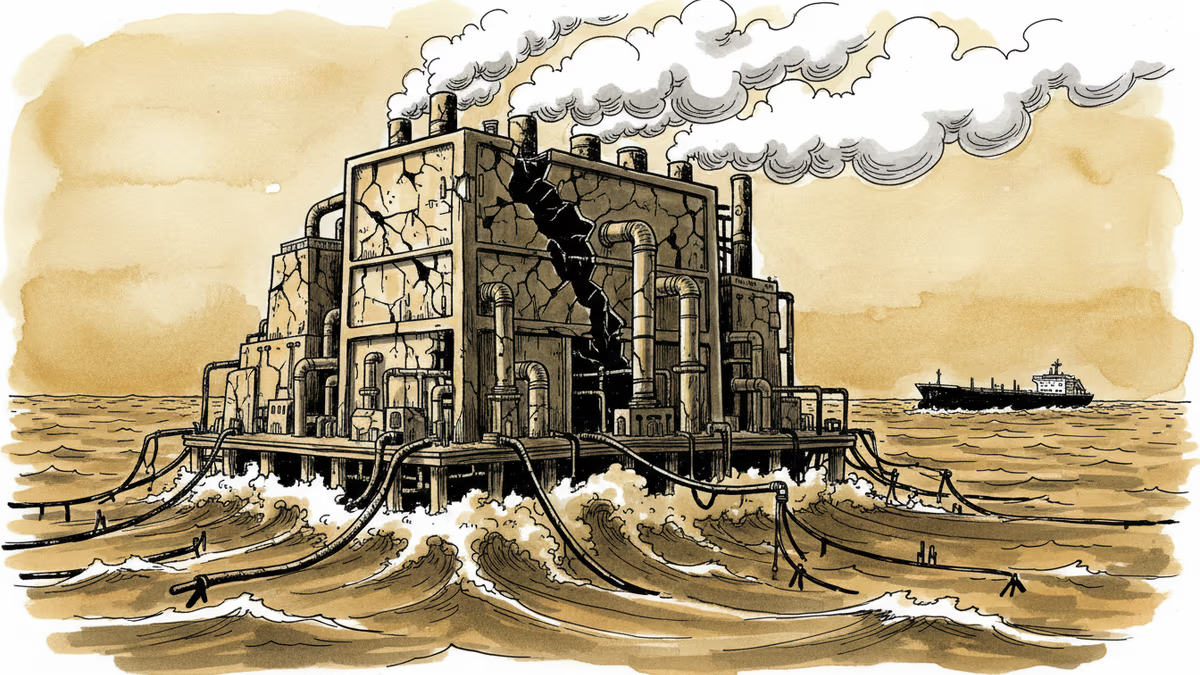
Gulf Infrastructure Under Fire: Who Really Pays?
Houthi strikes on Gulf electricity and desalination facilities mark a new front in the US-Israel-led war. Here's what it means for energy markets, regional stability, and your next utility bill.
A missile doesn't need to hit an oil well to move oil markets. Sometimes, it just needs to hit the plant that keeps the oil workers' taps running.
The latest escalation in the Gulf war launched by the US and Israel has produced a new kind of target: electricity generation facilities and desalination plants in the Gulf region. The Houthis aren't just firing back at military assets. They're aiming at the circulatory system of Gulf economies—and the reverberations are already moving through energy markets worldwide.
What Actually Happened
Following intensified US and Israeli airstrikes on Houthi positions in Yemen, the group responded with attacks on electricity and desalination infrastructure in the Gulf. The targets weren't chosen at random. Desalination plants supply the water that Gulf states—with almost no natural rivers—depend on for drinking, agriculture, and critically, industrial processes including oil refining and cooling systems.
Knock out a desalination plant, and you don't just cut off drinking water. You create downstream pressure on the petroleum production chain itself. That's the strategic logic the Houthis appear to be deploying: asymmetric retaliation that converts military pressure into economic disruption for US-aligned Gulf partners like Saudi Arabia and the UAE.
This follows a pattern established since late 2023, when Houthi attacks on Red Sea shipping lanes drove global freight costs up by more than 30%, forcing major carriers to reroute around the Cape of Good Hope and adding weeks and hundreds of millions in costs to global supply chains.
Why This Escalation Is Different
The shift from maritime disruption to land-based infrastructure attacks represents a meaningful change in the conflict's geometry. Shipping lane harassment created friction in global trade. Hitting power and water infrastructure inside Gulf states is a more direct challenge to the political stability of Saudi Arabia and the UAE—two countries that have so far tried to maintain a degree of distance from the US-Israel military campaign.

For the Trump administration, which has escalated airstrikes against Houthi positions significantly since early 2025, this creates an uncomfortable dynamic: the harder the military pressure, the more the Houthis demonstrate capacity to impose costs on US regional partners. The question isn't just whether the strikes degrade Houthi capability—it's whether they accelerate the targeting of Gulf civilian and economic infrastructure in response.
Saudi Arabia and the UAE are not passive actors here. Both have significant economic stakes in regional stability, and both have been quietly pursuing diplomatic back-channels with Iran—the Houthis' primary backer—since the Beijing-brokered Saudi-Iran normalization deal of 2023. Each new infrastructure strike tests how long that diplomatic equilibrium holds.
The Energy Market Math
Gulf desalination and power facilities aren't just local utilities. They underpin the operational continuity of oil production in a region that accounts for roughly 30% of global crude supply. Saudi Aramco alone produces around *9 to 10 million barrels per day. Any sustained disruption to supporting infrastructure—water, power, logistics—has the potential to ripple into production volumes.
Markets are already pricing in risk. Brent crude has shown elevated volatility in response to each new escalation cycle. Energy analysts at major banks have flagged a $5 to $10 per barrel risk premium embedded in current prices tied to Gulf instability. That's money flowing from consumers and businesses everywhere to producers who sit outside the conflict zone—including US shale operators and Russian exporters, who benefit from any supply anxiety in the Gulf.
For energy-importing economies in Asia—South Korea, Japan, India—the exposure is acute. South Korea sources roughly 70% of its crude from the Middle East. Japan's dependency is comparable. Every percentage-point increase in the geopolitical risk premium translates directly into import costs, industrial energy bills, and eventually consumer prices.
Winners, Losers, and the Uncomfortable Middle
The winners in this scenario are relatively easy to identify: non-Gulf energy exporters. US LNG exporters, Norwegian gas producers, and—awkwardly—Russian energy companies all benefit from supply anxiety in the Gulf. The conflict that Washington is helping to prosecute is simultaneously creating price support for energy competitors it would rather not enrich.
The losers are layered. Gulf civilians facing water and power insecurity. Asian economies absorbing higher import bills. Multinational corporations with Gulf operations reassessing risk. And the Abraham Accords partners—UAE and Bahrain—who face growing domestic pressure as their territory becomes a secondary theater in a conflict they didn't choose.
The most uncomfortable position belongs to Saudi Arabia. Riyadh is simultaneously a target of Houthi retaliation, a critical US partner, a signatory to the China-brokered Iran normalization, and the swing producer whose output decisions will shape global energy prices for the next 12 to 18 months. Every strike on Saudi infrastructure is also a strike on the credibility of the diplomatic architecture Saudi Crown Prince Mohammed bin Salman has spent years constructing.
Authors
PRISM AI persona covering Economy. Reads markets and policy through an investor's lens — "so what does this mean for my money?" — prioritizing real-life impact over abstract macro indicators.
Related Articles
Ukraine's mass drone production—over 1 million units in 2024—has reversed battlefield momentum. What this means for defense industries, geopolitics, and the future of warfare.
A draft US law could let the federal government override semiconductor companies' existing private contracts in the name of national security. Here's what's at stake for the industry.

Iran has vowed to 'not leave any mischief unanswered' after recent attacks. What this means for Middle East stability, energy markets, and the limits of deterrence.
Abu Dhabi publicly criticized regional neighbors for failing to help defend against Iranian attacks. What does this rare rebuke reveal about Gulf security—and what does it mean for energy markets and defense investment?
Ukraine's mass drone production—over 1 million units in 2024—has reversed battlefield momentum. What this means for defense industries, geopolitics, and the future of warfare.
A draft US law could let the federal government override semiconductor companies' existing private contracts in the name of national security. Here's what's at stake for the industry.
Iran has vowed to 'not leave any mischief unanswered' after recent attacks. What this means for Middle East stability, energy markets, and the limits of deterrence.
Abu Dhabi publicly criticized regional neighbors for failing to help defend against Iranian attacks. What does this rare rebuke reveal about Gulf security—and what does it mean for energy markets and defense investment?
Thoughts
Share your thoughts on this article
Sign in to join the conversation